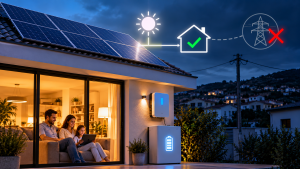
Short answer: usually not. A standard grid-connected solar system switches off automatically when the grid goes down, even on a sunny day. That is a safety requirement, not a fault. To keep power on during a blackout you need a system designed for it: a hybrid inverter with a backup output and, normally, a battery. A battery alone does not guarantee backup.
When much of Spain and Portugal lost power on 28 April 2025, thousands of homeowners with solar panels found their lights out too. It surprised many people, and it is now one of the most common questions we hear.
Why grid-tied solar shuts down in a blackout
Most homes in Spain have a grid-tied system. The panels feed the house and send the surplus to the grid. The inverter, which converts the panels’ DC output into household AC, is designed to follow the grid’s signal.
When the grid disappears, the inverter detects it and stops. This is called anti-islanding protection. It exists because:
- A solar system that keeps pushing power into a “dead” grid could electrocute utility workers repairing the line.
- Without the grid as a reference, the inverter cannot keep voltage and frequency stable.
So the sunshine is still there, but the system is legally and technically required to stop.
“But I have a battery. Why didn’t it work?”
This is the second surprise. Many batteries are installed to increase self-consumption, not to provide backup. A battery only supplies your home in a blackout if the system also has:
- A hybrid (or backup-capable) inverter that can run in an “island” mode, and
- A backup output (often called EPS or “emergency” output) wired to a separate circuit with the loads you want to keep on, and
- Automatic isolation from the grid (a switch that disconnects your house so you’re not feeding the dead network).
Without those three, the battery switches off with the rest of the system. A battery that’s charged but cut off from your sockets is no help in an outage.
What are the options for backup power?
| Option | What it does | Pros | Cons |
| Standard grid-tied (no battery) | Shuts down in a blackout | Cheapest, simplest | No power during outages |
| Grid-tied with battery (no backup output) | Stores solar for evenings; shuts down in a blackout | Higher self-consumption | Still no power in an outage |
| Hybrid inverter + battery with backup output | Powers selected circuits in a blackout, from the battery and the sun | Real backup | Higher cost; only selected circuits |
| Whole-house backup | Aims to power everything | Maximum comfort | Large inverter and battery needed, expensive |
| Off-grid system | Not connected to the grid at all | Independent | Complex, costly, needs careful sizing and often a generator |
For most homes, the sweet spot is the third option: a hybrid system with essential loads on a backup circuit.
What do you actually want to keep running?
Backup works best when you’re realistic. A battery has a finite energy store and the inverter has a maximum output, so you choose the circuits that matter most:
- Fridge and freezer: low, steady consumption.
- Lighting and Wi-Fi router.
- Phone and laptop charging.
- Water pump (especially if you’re on a well or tank).
- Gate or door openers and alarms.
Heavy loads such as air conditioning, electric ovens, induction hobs, a water heater or an EV charger usually need a much larger battery and inverter, and drain a battery fast. Many households leave them off the backup circuit.
A quick sizing example
Suppose your essential loads are a fridge-freezer (about 1–1.5 kWh per day), lights and router (about 1 kWh per day) and phone charging (a few tenths of a kWh). That’s roughly 2.5–3.5 kWh per day. A battery of around 5–10 kWh could cover that for a day or two, and your panels can top it up during the day if the sky is clear. These are rough numbers; the real answer depends on your appliances and habits.
How much does backup cost?
A home battery system with backup capability is a real investment: typically several thousand euros installed, depending on capacity, brand and how many circuits you want backed up. Published figures vary widely, from roughly €4,000 to €9,000 for a complete home battery system. Whole-house backup costs more. We recommend asking for a quote with two options: a basic essential-loads setup and a larger one, so you can compare.
Adding backup to an existing grid-tied system is sometimes possible but may mean replacing the inverter. Ask the installer first.
Is backup worth it?
It depends on how much a blackout would cost you:
- Medical equipment, remote working or a business: backup can be essential.
- A home with a well pump, or in an area with frequent outages: very useful.
- A holiday home you visit a few weeks a year: often not worth it; a fridge on a timer and good food-management are cheaper.
- Most urban homes: outages are rare and short, so many households skip the backup, or choose a modest essential-loads setup.
Also note that a battery is not only about blackouts. If you want one mainly for evening self-consumption, see our guide to where to buy solar battery storage.
Questions to ask your installer
- Is the inverter backup-capable (does it have an EPS/backup output)?
- Which circuits will stay on in a blackout, and what is the maximum power?
- How long can the battery run my essentials, in hours?
- Does the system switch automatically and how long does the changeover take?
- Can the panels recharge the battery during a blackout?
- What happens if the battery is empty at night?
- What are the warranty terms on the battery and the inverter?
- Is the legalisation included for the backup configuration?
Common myths
- “Solar panels always power your house.” Not without a backup-capable setup.
- “A battery means I’m covered.” Not unless it is wired for backup.
- “A generator is simpler.” A generator can work, but it adds fuel, noise and maintenance.
- “Backup means I can run everything.” Only what you sized for.
Frequently asked questions
Why did my solar panels stop working during the blackout?
Because most home systems are grid-connected and shut down automatically (anti-islanding) when the grid fails, to protect the network and the people repairing it.
Will a solar battery keep my lights on in a power cut?
Only if it is connected to a hybrid inverter with a backup output and an isolation switch. A battery installed purely for self-consumption won’t.
Can I add backup to my existing solar panels?
Often yes, but it may require a hybrid inverter and a battery, and sometimes a rewiring of selected circuits. A technical survey will tell you.
How long will a home battery last in a blackout?
It depends on the battery’s capacity and what you power. Essentials such as a fridge, lighting and Wi-Fi can last a day or more on a mid-sized battery; air conditioning can drain it in hours.
Is off-grid solar better for blackouts?
It’s independent of the grid, but it’s more expensive and needs careful sizing. Most homes are better served by a grid-connected hybrid system.
Want power when the grid is down?
Tell us what you need to keep running and we’ll design a clear options list with prices. 500+ installations in Alicante province, our own technicians, and a team that speaks English.
👉 Request your free technical study; we will call you within 24 hours.
📞 669 34 86 07 · www.solareatech.com/en/