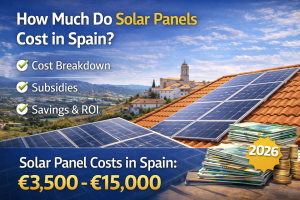

Making the switch to solar energy has never been more financially attractive than in 2026, thanks to comprehensive government incentives and subsidies designed to accelerate Spain’s renewable energy transition. At Solarea Tech, we help homeowners across Spain navigate the complex landscape of subsidies, tax breaks, and grants that can reduce solar installation costs by 40-60%.
This guide directly answers your question: What government incentives and subsidies are available for solar energy in Spain? We’ll break down every financial benefit, how to access them, and how much you can save.
What Government Incentives Are Available for Solar Energy?
Spain offers multiple layers of financial support combining European funds, national tax benefits, and municipal incentives. These programs typically reduce payback periods from 8-10 years to just 4-6 years, making solar one of the best financial investments available in 2026.
Main government incentives:
- European Next Generation Funds (direct subsidies)
- Income tax deductions (IRPF) up to 40%
- IBI property tax reductions (25-50% for 3-5 years)
- ICIO construction tax exemptions
- Battery storage additional subsidies
- Surplus energy compensation
European Next Generation Funds: Direct Subsidies
The cornerstone of Spain’s solar subsidy program comes from European Next Generation funds distributed through regional energy agencies. Critical: These funds operate on first-come, first-served basis and are expected to deplete during 2026.
How it works: Direct subsidies reduce installation costs immediately, covering a significant portion of your investment. Exact amounts vary by region but typically provide substantial support for residential installations.
Who qualifies: All property owners in Spain—individuals, homeowner communities, and businesses. Installation must be performed by certified installers like Solarea Tech, and all equipment must meet European quality standards.
Application process: Applications are submitted after installation completion through your autonomous community’s energy agency:
- Valencian Community: IVACE
- Andalusia: IDAE offices/Andalusian Energy Agency
- Madrid: Regional energy agency
- Catalonia: ICAEN
- Basque Country: EVE
Processing times currently run 2-4 months from application to payment.
Why act now: With limited remaining budget in 2026, early applicants secure funding while late applicants risk missing out on thousands of euros in subsidies.
Income Tax Deduction: Recover Up to 40% of Your Investment
Spanish tax residents can claim significant income tax deductions (IRPF) for solar installations that improve home energy efficiency ratings.
The 40% deduction: For installations achieving at least 30% reduction in primary energy consumption or improving the energy rating to A or B classification, you can deduct 40% of installation costs, maximum €7,500.
Why solar qualifies: Solar panels directly reduce non-renewable primary energy consumption, making most installations automatically eligible for the maximum 40% deduction.
Requirements:
- Pre-installation and post-installation energy performance certificates demonstrating improvement
- Traceable payment methods (bank transfer, card—no cash)
- Installation completed within eligible timeframe
Combining with other subsidies: You can claim the income tax deduction on the net cost after applying Next Generation subsidies. Example: €7,000 installation – €3,000 subsidy = €4,000 × 40% = €1,600 additional tax savings.
Real example: A €8,000 system receiving €3,200 Next Generation subsidy qualifies for €1,920 income tax deduction (40% of remaining €4,800). Total out-of-pocket cost: just €2,880—a 64% reduction from original price.
IBI Property Tax Reductions: Ongoing Annual Savings
Many municipalities across Spain offer IBI (property tax) reductions for homes with solar installations, providing valuable ongoing savings for 3-5 years.
How it works: Municipalities discount your annual property tax by 25-50% once your solar system is registered. Major cities like Madrid, Barcelona, Valencia, Seville, and Málaga offer substantial IBI reductions.
Annual savings: For a typical detached house with annual IBI of €600-800, a 50% reduction saves €300-400 annually. Over five years: €1,500-2,000 in total tax savings.
Application: Some municipalities apply reductions automatically upon installation registration; others require specific applications. Solarea Tech provides guidance on your municipality’s exact requirements.
Important timing: Reductions typically apply from the tax year following installation. Installing late 2026 means benefits start with your 2027 IBI bill.
ICIO Construction Tax Exemptions
The ICIO (construction tax) is typically 4% of installation cost. Many Spanish municipalities waive or reduce this tax for renewable energy projects.
Savings: Without exemptions, a €7,000 installation incurs €280 ICIO tax. Most progressive municipalities exempt solar installations entirely, saving €280 per project.
How to access: ICIO exemption is handled during the building permit process. When Solarea Tech applies for your installation permits, we ensure you receive applicable ICIO benefits.
Battery Storage Additional Subsidies
Battery storage systems qualify for enhanced subsidies recognizing their role in maximizing solar self-consumption and supporting grid stability.
Combined installations: Installing solar panels and batteries simultaneously qualifies for both subsidies, significantly reducing total system cost.
Real example: Antonio’s 4 kW system with 8 kWh battery cost €10,500. With €2,400 solar subsidy, €3,920 battery subsidy, and €1,640 income tax deduction, his net cost was only €2,540. Payback period: under 3 years.
Surplus Energy Compensation
Spain’s surplus compensation mechanism provides ongoing financial benefits throughout your system’s lifetime.
How it works: When your solar panels generate more electricity than you consume, surplus automatically feeds to the grid. Your electricity company credits this energy on your monthly bill at €0.05-€0.09 per kWh in 2026.
Realistic expectations: A typical Spanish home generates 500-700 kWh annual surplus. At €0.07/kWh, this adds €35-49 annually—modest but welcome additional return.
Registration requirement: Your installation must be registered with your electricity distributor. Solarea Tech handles all required registrations as part of our installation service.
Regional Program Highlights
Valencian Community: IVACE offers streamlined permitting and complementary programs for rural properties and historic buildings.
Andalusia: Additional support through the Andalusian Energy Agency, including technical assistance and expedited grid connections.
Catalonia: ICAEN focuses on community solar projects and integrated renewable solutions.
Madrid: Additional incentives for combining solar with energy efficiency measures like heat pumps.
Basque Country: EVE provides generous complementary subsidies for installations combining solar with storage or EV charging.
Municipal bonuses: Some towns provide one-time bonuses of €200-500 for residents installing solar panels. Progressive cities also offer expedited permitting, processing solar permits within 15-30 days.
Real Savings: What Homeowners Actually Pay
Barcelona Apartment Building: A 20-unit building installed a 30 kW collective system for €35,000 total. With €18,000 in subsidies and €6,800 in collective tax benefits, the net cost per apartment was just €510. Each apartment saves €400-600 annually.
Andalusia Rural Property: €10,500 system (4 kW + battery) reduced to €2,540 net cost after all subsidies. Payback period: under 3 years.
Typical Scenario: A standard €7,000 installation receives €3,000 direct subsidy + €1,600 income tax deduction + €1,500-2,000 IBI reduction over 5 years = total cost after incentives of just €880-1,400.
How to Access Government Incentives and Subsidies
Step 1: Obtain pre-installation energy certificate Schedule this BEFORE any work begins. Without it, you forfeit income tax deductions worth thousands of euros.
Step 2: Verify regional subsidy availability Check your autonomous community’s energy agency for current program status and deadlines.
Step 3: Work with certified installers Only certified installations qualify for incentives. Solarea Tech’s certifications ensure compliance with all requirements.
Step 4: Complete installation and legalization Obtain all required permits, pass inspections, and register with electricity distributor.
Step 5: Get post-installation energy certificate This demonstrates efficiency improvement, essential for IRPF deduction.
Step 6: Apply for regional subsidies promptly Submit applications immediately after installation completion while funds remain available.
Step 7: Request municipal bonuses Apply for IBI and ICIO benefits at your town hall after work is finalized.
Step 8: Include deduction in tax declaration Claim IRPF deduction in your annual tax filing the year following installation.
Step 9: Maintain documentation Keep all invoices, certificates, and paperwork for minimum 5 years.
Common Mistakes That Cost Thousands
Mistake 1: Skipping the pre-installation certificate This single oversight forfeits €1,360-€3,000 in IRPF deductions. Always obtain it before starting work.
Mistake 2: Using uncertified installers Attempting to save money with unlicensed installers disqualifies you from ALL government incentives and subsidies.
Mistake 3: Missing application deadlines Regional programs operate first-come, first-served. Delaying applications risks fund depletion.
Mistake 4: Overlooking municipal programs Many homeowners claim national incentives but forget local IBI reductions, leaving €1,500-2,000 unclaimed.
Mistake 5: Poor tax planning Claiming deductions without sufficient taxable income wastes the benefit. Coordinate with your accountant.
Mistake 6: Oversizing systems Expecting profitable surplus sales leads to disappointment. Size systems for self-consumption first.
Why Choose Solarea Tech for Incentive Management
At Solarea Tech, maximizing your government incentives and subsidies is integral to our comprehensive service:
Comprehensive incentive audit: We identify every program you qualify for based on your location, calculating expected benefits and total net investment.
Complete application management: We handle all paperwork, applications, and follow-up for regional subsidies, ensuring accuracy and maximizing approval speed.
Energy certificate coordination: We arrange pre- and post-installation certificates with certified assessors, ensuring proper documentation for tax deductions.
Municipal liaison: We communicate with your town hall regarding IBI and ICIO benefits, ensuring you receive all available local incentives.
Transparent pricing: Our quotes clearly show total system cost, expected incentives, and your net out-of-pocket investment.
Professional support: Many homeowners attempting DIY subsidy applications lose thousands through missed programs or documentation errors. Professional support is included in our installation service.
Act Now: 2026 Is Critical for Maximum Subsidies
With Next Generation EU funds depleting during 2026, this represents potentially the final year to access substantial direct subsidies. Every month of delay means:
- Less remaining subsidy budget and higher application competition
- Continued high electricity bills instead of solar savings
- Risk of incentive program changes or closures
- Lost energy production opportunity
The combination of European funds, national tax benefits, and municipal bonuses creates unprecedented opportunity to reduce solar costs by 40-60%—but this window is closing.
Ready to discover exactly which government incentives and subsidies you qualify for? Contact Solarea Tech for a free, comprehensive assessment identifying every available benefit for your specific location and situation.
Get your personalized incentive analysis today and start saving with government-supported solar energy!