
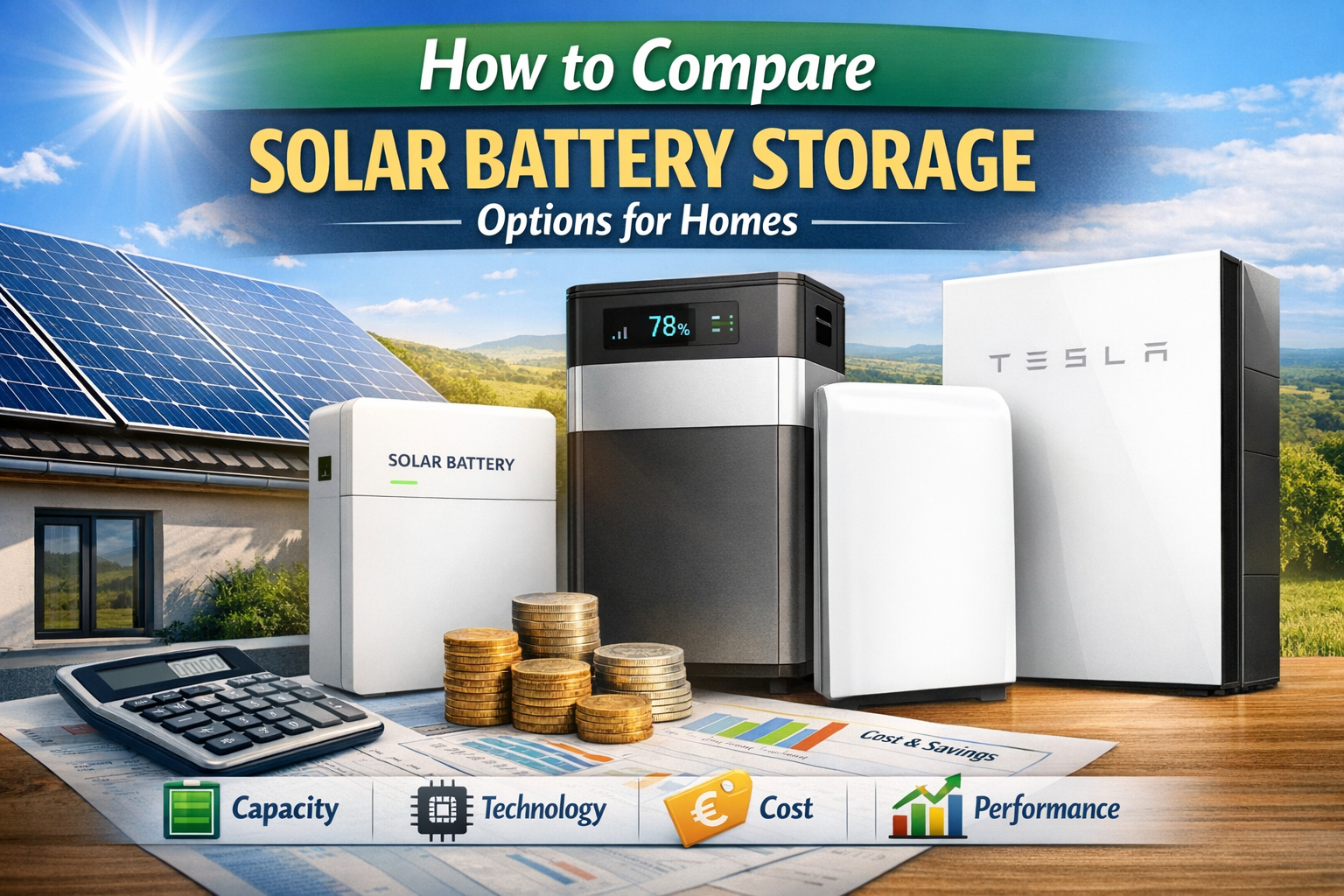
Choosing the right solar battery storage system can dramatically increase your energy independence and maximize solar panel savings. At Solarea Tech, we help Spanish homeowners compare battery options based on capacity, technology, cost, and real-world performance to find the ideal storage solution for their needs.
This comprehensive guide shows you exactly how to compare solar battery storage options, what factors matter most, and how to determine if battery storage makes financial sense for your home in 2026.
Understanding Solar Battery Storage Basics
Solar battery storage systems capture excess electricity your solar panels generate during daytime for use at night or during peak-rate periods. Instead of sending surplus energy to the grid for minimal compensation, you store it for later use—maximizing self-consumption and reducing grid dependence.
How battery storage works:
- Solar panels generate electricity during daylight
- Your home consumes what it needs immediately
- Excess production charges the battery
- After sunset, your home draws power from the battery
- Only when the battery depletes do you use grid electricity
This cycle repeats daily, dramatically increasing the percentage of your electricity consumption covered by solar energy from typical 30-40% to 70-90%.
Solar Battery Costs in Spain 2026
Battery storage costs vary significantly based on capacity and technology:
By capacity:
- 5 kWh battery: €3,500 – €4,500 (provides 5-8 hours autonomy)
- 10 kWh battery: €5,500 – €7,000 (provides 10-15 hours autonomy)
- 15 kWh battery: €7,500 – €9,000 (provides 15-24 hours autonomy)
- 20+ kWh battery: €9,000 – €12,000 (provides 24+ hours autonomy)
Autonomy estimates based on average Spanish home consuming 30 kWh daily
Price per kWh decreases with larger capacity: A 10 kWh battery costs €550-€700 per kWh, while a 20 kWh battery costs €450-€600 per kWh.
Key Factors for Comparing Battery Options
1. Storage Capacity (kWh)
What it means: The amount of electricity the battery can store, measured in kilowatt-hours (kWh).
How to compare: Calculate your nighttime electricity consumption. If you typically use 15 kWh between 8pm and 8am, a 15 kWh battery covers one full night. Most Spanish homes need 8-15 kWh capacity.
Consider your goals:
- Partial backup: 5-8 kWh covers essential nighttime use
- Full nighttime coverage: 10-15 kWh covers typical overnight consumption
- Complete autonomy: 15-20+ kWh covers extended periods or higher consumption
2. Battery Technology Type
High voltage, low current batteries:
- Brands: Huawei, Fronius, SolarEdge
- Characteristics: Lower discharge capacity, more compact design
- Best for: Homes with moderate power needs, space-constrained installations
- Typical discharge rate: 3-5 kW continuous
Low voltage, high current batteries:
- Brands: Pylontech, Deye, Dyness
- Characteristics: Higher discharge capacity, modular expansion
- Best for: Homes with high simultaneous power demands, future expansion plans
- Typical discharge rate: 5-10+ kW continuous
How to compare: Consider your peak power usage. If you run air conditioning, oven, and water heater simultaneously, high-current batteries handle these loads better.
3. Lithium Battery Chemistry
Lithium iron phosphate (LiFePO4):
- Safest chemistry with excellent thermal stability
- 6,000-10,000 charge cycles (15-25 year lifespan)
- Slightly lower energy density
- Industry standard for residential storage
- Best choice for most homes
Lithium nickel manganese cobalt (NMC):
- Higher energy density (more compact)
- 3,000-5,000 charge cycles (8-12 year lifespan)
- Slightly lower safety margins
- Less common in residential applications
Lead-acid batteries:
- Outdated technology with 500-1,500 cycles
- Significantly cheaper upfront but poor long-term value
- Not recommended for new installations in 2026
4. Cycle Life and Warranty
Cycle life: Number of complete charge/discharge cycles before capacity degrades to 80%.
How to compare:
- Premium batteries: 6,000-10,000 cycles = 15-25 years at one cycle daily
- Standard batteries: 4,000-6,000 cycles = 10-15 years
- Budget batteries: <4,000 cycles = <10 years
Warranty coverage:
- Product warranty: 8-12 years for manufacturing defects
- Performance warranty: Guarantees minimum capacity retention (typically 70-80% after 10 years)
Calculate lifespan value: A €7,000 battery lasting 20 years costs €350/year. A €5,000 battery lasting 10 years costs €500/year—the premium battery offers better value.
5. Round-Trip Efficiency
What it means: Percentage of stored energy you can actually use. Some energy is lost during charging, storage, and discharging.
How to compare:
- Excellent efficiency: 95-97% (lose 3-5% of stored energy)
- Good efficiency: 90-95% (lose 5-10%)
- Acceptable efficiency: 85-90% (lose 10-15%)
Real impact: With 95% efficiency, a 10 kWh battery provides 9.5 kWh usable. With 85% efficiency, the same battery provides only 8.5 kWh usable—a significant difference over time.
6. Depth of Discharge (DoD)
What it means: Percentage of battery capacity you can safely use without degrading lifespan.
How to compare:
- Modern lithium batteries: 90-100% DoD
- Older technologies: 50-80% DoD
Why it matters: A 10 kWh battery with 90% DoD provides 9 kWh usable capacity. The same battery with 50% DoD provides only 5 kWh usable—half the real capacity despite identical nominal specifications.
Always check usable capacity, not just total capacity.
7. Power Output (Continuous and Peak)
Continuous power: Sustained power delivery for regular loads. Peak power: Maximum short-term power for starting motors or heavy appliances.
How to compare:
- Low power needs: 3-5 kW continuous sufficient for lights, electronics, refrigerator
- Moderate needs: 5-7 kW continuous handles most household loads
- High needs: 7-10+ kW continuous powers air conditioning, electric heating, induction cooktops simultaneously
Consider your largest loads: If your air conditioning draws 4 kW and you want to run other appliances simultaneously, ensure battery delivers 5-7 kW continuous.
8. Inverter Compatibility
Hybrid inverters: Most modern solar batteries require hybrid inverters that manage both solar panels and battery charging/discharging.
How to compare:
- AC-coupled batteries: Work with existing solar inverters, adding battery-specific inverter
- DC-coupled batteries: Require hybrid inverter replacement if upgrading existing system
- Integrated systems: Battery and inverter sold together, ensuring perfect compatibility
Upgrading existing systems: If adding battery to existing solar panels, verify compatibility or budget for inverter replacement (€800-€2,500).
Do You Actually Need Battery Storage?
Battery storage isn’t essential for every solar installation. Consider these factors:
When batteries are NOT priority:
Your consumption is primarily daytime: If you’re home during the day using air conditioning, appliances, and electronics while sun shines, you’re already consuming your solar production directly—no storage needed.
Good surplus compensation rates: If your electricity company offers favorable compensation (€0.08-€0.09 per kWh), selling surplus may be more economical than battery storage initially.
Limited budget: Solar panels alone provide 80% of total benefits at 60% of combined system cost. If budget is tight, prioritize quality panels over batteries—you can always add storage later.
When batteries ARE highly recommended:
High nighttime consumption: If you work during the day and consume most electricity in evenings (heating, cooking, entertainment), batteries dramatically increase solar savings.
Maximum energy independence: For homeowners prioritizing self-sufficiency and grid independence, batteries are essential for 70-90% autonomy.
Frequent power outages: If your area experiences regular supply interruptions, batteries with backup capability provide security and comfort.
Peak-hour electricity rates: In areas with expensive peak-rate periods, batteries allow you to avoid high rates by using stored solar energy.
Future EV ownership: Planning to charge an electric vehicle at night? Batteries let you use solar energy for overnight EV charging instead of expensive grid electricity.
Backup Power Capability
Important distinction: A battery alone doesn’t provide power during grid outages. During blackouts, standard grid-connected systems automatically disconnect for safety—even with batteries.
Backup Box requirement: To use battery power during outages, you need a Backup Box (€800-€2,000) that:
- Detects grid failures
- Isolates your home from the grid
- Allows battery to power your home independently
- Reconnects to grid when power restores
Partial vs. full backup:
- Partial backup: Powers essential circuits (refrigerator, lights, internet)—requires electrician to separate essential loads
- Full backup: Powers entire home—requires larger battery and Backup Box
Most homeowners choose partial backup as it’s more economical and covers critical needs during outages.
Government Subsidies for Battery Storage
Battery subsidies significantly reduce costs in 2026:
Next Generation EU Program: Up to 45% subsidy, approximately €490 per kWh installed capacity.
Subsidy examples:
- 10 kWh battery (€6,500 cost): €4,900 subsidy = €1,600 net cost
- 15 kWh battery (€8,500 cost): €7,350 subsidy = €1,150 net cost
Additional benefits:
- IBI property tax reduction: 25-50% discount for 3-5 years in many municipalities
- ICIO construction tax exemption: 50-95% reduction in most areas
Combined with solar panel subsidies: Installing solar panels and battery simultaneously qualifies for both programs, maximizing total incentives.
Application process: Solarea Tech handles all subsidy applications and documentation, ensuring you receive maximum available support.
Top Battery Brands in Spain 2026
Premium tier:
- Huawei Luna: Excellent efficiency, compact design, proven reliability
- BYD Battery-Box: Industry-leading safety, modular expansion, strong warranty
- Tesla Powerwall: High power output, sleek design, integrated system
Quality tier:
- Pylontech: Modular design, excellent value, widely compatible
- Dyness: High current capability, competitive pricing, expandable
- Deye: Strong performance, good warranty, cost-effective
Solarea Tech installs: We primarily work with Pylontech, Dyness, and Huawei for their proven performance in Spanish climate, strong warranties, and excellent value proposition.
How to Size Your Battery Correctly
Step 1: Calculate nighttime consumption Review your hourly electricity data (available from your supplier) to determine typical consumption between sunset and sunrise. Average Spanish homes use 12-18 kWh overnight.
Step 2: Consider seasonal variation Winter heating and summer air conditioning create consumption peaks. Size for your highest season if seeking year-round coverage.
Step 3: Account for backup needs If including backup capability, ensure capacity covers essential loads for your desired autonomy period (typically 8-24 hours).
Step 4: Future-proof appropriately If planning EV purchase or home expansion, consider 20-30% extra capacity.
Solarea Tech recommendation: Most Spanish homes achieve optimal balance with 10-15 kWh capacity—sufficient for nighttime needs without oversizing.
Battery Storage ROI and Payback Period
Without subsidies:
- Average payback: 12-15 years
- 20-year total savings: €3,000-€6,000
With subsidies (45% cost reduction):
- Average payback: 6-8 years
- 20-year total savings: €8,000-€12,000
Factors improving ROI:
- High electricity rates (batteries save more when grid electricity is expensive)
- Low surplus compensation (batteries more valuable than selling surplus cheaply)
- Nighttime consumption patterns (maximizes battery utilization)
- Battery longevity (premium batteries with 20+ year lifespan offer better value)
Why Choose Solarea Tech for Battery Storage
Expert assessment: We evaluate your consumption patterns, existing solar system, and needs to recommend optimal battery solutions.
Quality equipment: We install only proven brands with verified performance in Spain’s climate and comprehensive warranties.
Complete integration: We ensure perfect compatibility between your solar panels, inverter, and battery storage for maximum efficiency.
Subsidy management: We handle all incentive applications, maximizing your government support and minimizing your net investment.
Professional installation: Certified electricians complete installations meeting all Spanish safety regulations with proper legalization.
Ongoing support: Post-installation monitoring, maintenance guidance, and technical support throughout your battery’s lifetime.
Get Your Personalized Battery Assessment
Wondering if battery storage makes sense for your home? Contact Solarea Tech for a free, detailed evaluation.
We provide:
- Consumption pattern analysis identifying nighttime usage
- Battery capacity recommendations for your needs
- Complete cost breakdown including subsidies
- ROI calculation and payback period projection
- Multiple battery options at different price points
- Integration assessment with existing or planned solar panels
With 2026 subsidies reducing costs by 45% and battery technology more affordable than ever, now is an excellent time to achieve greater energy independence through solar battery storage.
Contact Solarea Tech today for your free battery storage assessment and discover how much independence you can achieve!