
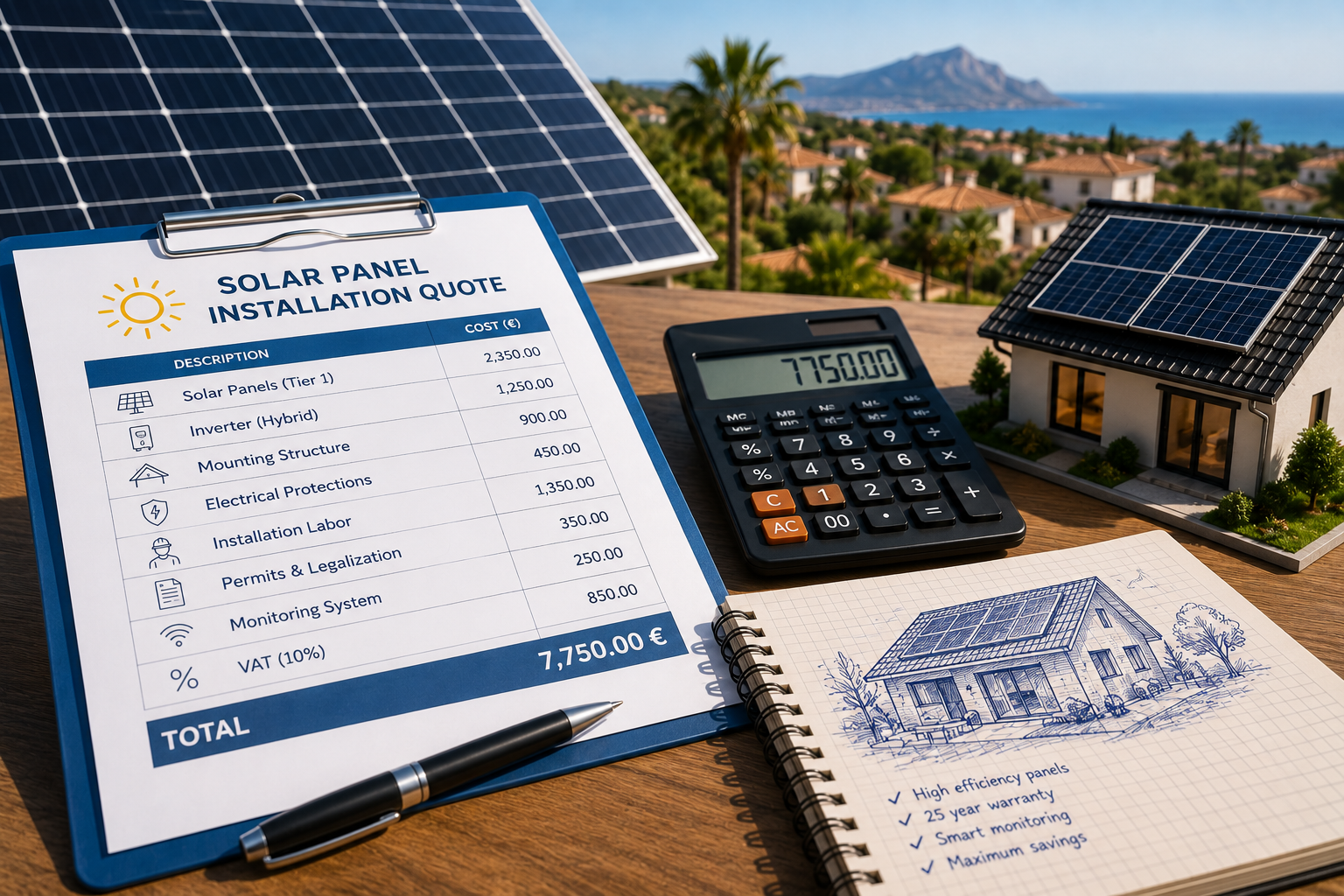
If you have already asked two or three companies for a quote to install solar panels on your home in Spain, you have probably noticed something surprising: two quotes for the same nominal power (say, 5 kWp) can differ by €3,000 to €5,000 with no obvious reason. One company says €6,200, another says €10,500. Both claim they use “high quality components” and both promise a professional installation. So which one is honest, and which one is either cutting corners or overcharging?
This article explains why the cost of residential solar panel installation in Spain varies so much, and gives you the 10 real factors that determine the final price of your installation. Once you understand these factors, you can read any quote critically, compare fairly between installers, and know exactly what you are paying for.
At Solarea Tech we have completed more than 500 solar installations across the Alicante province. We know exactly how the price of each installation is built up from real cost elements, and we know why some quotes are misleadingly cheap or unnecessarily expensive. Here is the honest breakdown.
If you are looking for typical price ranges by installation size rather than the factors behind them, see our companion guide on how much do solar panels cost in Spain. This article focuses on the variables that determine the price, not the ranges themselves.
Why two quotes for the same size can differ so much
Before diving into the 10 factors, a quick framing point. A quote for a “5 kWp solar installation” is not a standardised product like buying a specific model of TV. It is a bundle of decisions: which panels, which inverter, which mounting structure, which electrical protections, which installer expertise, which permits included, which subsidies handled, which warranty support included.
Each of these variables can shift the final price by hundreds or thousands of euros. A cheap 5 kWp quote may skip essential elements or use budget components. An expensive one may include all the good practices and provide long term peace of mind. The right comparison is not price against price, but value delivered against price.
Now, the 10 factors.
Factor 1: quality tier of the solar panels
The panels typically represent 30 to 40 percent of the total installation cost. Their quality tier has a direct impact on the final price and, more importantly, on the value you get over 25 years.
Tier 1 panels (JA Solar, LONGi, REC, Canadian Solar, Jinko, Trina Solar): cost around 0.20 to 0.35 €/Wp. Come with 25 to 30 year performance warranties, degradation rates around 0.4 to 0.5 percent per year, strong financial backing from established manufacturers.
Tier 2 panels (mid range manufacturers): cost around 0.15 to 0.20 €/Wp. Shorter warranty periods, higher degradation rates (0.5 to 0.7 percent per year), and less certainty that the manufacturer will exist in 15 years to honour warranty claims.
Tier 3 or unbranded panels: cost around 0.10 to 0.15 €/Wp. Very short or unenforceable warranties, unpredictable long term performance, and often not certified for European standards.
Real impact on a 5 kWp installation: the difference between Tier 1 and Tier 3 panels is around €500 to €1,000 on the panels alone. But over 25 years, that same difference means around 15,000 to 25,000 kWh of extra electricity produced by the Tier 1 panels, worth €4,000 to €7,000 at current Spanish electricity prices.
The “saving” on Tier 3 panels turns into a lifetime loss. At Solarea Tech we only install Tier 1 panels (JA Solar and LONGi as our primary suppliers).
Factor 2: type and quality of the inverter
The inverter typically represents 15 to 25 percent of the total installation cost. Its type and brand have a significant impact both on price and on the flexibility of your system.
Standard string inverter, mid range brand: around €600 to €1,000 for a 5 kW unit. Basic monitoring, no battery capability, 5 year warranty.
Hybrid inverter, Tier 1 brand (Huawei, Sungrow, SMA, Fronius): around €1,200 to €1,800 for a 5 kW unit. Ready for future battery, advanced monitoring app, 10 year warranty extendable to 20.
Microinverters (Enphase) or string with optimisers (SolarEdge): around €1,800 to €2,500 for a 5 kW equivalent installation. Best for complex shading, panel level monitoring, 12 to 25 year warranties depending on brand.
The difference between a basic non hybrid inverter and a proper hybrid Huawei unit is around €500 to €800 upfront. But installing a non hybrid inverter means that adding a battery later requires replacing the inverter entirely (€1,500 to €2,500 extra). The apparent saving turns into a much larger future cost.
For more on choosing the right inverter, see our detailed guide on top rated solar inverter brands for residential use.
Factor 3: mounting structure appropriate for your roof
The mounting structure holds the panels on your roof and is typically 8 to 12 percent of the installation cost. Its quality and appropriateness for your specific roof type matter enormously.
Standard aluminium mounting on tile or metal roofs: included in the base quote, around €50 to €100 per panel.
Specialised mounting for traditional Spanish clay tile roofs: €80 to €150 per panel. Required to avoid tile breakage and ensure long term structural integrity. Novotegra is one of the best European mounting brands for this application.
Marine grade anodised aluminium or stainless steel mounting for coastal properties: €120 to €200 per panel. Essential in Torrevieja, Punta Prima, La Zenia, Altea, Calpe, Denia, Jávea, and any coastal location where salt exposure would corrode standard mounting.
Ballasted mounting for flat roofs: €70 to €130 per panel. No roof penetration, uses weights to hold panels at optimal angle.
Free standing structures for gardens or pergolas: €200 to €400 per panel. Complete structures independent of your building.
The difference between generic mounting and coastal grade mounting on a 10 panel installation is around €500 to €1,000. Cheap coastal installations that use generic mounting can suffer serious corrosion within 5 years, requiring expensive replacement.
Factor 4: shading optimisers (TIGO or SolarEdge)
If your roof has any partial shading (from chimneys, antennas, neighbouring buildings, trees, or gables), you have two options:
Accept the shading loss: cheap, but you lose 10 to 30 percent of annual production, permanently.
Install shade optimisers (TIGO): €30 to €50 per panel added to the cost. Each panel operates independently, so a shaded panel does not drag down the others.
Use a SolarEdge system: €50 to €80 per panel equivalent additional cost, but includes panel level monitoring as a bonus.
For a 10 panel installation with meaningful shading, TIGO optimisers add around €300 to €500 to the price, but recover 1,500 to 3,000 kWh of otherwise lost production per year. Payback is typically 2 to 3 years.
If your quote is very cheap and does not include optimisers despite obvious shading on your roof, the installer is either not aware or hoping you will not notice the production loss later.
Factor 5: electrical protections and safety systems
A serious installation includes proper electrical protections that a budget quote may skip:
Surge protectors (DC and AC sides): €150 to €300. Essential in Spain where thunderstorms can damage inverters. Skipping them means one lightning storm can destroy your inverter (not covered by warranty).
Circuit breakers and disconnects rated for solar: €100 to €200. Required by REBT (Spanish electrical regulation) but sometimes underspecified in budget quotes.
Ground fault protection and RCDs: €80 to €150. Safety devices legally required.
Grounding system for the array: €150 to €300. Essential for safety and warranty validity.
A quote that comes in noticeably below market price often achieves this by using undersized or partial electrical protections. This creates real safety risks and voids manufacturer warranties. Total difference between budget and proper protection setup: around €500 to €1,000.
Factor 6: installation labour and technical expertise
Labour typically represents 20 to 30 percent of the total installation cost. This is where many budget installations cut corners, and where problems most commonly appear.
Employed technical team by a registered installer: higher labour cost per hour, but the technicians are trained, insured, and part of the company culture. Installation quality is consistent.
Subcontracted casual labour: lower cost per hour, but variable quality, no direct accountability, no relationship with the installing company for future maintenance or warranty claims.
Certified electrician handling the electrical connection: required by law for safe grid connection. Some budget installers use non certified labour and forge the certification later, which invalidates your warranty and grid registration.
The difference in labour cost between a serious installer and a budget one is around €800 to €1,500 on a typical residential installation. What you save in labour cost, you often pay in inferior workmanship and unresolved issues later.
Factor 7: permits, legal registration, and grid connection
Every legal solar installation in Spain requires:
Declaración responsable to the town hall: €50 to €150 depending on municipality. Required for permit approval. In some municipalities (Alicante, Elche) fees are higher and require a technical project.
ICIO tax (Impuesto sobre Construcciones): typically 2 to 4 percent of the project cost, varies by municipality. Often subject to significant bonifications (Elche 95 percent, Elda 50 percent).
Industry registration with the Generalitat Valenciana: requires a technical project, CIE (Certificado de Instalación Eléctrica), and formal registration. €100 to €250 typical cost.
Grid connection paperwork with the distribution company (Iberdrola, Endesa, etc.): €100 to €200 typical cost, requires specific technical documentation.
Registration in the autoconsumo registry: required for self consumption legal recognition. €50 to €100 typical cost.
Total permits and legal registration: around €400 to €800 for a typical residential installation. Some budget quotes exclude these, leaving you to sort them out later (at higher cost because you now need external technical support).
Factor 8: subsidy management on your behalf
Subsidies in Spain can dramatically reduce the net cost of your installation, but they require paperwork:
Generalitat Valenciana (IVACE) subsidy: up to €3,000 for residential installations. Requires energy efficiency documentation before and after, plus specific technical certifications.
MOVES III subsidy for EV chargers: managed together with solar if you install both.
Municipal IBI bonification: Elche 50 percent for 3 years, Torrevieja 50 percent for 3 years, Alicante 30 to 50 percent for 3 to 5 years, other municipalities variable.
IRPF income tax deduction: 20 to 60 percent depending on energy improvement achieved, available to Spanish tax residents.
A serious installer manages all applicable subsidies as part of the standard service. A less serious one says “you can apply for subsidies” and leaves it to you, which often means the paperwork never gets filed and thousands of euros are left on the table.
The value of proper subsidy management on a typical installation is €3,000 to €5,000 in recovered subsidies and deductions. This is one of the largest sources of value that separates a serious installer from a budget one.
Factor 9: battery inclusion and battery quality
Batteries are optional, and their inclusion multiplies the installation cost. The specific battery affects the total significantly:
5 kWh lithium battery, mid range (BYD, Pylontech): €3,000 to €4,500 installed.
10 kWh lithium battery, premium (Huawei LUNA2000, Tesla Powerwall, BYD Battery-Box): €6,000 to €8,000 installed.
15 kWh lithium battery: €8,500 to €11,000 installed.
“Solar generator” battery packages (portable units): €800 to €2,500. Not suitable for whole home backup, only for specific appliances.
The battery is one of the largest single variables in a solar quote. If a quote is very expensive, batteries are usually the reason. If a quote for “solar with battery” is suspiciously cheap, either the battery is very small or of unknown origin. Ask for the exact battery model.
Factor 10: warranty registration and post installation support
The elements that determine the value of your installation for the next 25 years:
Warranty registration with manufacturers: requires the installer to register each panel, inverter, and mounting structure with the manufacturer’s warranty programme. Free but time consuming, so many budget installers skip it. Result: you have no warranty when you need it.
First year technical support: monitoring the installation, alerting you to issues, resolving early problems. Around €100 to €200 in equivalent cost, but included by serious installers.
Ongoing maintenance contract offering: annual cleaning, technical revision, monitoring. Not included in installation price but availability from the installer matters for long term relationship.
Monitoring app setup: the FusionSolar app (Huawei) or equivalent from other brands, so you can monitor production from anywhere in the world. Essential for expats and non resident owners.
A serious installer includes all of these as standard. A budget one may skip warranty registration entirely, which means the “warranty” you thought you had at purchase does not actually exist when you need it.
The typical breakdown of a residential solar quote in Spain
To give you a concrete sense of how these factors add up, here is a typical breakdown for a 5 kWp residential installation with Tier 1 components on the Costa Blanca:
| Element | Approximate cost | % of total |
| Panels (10 x 500W Tier 1) | €1,600 to €2,000 | 30 to 35% |
| Inverter (Huawei hybrid 5 kW) | €1,200 to €1,600 | 20 to 25% |
| Mounting structure (Novotegra, coastal grade) | €800 to €1,200 | 12 to 15% |
| Electrical protections | €400 to €700 | 6 to 9% |
| TIGO optimisers (if needed) | €300 to €500 | 4 to 6% |
| Cabling and connectors | €200 to €300 | 3 to 5% |
| Installation labour | €1,000 to €1,500 | 15 to 20% |
| Permits and legal registration | €400 to €800 | 6 to 10% |
| Warranty registration and support | €0 to €200 (usually included) | 0 to 3% |
| Total gross cost | €6,000 to €8,500 | 100% |
Subtract subsidies:
- IVACE subsidy: up to €3,000
- IBI bonification: €500 to €1,000 over 3 to 5 years
- IRPF deduction (for tax residents): 40 percent of the remaining cost
Typical net cost after subsidies for a Spanish tax resident: €2,000 to €3,500.
Red flags to watch for in cheap quotes
If a quote for a similar sized installation is significantly cheaper than the ranges above, one or more of these is likely happening:
Cheaper panels than declared (Tier 2 or Tier 3 sold as “high quality”).
Non hybrid inverter that will require replacement to add a battery later.
Generic mounting structure not suitable for your specific roof.
No shading optimisers despite obvious partial shading.
Undersized electrical protections.
Subcontracted casual labour instead of employed technical team.
Permits and legal registration excluded from the quote (added as extras later).
No subsidy management (you handle it yourself).
No warranty registration.
No monitoring app setup.
Any one of these is a warning. Several together mean the “cheap” quote is not actually cheaper, it just hides the missing value.
Why the right price is not the cheapest price
The temptation to accept the cheapest quote is understandable. Solar is a significant investment, and saving €2,000 or €3,000 feels valuable. But here is the honest analysis over 25 years:
A cheap installation that uses Tier 3 panels, non hybrid inverter, generic mounting, no optimisers, no subsidy management, and no warranty registration might save you €2,000 to €3,000 upfront.
But it typically results in:
- €3,000 to €5,000 in lost subsidies and tax deductions (not managed).
- €4,000 to €7,000 in reduced lifetime production (Tier 3 vs Tier 1 panels).
- €1,500 to €2,500 in future inverter replacement (to add a battery).
- €1,000 to €3,000 in early mounting replacement (coastal corrosion).
- Unrecoverable losses when a warranty claim cannot be honoured because the paperwork was never filed.
Total real cost of the “cheap” installation over 25 years: €7,500 to €14,500 more than the professional installation, in exchange for saving €2,000 to €3,000 upfront.
What Solarea Tech includes in every quote
To be transparent about what a serious installation from us actually includes:
Panels: JA Solar or LONGi Tier 1, with exact model specified. 25 year performance warranty registered.
Inverter: Huawei SUN2000 hybrid series, ready for future battery. 10 year warranty extendable to 20.
Mounting: Novotegra system appropriate for your specific roof, coastal grade for coastal properties (anodised aluminium or stainless steel).
Optimisers: TIGO where partial shading requires them, specified in the quote.
Electrical protections: complete safety setup meeting REBT requirements, surge protectors, breakers, disconnects.
Labour: employed technical team, not subcontracted. Named technicians visible in Google reviews.
Permits: declaración responsable, industry registration, CIE, grid connection paperwork, autoconsumo registry. All included.
Subsidies: IVACE (Generalitat Valenciana), MOVES III (if EV charger included), IBI bonification (applicable to your municipality), IRPF documentation for Spanish tax residents. All managed by us.
Warranty registration: every component registered with its manufacturer.
Monitoring: Huawei FusionSolar app setup, accessible from anywhere in the world.
First year technical support: included.
Bilingual service: full English throughout, from initial quote to ongoing support.
For our full residential service, see self-consumption solar installation for homes. For the specific service to coastal and international clients, see solar panel installation across the Costa Blanca.
Frequently asked questions
What is a typical price per kWp for residential solar installation in Spain in 2026?
For a Tier 1 installation with proper components and subsidy management, expect €1,100 to €1,500 per kWp for medium sized installations (5 to 7 kWp), €1,300 to €1,600 per kWp for smaller installations (3 kWp), and €1,000 to €1,300 per kWp for larger installations (8 to 10 kWp). Prices below these ranges almost always mean corners cut somewhere.
Why can two quotes for the same size differ so much?
The 10 factors described in this article: panel tier, inverter type, mounting appropriateness, shading optimisers, electrical protections, labour quality, permits included, subsidy management, battery inclusion, and warranty registration. Any of these can shift a quote by hundreds or thousands of euros.
Is Chinese made solar equipment cheaper and worse?
Chinese made Tier 1 panels (JA Solar, LONGi, Jinko) and inverters (Huawei, Sungrow) are cheaper than European alternatives and offer comparable technical performance. What matters is Tier 1 status, not country of manufacture. Chinese Tier 3 unbranded panels are cheap and problematic, but that is about tier, not country.
How much can subsidies reduce the price of my installation?
For a Spanish tax resident in the Valencian Community with a 5 kWp installation costing €7,000 gross, subsidies can reduce the net cost by €4,000 to €5,500: IVACE up to €3,000, IRPF deduction around €1,500 to €2,000, IBI bonification €500 to €1,000 over 3 to 5 years. For non residents, IVACE and IBI are available (typical reduction €3,000 to €4,000), but not IRPF.
Should I always add a battery to my installation?
Not necessarily. Batteries add €3,000 to €8,000 to the cost and pay back over 8 to 12 years depending on your consumption pattern. If you have high evening consumption (AC use, evening cooking, EV charging at night), a battery pays back well. If your consumption is heavily daytime, a battery adds cost without much benefit initially. A hybrid inverter lets you add the battery later without replacing the inverter.
How much does installation labour typically cost?
Labour typically represents 20 to 30 percent of the total installation cost, or around €1,000 to €1,500 for a 5 kWp installation. Costs below €500 for the labour on a 5 kWp installation usually indicate subcontracted casual labour or undocumented work, which affects quality and legality.
Are there hidden costs to watch for?
Yes, several: permits excluded, subsidy paperwork excluded, mounting upgrade needed for your specific roof, non hybrid inverter that will require replacement later, warranty registration not performed, missing electrical protections. Ask specifically about each of these before signing.
Is the price different for coastal vs inland installations?
Yes, typically 10 to 20 percent higher for coastal installations due to the need for IEC 61701 certified panels and marine grade mounting structures. This premium is worthwhile: coastal installations without proper materials can lose 15 to 25 percent of production due to corrosion within 5 years.
Can I finance the installation?
Yes. Spanish banks offer specific solar financing with monthly payments often lower than the electricity bill savings. Effectively, the panels pay for their own loan from day one.
How long from paying the deposit to a functioning installation?
Typically 6 to 10 weeks total: site visit, technical design, permits, subsidy applications, physical installation (1 to 3 days), grid connection, and legal registration.
Get a transparent quote for your specific case
The factors described in this article are how a proper installation is priced. If you would like a completely transparent quote for your specific home, showing every component and every subsidy included, we would be happy to help.
Our free, no obligation assessment includes:
Analysis of your recent electricity bills. Site visit and roof assessment. Complete itemised quote with every component and cost visible. All applicable subsidies calculated and managed on your behalf. Warranty documentation and registration plan. Remote coordination if you are not based in Spain full time.
👉 Request your free quote in English and we will get back to you within 24 hours.