
Solar panels convert sunlight into electricity using a phenomenon called the photovoltaic effect, discovered back in 1839 and now refined into one of the most reliable ways to generate power. The short version: light hits a semiconductor material, knocks electrons loose, and that movement of electrons is captured as an electric current. Here’s how that actually happens, step by step, from the sun to your light switch.
The short answer
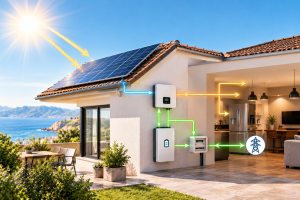
Solar panels are made of photovoltaic (PV) cells, usually built from silicon. When sunlight hits these cells, it excites electrons in the silicon, causing them to flow and generate direct current (DC) electricity. An inverter then converts that DC electricity into the alternating current (AC) electricity your home actually uses, and any surplus either charges a battery or gets exported to the grid.
Step 1: Sunlight hits the photovoltaic cells
Each solar panel is made up of dozens of individual photovoltaic cells, most commonly made from crystalline silicon — the same base material used in computer chips. Silicon is a semiconductor, meaning it sits between being a conductor (like copper) and an insulator (like rubber), which makes it uniquely suited to controlling the flow of electrons.
Each cell is treated with trace amounts of other elements (phosphorus and boron, typically) in a process called doping. This creates two distinct layers within the cell — one with extra electrons, one with “holes” missing electrons — forming what’s known as a P-N junction. This junction is what makes the whole process possible.
Step 2: The photovoltaic effect knocks electrons loose
Sunlight is made up of particles called photons. When photons strike the silicon cell with enough energy, they knock electrons loose from their atoms. Thanks to the electric field created by the P-N junction, those freed electrons are pushed in one direction rather than just moving randomly — and a directional flow of electrons is, by definition, an electric current.
This is the core of the photovoltaic effect: light energy converted directly into electrical energy, with no moving parts, no combustion, and no emissions.
Step 3: The current flows as direct current (DC) electricity
The electricity generated at this stage is direct current (DC) — the same type of current that flows from a battery. Individual cells generate a small amount of DC voltage each, so they’re wired together within the panel, and multiple panels are then wired together (in what’s called a solar array) to add up to a meaningful amount of power.
Step 4: The inverter converts DC into usable AC electricity
Homes and the electrical grid run on alternating current (AC), not DC. This is where the solar inverter comes in — one of the most important components of any solar system, arguably as important as the panels themselves.
The inverter takes the DC electricity produced by the panels and converts it into clean AC electricity that matches the voltage and frequency your home’s electrical system expects. Without this conversion step, the electricity generated by your panels would be unusable for virtually anything in a standard home.
Modern inverters also handle a second critical job: maximum power point tracking (MPPT), which continuously adjusts how the system draws power from the panels to extract as much usable electricity as possible, even as sunlight conditions change throughout the day.
Step 5: The electricity is used, stored, or exported
Once converted to AC, the electricity has three possible destinations, generally in this order of priority:
- Powering your home directly, covering whatever appliances and devices are running at that moment.
- Charging a battery, if your system includes one, for use later when the sun isn’t shining.
- Exporting to the grid, if there’s genuine surplus beyond what your home needs and any battery can store, typically earning a bill credit depending on your local compensation scheme.
A smart meter (or bidirectional meter) tracks how much electricity flows in each direction — from the grid to your home, and from your panels back to the grid — which is what makes accurate billing and compensation possible.
The main components of a solar panel system
Putting it all together, a complete residential solar system typically includes:
- Solar panels — the PV cells that capture sunlight and generate DC electricity
- Mounting structure — secures the panels to your roof at the correct angle
- Inverter — converts DC to usable AC electricity
- Battery (optional) — stores surplus electricity for later use
- Bidirectional meter — measures electricity flowing both to and from the grid
- Monitoring system — lets you track production and consumption, usually via an app
Why some panels produce more electricity than others
Not every panel converts the same percentage of sunlight into usable electricity — this is what’s referred to as a panel’s efficiency, typically ranging from about 15% to over 24% in panels available today. Efficiency is affected by the specific semiconductor technology used, the panel’s temperature, its orientation and angle relative to the sun, and how much shading it receives. If you want to go deeper into what drives these differences, we cover it in detail in our complete guide to solar panel efficiency.
Do solar panels work on cloudy days?
Yes, though at reduced output. Solar panels don’t need direct, unobstructed sunlight to work — they still generate electricity from diffused light on a cloudy day, typically producing somewhere between 10% and 25% of their rated output under heavy cloud cover, compared to full sun. This is one of the reasons total annual sun hours in a given location matter more than any single day’s weather.
Frequently asked questions
Do solar panels work without direct sunlight? Yes, though less efficiently. Panels still generate electricity from diffused or indirect light on cloudy days, just at a reduced output compared to direct, unobstructed sunlight.
What happens to solar electricity at night? Without a battery, panels simply stop producing once the sun sets, and your home draws electricity from the grid as usual. With a battery, stored daytime surplus can cover nighttime use instead.
Why do solar panels need an inverter? Panels generate direct current (DC) electricity, but homes and the grid run on alternating current (AC). The inverter performs that conversion, without which the electricity generated couldn’t be used by standard appliances.
How long do solar panels actually last? Most modern panels carry product warranties of 12-15 years and performance warranties guaranteeing meaningful output for 25 years or more, with many panels continuing to generate electricity well beyond that, just at a gradually reduced capacity.
See how this works for your specific roof
Understanding the mechanism is one thing — knowing how much electricity a system would actually generate on your roof, in your location, is another. If you’re in Alicante or along the Costa Blanca, Solarea Tech offers a free technical assessment based on your real roof orientation, shading, and consumption.
📞 Contact us at 669 34 86 07 or visit www.solareatech.com to request your assessment.