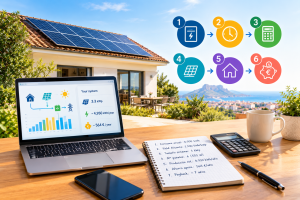

Knowing how to calculate your self-consumption photovoltaic system is the difference between a solar installation that saves you money and one that is too small to matter or too big to pay off. The good news: the maths is simple. You need five numbers, a calculator and about twenty minutes. This guide walks you through each step with a worked example for a typical home in the Alicante province, so you can run your own figures before asking anyone for a quote.
The short answer
To size a self-consumption photovoltaic system:
- Find your annual electricity consumption (kWh) on your bills.
- Look at when you use it (day vs. night).
- Divide the consumption you want to cover by your location’s yearly yield per kWp to get the system size in kWp.
- Divide that size by the panel wattage to get the number of panels.
- Check your roof space, orientation and shading, then estimate savings and payback.
Step 1: Find your annual consumption
Look at your last 12 months of bills, or log in to your distributor’s customer area, and add up the kWh. Annual figures matter more than a single month, because summer air conditioning and pool pumps can double your usage.
Example: a family home in Alicante consuming 4,500 kWh per year.
Step 2: Understand when you consume
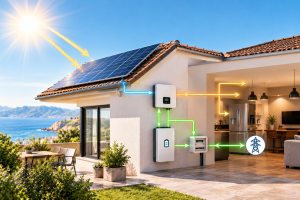
Solar panels only produce during daylight. The share of your production that you use directly in the home is your self-consumption ratio, and it drives most of your savings, because energy you use directly is worth much more than energy you send to the grid.
- Home occupied during the day (remote work, retirees, pool, air conditioning): higher direct use.
- Home empty from morning to evening: more surplus, lower direct use.
As a rough guide, systems without a battery often use only a minority-to-half of what they produce directly; a battery or shifting loads (water heater, dishwasher, washing machine, EV charging) to midday raises that figure. This is the number worth discussing in a real technical study, because it depends on your habits.
Step 3: Calculate the system size in kWp
Formula:
System size (kWp) = Annual consumption to cover (kWh) ÷ Yearly yield per kWp (kWh/kWp)
In the Alicante area, a well-oriented, unshaded system typically produces in the order of 1,500 kWh per kWp per year (an orientative figure: orientation, tilt, shading and equipment change it).
Example: to cover all 4,500 kWh: 4,500 ÷ 1,500 = 3 kWp
Do you want to cover 100%? Not necessarily. Because surplus energy is compensated at a lower price than the one you pay for energy you buy, many homes aim to cover a large share of their consumption rather than oversizing. Plan ahead too: an electric car, a heat pump or a new pool will raise your consumption and justify a bigger system now.
Typical residential systems fall between 3 and 8 kWp.
Step 4: Calculate the number of panels
Formula:
Number of panels = System size (W) ÷ Panel power (W)
Example: 3,000 W ÷ 550 W = 5.5, so round up to 6 panels of 550 W = 3.3 kWp.
Higher-wattage panels mean fewer panels for the same kWp, which matters if roof space is limited. Remember that panel power and panel efficiency are different things: efficiency tells you how much power you get per square metre.
Step 5: Check your roof
The calculation only works if the panels fit and receive sun. Check:
- Surface: a 550 W panel takes roughly 2.6 m², so 6 panels need about 15–16 m² of usable roof (plus space for access and spacing).
- Orientation: south is ideal; south-east and south-west lose only a little.
- Tilt: a moderate tilt works well in Spain.
- Shading: chimneys, aerials, parapets and neighbouring buildings can cost more production than the difference between two panel brands.
Step 6: Estimate production, savings and payback
Estimated production: 3.3 kWp × 1,500 = about 4,950 kWh per year.
Illustrative savings (assumptions: 40% used directly, 60% sent to the grid; you pay around 0.18 €/kWh; surplus compensated around 0.07 €/kWh):
| Item | Calculation | Result |
| Energy used directly | 4,950 × 40% = 1,980 kWh × 0.18 € | ≈ 356 € |
| Surplus compensated | 4,950 × 60% = 2,970 kWh × 0.07 € | ≈ 208 € |
| Total yearly saving | ≈ 564 € |
Estimated cost: installed residential systems are commonly in the range of 1,000–1,500 € per kWp. For 3.3 kWp, at about 1,250 €/kWp, that is roughly 4,100 €.
Payback: 4,100 ÷ 564 = about 7 years before any tax relief. With the personal income tax (IRPF) deduction (40% of the cost, up to 3,000 €, when its conditions are met) and municipal rebates on IBI and ICIO, the real payback falls noticeably, and a higher direct-use ratio shortens it further.
All prices and tariffs in this example are illustrative. Your real figures depend on your tariff, your usage pattern and the final quote. Solar subsidies change often; check our guide to solar panel subsidies in Alicante for what is currently open. The Next Generation EU funds are closed to new applications.
Should you add a battery to the calculation?
A battery is optional. It raises your self-consumption by storing midday surplus for the evening, and can provide backup during blackouts, but it adds cost. A common approach is to calculate the system without a battery first, then test whether the extra self-consumption justifies the investment. Many homes start without one and leave the installation ready to add it later.
Common mistakes when calculating a self-consumption system
- Using one month’s bill instead of 12 months.
- Ignoring daily consumption timing, which sets your real savings.
- Oversizing just to cover 100% when surplus is paid at a lower price.
- Ignoring shading and roof orientation.
- Forgetting future consumption (EV, heat pump, pool).
- Counting subsidies that no longer exist.
Frequently asked questions
How do I calculate the size of my self-consumption photovoltaic system?
Divide the annual consumption you want to cover (kWh) by the yearly yield per kWp for your location. In the Alicante area, around 1,500 kWh/kWp is a reasonable orientative figure.
How many solar panels do I need for a house?
Divide the system size in watts by the power of each panel. For example, 3,300 W of system with 550 W panels means 6 panels. Typical homes use between 3 and 8 kWp.
How much does a residential self-consumption system cost?
As a general market reference, installed systems range from about 1,000 to 1,500 € per kWp, before tax deductions and municipal rebates. A real quote depends on the roof, equipment and whether a battery is included.
How long does a self-consumption system take to pay for itself?
In the Alicante province, typical payback ranges from 5 to 7 years, depending on how much of your production you use directly and on the incentives you can apply.
Can I do this calculation myself?
Yes, the steps above give a solid estimate. A technical study then refines it with your real consumption profile, roof measurements and shading analysis.
Get your system calculated by professionals
Solarea Tech has completed more than 500 installations in the Alicante province, with our own technical team and a 5.0/5 rating on Google from over 129 reviews. Send us your bills and we will size your system, check your roof and give you a clear proposal, including the incentives that apply in your town. For typical prices, see our guide to how much solar panels cost in Spain.
👉 Request your free quote in English and we will get back to you within 24 hours.
📞 669 34 86 07