
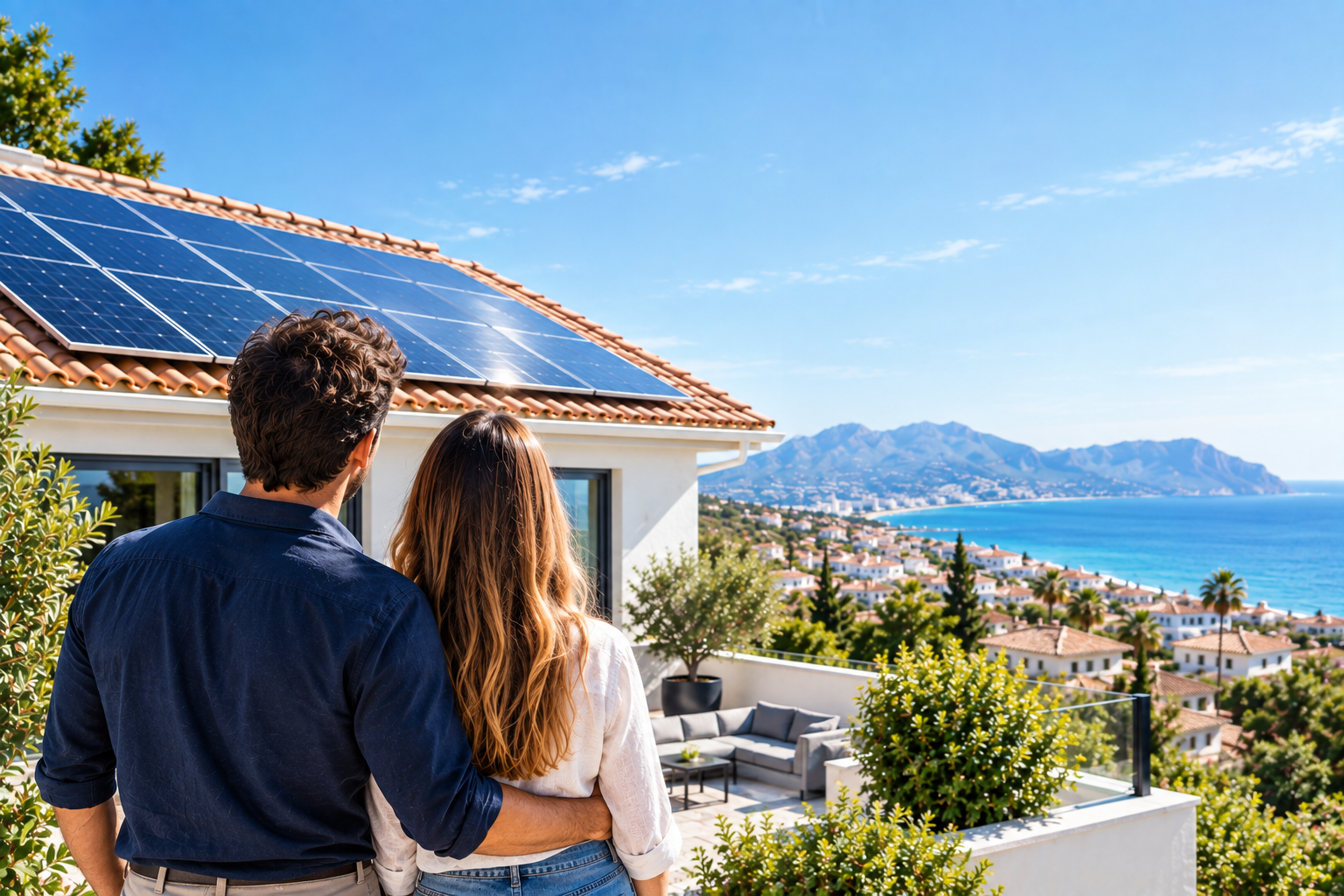
If an installer has quoted you a 10 kW solar system, or you’ve seen it mentioned as a common size, the natural question is whether that’s actually enough to run your house or whether it’s overkill, or not nearly enough. The honest answer is: it depends heavily on where you live and how you use electricity, but for the large majority of homes, 10 kW is a generous system, not a minimal one. Here’s how to check where your home falls.
What “10 kW” actually means
10 kW (10 kilowatts, or 10,000 watts) describes the system’s peak generating capacity under ideal sunlight, not a guaranteed daily output. What the system actually produces depends on your location’s sun hours, the orientation of your roof, shading, and the season.
As a rough range: a 10 kW system typically generates somewhere between 11,000 and 15,000 kWh per year in sunny locations, and less in cloudier climates. In a Mediterranean climate like southern Spain, with strong year-round sun exposure, a 10 kW system tends to land toward the higher end of that range or above it.
How many panels does a 10 kW system need
With today’s panels, typically rated between 450W and 600W, a 10 kW system usually needs somewhere between 17 and 22 panels, depending on the exact wattage chosen. Higher-wattage, higher-efficiency panels need less roof space to reach the same total capacity — relevant if your roof area is limited.
Is 10 kW enough for an average household?
For context, here’s what typical annual household electricity consumption looks like in a few reference points:
- Average U.S. home: roughly 10,500 kWh per year
- Average Spanish home: roughly 3,500-4,500 kWh per year for a standard household, more with electric heating, a pool, or air conditioning used heavily in summer
Against those numbers, a 10 kW system comfortably covers — and often exceeds — the annual consumption of a typical home in either country. In Spain specifically, a 10 kW system is generally more than what a standard single-family home needs; most residential installations in the Spanish market are sized between 3 and 6 kW, with 10 kW more common for larger homes, homes with a pool and air conditioning running through the summer, homes charging an EV daily, or properties combining residential use with a home office or small business.
When 10 kW is genuinely enough
A 10 kW system is a strong fit for your situation if:
Your annual consumption is at or below roughly 12,000-14,000 kWh. This covers the large majority of single-family homes, even ones with above-average usage.
You have decent sun exposure and limited shading. A 10 kW system on a shaded, poorly-oriented roof produces meaningfully less than the same system on a clear, south-facing one — sometimes enough to move a “more than enough” system into “just about right” or “not quite enough.”
Your electric vehicle charging, pool pump, or air conditioning load is moderate, not extreme. Households with two EVs charging daily, a heated pool running year-round, or whole-home electric heating in a cold climate can push consumption well past what 10 kW comfortably covers.
When 10 kW might not be enough
All-electric heating in a cold climate. Heat pumps and electric resistance heating can add several thousand kWh per year, especially in homes with poor insulation.
Multiple electric vehicles charged primarily at home. Each EV typically adds 2,000-4,000+ kWh per year depending on how much it’s driven.
Large homes with high year-round air conditioning use. Consistently running central AC across a large floor plan in a hot climate adds up quickly.
A home business or workshop with significant daytime electrical load. Equipment, servers, or machinery running for hours each day changes the calculation considerably.
In any of these cases, the right move isn’t to guess — it’s to look at 12 months of actual utility bills and size the system to that real number, plus some margin for future changes (an EV you’re planning to buy, for example).
When 10 kW is more than you need
If your annual consumption is closer to 3,500-6,000 kWh — typical for a smaller or more energy-efficient Spanish home without a pool or heavy air conditioning — a 10 kW system will likely generate significantly more than you use. That’s not necessarily wasted: depending on your local compensation scheme for surplus energy, exported electricity can still reduce your bill, though usually at a lower rate than the electricity you consume directly. In most cases, though, a smaller system (often 4-6 kW for a standard Spanish home) reaches a similar payback period at a lower upfront cost, which is why oversizing without a specific reason to do so isn’t usually the most efficient choice.
Does 10 kW need a battery to actually run the house?
Not necessarily. A grid-connected 10 kW system without a battery still offsets your daytime consumption directly and, depending on local rules, can export surplus to the grid for a bill credit. What it won’t do without a battery is keep your home running during a power outage, or let you use solar-generated electricity after dark — for either of those, you’d need to add battery storage sized to your evening and nighttime consumption specifically, which is a separate calculation from panel capacity.
The right way to answer this for your specific home
Rather than relying on general benchmarks, the accurate approach is:
- Pull your last 12 months of electricity bills to get your real annual kWh consumption, including seasonal swings.
- Account for planned changes — an EV, a pool, an extension to the house — that will increase future consumption.
- Get your roof’s actual sun exposure assessed, not just a regional average, since orientation and shading materially change what any given system size produces.
- Size the system to that real number, not to a round figure like “10 kW” chosen because it’s a common quote size.
Frequently asked questions
Will a 10 kW solar system run a whole house? For most homes, yes — a 10 kW system covers the annual consumption of a typical household in most countries, including the majority of homes in Spain. Homes with heavy electric heating, multiple EVs, or large pools may need more.
How many solar panels make up a 10 kW system? Typically 17 to 22 panels, depending on whether you use standard (450-500W) or higher-wattage (550-600W+) panels.
Is 10 kW too much for a typical Spanish home? Often, yes. Most Spanish single-family homes use less electricity than a 10 kW system generates, and a smaller 4-6 kW system is more common and usually reaches a similar payback period for less upfront cost, unless the home has a pool, heavy air conditioning, or EV charging.
Do I need a battery with a 10 kW system? Only if you want to use your solar power after sunset or maintain power during outages. Without a battery, a 10 kW system still offsets daytime use and can export surplus for a bill credit, depending on local compensation rules.
How do I know the right system size for my home instead of guessing? Base it on your actual annual electricity consumption from your last 12 months of bills, plus your roof’s real sun exposure — not a generic benchmark like 10 kW.
Get the right system size for your home in Alicante
If you’re in Alicante or along the Costa Blanca and want to know the actual system size your home needs — rather than a generic recommendation — Solarea Tech offers a free technical assessment based on your real consumption and your roof’s exact conditions.
📞 Contact us at 669 34 86 07 or visit www.solareatech.com to request your assessment.