
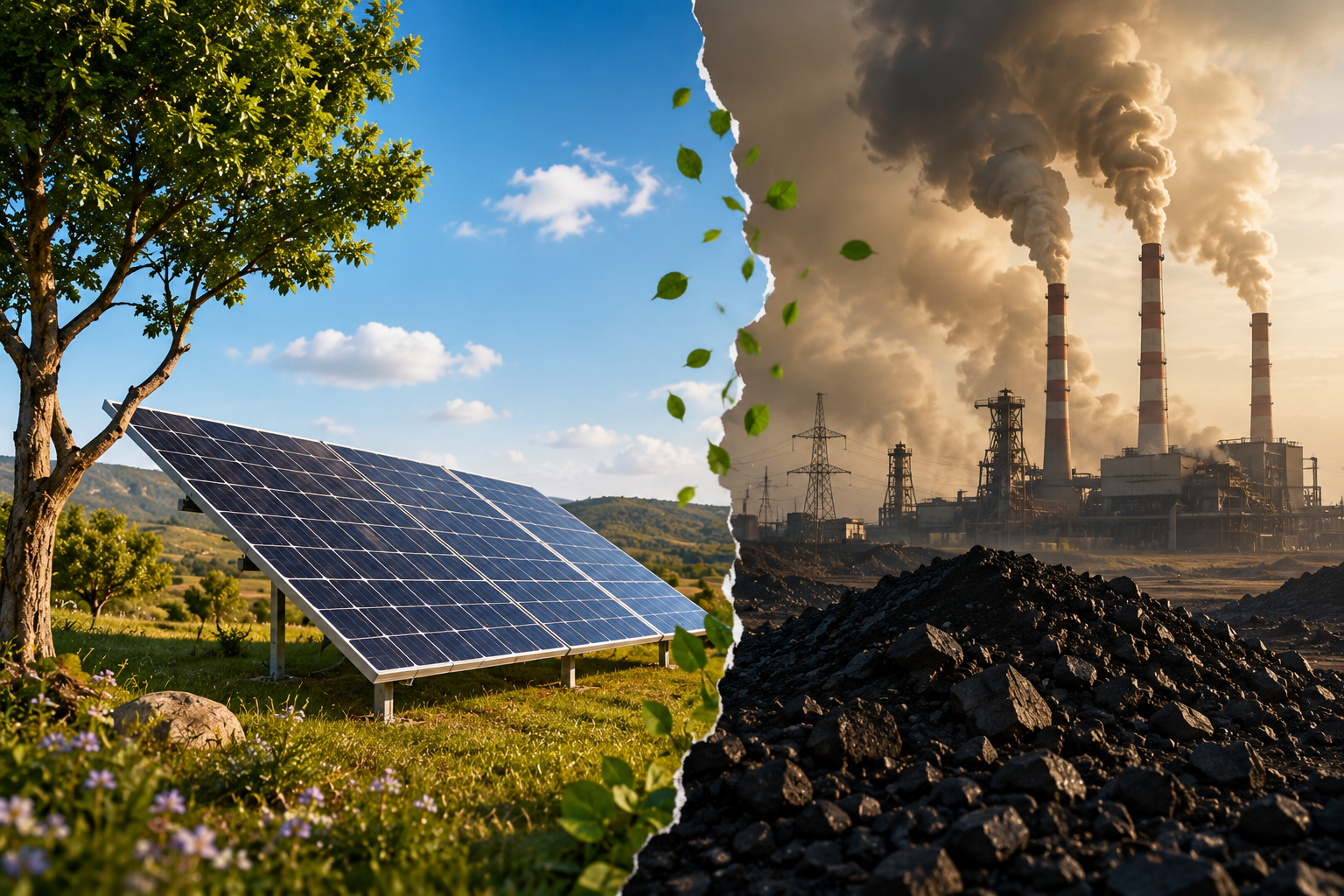
If you have been researching solar panels for your home in Spain, you may have come across articles, videos, or social media posts claiming that solar panels are “not as green as they seem”. The narrative usually goes something like this: they are manufactured with heavy pollution in China, they use rare earth metals, they consume massive amounts of water to produce, they end up as unrecyclable waste, and by the time you add all this up, they might even be worse for the planet than the fossil fuels they replace.
If you are the kind of person who takes these claims seriously (and you should, because environmental decisions matter), you deserve a proper answer with real data, not a marketing brochure that dismisses your concerns. So this article does something most solar company blogs will not do: it takes the concerns one by one, gives you the actual data, and lets you decide.
At Solarea Tech we have completed more than 500 solar installations across the Alicante province. We install solar because we genuinely believe it is one of the most valuable investments a homeowner can make, both financially and environmentally. But we also believe that customers deserve honest information, including the parts of the story that are not entirely rosy. Here is the full picture.
The short answer
Solar panels are not perfect, but they are substantially better for the environment than fossil fuel electricity by every meaningful measure. Here is the honest breakdown:
- Their manufacturing does have real environmental costs.
- The carbon “debt” is repaid within 1 to 3 years of operation.
- After that, they generate clean electricity for 22 to 28 more years.
- Lifetime CO2 emissions per kWh produced are 25 to 50 times lower than fossil fuels.
- Modern recycling programmes recover 90+ percent of panel materials.
The claim that solar panels are “bad for the environment” is technically false when compared with the alternative that would otherwise power your home. But that does not mean the industry is free of legitimate concerns worth understanding.
Let us go through them properly.
Concern 1: manufacturing pollution and energy consumption
The claim: Manufacturing a solar panel requires enormous energy, most of which comes from coal in China, cancelling out any environmental benefit.
The reality: Manufacturing a solar panel does require significant energy, that part is true. The main steps are silicon purification, wafer production, cell manufacturing, and module assembly, and each has an energy footprint.
The relevant measure here is the energy payback time: how long the panel needs to operate to produce as much energy as it took to make it.
For a modern silicon panel installed in Spain, the energy payback is between 1 and 3 years, depending on the panel technology and the location. In Alicante, with 2,800 hours of sunshine per year and high irradiation levels, the payback is at the shorter end of that range, typically around 1.5 years.
Given that panels are designed to last 25 to 30 years, that means they operate as net positive energy producers for 22 to 28 years after their carbon debt has been paid. This is not marketing spin, it is a widely published metric in industrial ecology journals.
On the manufacturing location: yes, the majority of solar panels are made in China. And yes, China’s electricity grid remains coal heavy (although it is decarbonising rapidly, and Chinese solar manufacturing is increasingly powered by renewable energy). But even accounting for the Chinese grid mix, the lifetime carbon footprint of a Chinese made panel installed in Spain is dramatically lower than the coal or gas electricity it displaces over 25 years.
Key comparison in numbers:
- Lifetime CO2 emissions from a Chinese-made silicon panel operating in Spain: approximately 40 to 60 grams of CO2 per kWh produced
- Lifetime CO2 emissions from natural gas electricity: approximately 450 to 550 grams of CO2 per kWh
- Lifetime CO2 emissions from coal electricity: approximately 900 to 1,050 grams of CO2 per kWh
So the “worse than fossil fuels” claim is off by a factor of 10 to 25 times. Even with all the manufacturing pollution counted in, solar wins the environmental comparison by a landslide.
Concern 2: water consumption during manufacturing
The claim: Solar panel manufacturing requires vast amounts of water, particularly in the silicon purification stage, contributing to water scarcity in production areas.
The reality: This is a legitimate concern that is often exaggerated but not without foundation.
Solar panel manufacturing uses water primarily for cleaning silicon wafers during production. The water consumption varies by manufacturer and production process, but current industry averages are around 10 to 15 litres per panel produced, depending on technology.
For context, a typical Spanish family home consumes roughly 150,000 litres of water per year. The water used to manufacture the panels for that home (about 10 panels for a 4 kWp system) is around 100 to 150 litres, which is less than one day of household water use.
Compare this with the water consumption of the electricity you avoid using:
- Coal electricity: approximately 2 litres of water per kWh for cooling and steam generation
- Nuclear electricity: approximately 1.5 to 3 litres of water per kWh for cooling
- Solar electricity (after installation): approximately 0 litres of water per kWh
A 4 kWp home solar system in Alicante produces around 6,000 kWh per year. If that same electricity came from coal, it would require 12,000 litres of water per year. Over 25 years: 300,000 litres saved just on cooling.
The one time water investment to manufacture your panels (around 150 litres) pays back in water savings within the first month of operation.
Concern 3: rare earth metals and mining
The claim: Solar panels rely on rare earth metals whose extraction is environmentally destructive and geopolitically problematic.
The reality: This is a common misconception. Standard silicon based solar panels (the type installed on virtually every residential roof in Spain) do not contain rare earth metals.
The confusion comes from mixing solar panels with other clean energy technologies. Wind turbine magnets and some electric motors do use rare earth metals like neodymium. Solar panels do not.
Silicon based solar panels are made primarily of:
- Silicon (the second most abundant element in the Earth’s crust, essentially refined sand)
- Aluminium for the frame (readily available, recyclable)
- Glass for the front cover (widely produced, recyclable)
- Copper for the wiring (mined at industrial scale globally)
- Silver as a conductor (small quantities, industry is reducing usage year over year)
- Some polymers in the encapsulation
There are some solar technologies that do use rarer materials. Cadmium telluride (CdTe) thin-film panels contain cadmium, which is toxic but tightly regulated. CIGS panels contain small amounts of indium and gallium. But these are niche technologies used in some large scale installations, not on residential roofs. If you install standard panels from JA Solar, LONGi, Jinko, REC, or Canadian Solar (the mainstream Tier 1 brands we use at Solarea Tech), you get silicon based panels with no rare earths.
Silver is worth noting separately. Modern panels use around 10 to 15 milligrams of silver per watt. The industry is actively reducing this, and copper-based conductive pastes are being introduced. Silver mining is a legitimate environmental concern in some regions, but silver is also extensively recycled from many other industries.
Concern 4: end of life waste and recycling
The claim: Solar panels create massive amounts of hazardous waste at the end of their life, and current recycling infrastructure cannot handle it.
The reality: This is a genuine concern, and one where the industry is actively improving, but it is more nuanced than the alarming headlines suggest.
How much end of life waste do solar panels actually create?
Modern panels have a 25 to 30 year lifespan with proper maintenance. The first massive wave of installed panels globally (from the mid 2010s onward) will start reaching end of life around 2035 to 2045. This means the recycling volume challenge is real but is a future problem the industry has time to prepare for, not a current crisis.
Can solar panels actually be recycled?
Yes, and increasingly well. Modern recycling processes can recover:
- 95 to 100 percent of the aluminium frame
- 90 to 95 percent of the glass
- 85 to 90 percent of the copper
- 80 to 90 percent of the silicon
- 60 to 75 percent of the silver
In total, current European recycling processes recover 90 to 95 percent by weight of a modern silicon panel. The remaining 5 to 10 percent includes plastics and encapsulants that go to specialised waste treatment.
Is there recycling infrastructure in Spain?
Yes. The PV CYCLE European scheme covers Spain and provides collection points for end of life solar panels. Producers who sell panels in the EU market are legally required (under the WEEE Directive) to fund recycling. So the panels you install today have already been paid into a recycling scheme via the manufacturer’s registration fees.
There are also several dedicated solar panel recycling facilities in Europe (Veolia in France operates one of the largest), and Spain has smaller domestic facilities being expanded to meet future demand.
What about the toxic materials?
Silicon panels contain very small amounts of lead in the solder used to connect cells. The industry is actively phasing this out in favour of lead-free solders. Even in current panels, the lead content is far lower than in many other electronic devices you already discard responsibly.
The claim that end of life solar panels are “hazardous waste” is technically incorrect for silicon panels. Under EU classification, they are treated as electrical and electronic equipment (WEEE), not hazardous waste.
Concern 5: land use and biodiversity
The claim: Large solar farms take up huge amounts of land that could be used for agriculture or nature.
The reality: This is a valid concern for utility scale solar farms, but essentially not relevant for residential installations.
A residential installation on your roof uses zero additional land. You are placing panels on existing infrastructure (your roof) that was already occupying that space. No trees are cut, no meadows are paved, no habitats are disrupted. In fact, the panels reduce heat absorption by the roof, slightly cooling the local microclimate.
For utility scale solar farms, land use is a legitimate concern, and this is where the industry is working on solutions:
- Agrivoltaics: combining solar panels with agriculture (growing crops or grazing livestock under the panels). Increasingly common in Spain, particularly in Aragón, Extremadura, and Castilla-La Mancha.
- Dual use industrial: installing panels on parking canopies, warehouse roofs, water reservoirs, brownfield sites.
- Restoration projects: using degraded lands (former quarries, abandoned agricultural land) for solar generation.
For your home, none of this applies. Residential solar has zero land use impact.
Concern 6: efficiency degradation over time
The claim: Solar panels lose so much efficiency over their lifetime that their “25 year lifespan” is misleading, and the environmental payback calculations do not hold.
The reality: Panels do degrade, but far less than critics claim, and modern warranties reflect this.
A Tier 1 panel from JA Solar, LONGi, or similar Tier 1 manufacturer degrades at approximately 0.4 to 0.5 percent per year. Over 25 years, that means the panel still produces around 87 to 90 percent of its original output.
This is not projection, it is what warranties guarantee. Modern panels come with 25 year performance warranties that legally commit the manufacturer to a minimum output percentage at year 25.
The environmental payback calculations (energy payback in 1 to 3 years, then 22 to 28 years of net positive production) already account for this degradation curve. The numbers hold up.
The honest comparison
Here is the direct environmental comparison across a 25 year lifetime for a typical 4 kWp residential installation in Alicante:
Solar installation:
- Manufacturing carbon debt: approximately 2 to 3 tonnes of CO2
- Water used to manufacture panels: approximately 150 litres
- Land used: 0 square metres additional
- Lifetime clean electricity produced: approximately 150,000 to 160,000 kWh
- Net CO2 emissions per kWh over lifetime: 40 to 60 grams
Same electricity from the Spanish grid mix (current):
- Total CO2 emissions: approximately 35 to 45 tonnes
- Water consumption for cooling generators: approximately 240,000 litres
- Fuel extraction and infrastructure impacts: significant
Net environmental benefit of choosing solar for one home over 25 years:
- 32 to 42 tonnes of CO2 avoided
- 240,000 litres of water saved
- No additional land use
These numbers are why every serious environmental assessment (from the IPCC to the European Environment Agency to the International Energy Agency) treats residential solar as one of the most cost effective ways for a household to reduce its environmental footprint.
What the industry still needs to improve
To be fair to the critics, the solar industry has genuine work to do, and it is worth acknowledging it:
Decarbonising manufacturing further. The Chinese solar manufacturing industry is transitioning to renewable powered facilities, but the process is still in progress. Panels made in facilities running on 100 percent renewable energy have even lower lifetime footprints, and this is where the industry is heading.
Reducing silver content further. Silver is one of the more environmentally intensive materials in modern panels. Copper based alternatives are being introduced in newer product lines.
Scaling up recycling infrastructure. The wave of end of life panels from the 2030s onward will require substantially more recycling capacity than currently exists. The EU is actively investing in this, and Spain will benefit.
Improving traceability. The industry needs better tracking of where materials come from and where they end up, so consumers can make informed choices. Some manufacturers are leading here (LONGi’s decarbonisation reporting is one example).
None of these issues invalidate solar as the environmentally superior choice. They are the improvement roadmap of a genuine industry, not damning flaws.
What we recommend at Solarea Tech
Given all of the above, here is how we approach the environmental question for our clients:
We install Tier 1 silicon panels only. JA Solar and LONGi as our primary suppliers, both with strong sustainability reporting and 25 year performance warranties. No thin film panels for residential clients (their lower efficiency and higher toxic material content do not justify the marginal cost saving).
We include warranty registration for eventual recycling. All our installations are registered with the manufacturer’s producer responsibility scheme, meaning the panels you install today are legally committed to be recycled at end of life at no additional cost to you.
We size systems appropriately. Oversized systems create more manufacturing waste for marginal returns. Correctly sized systems (see our guide on the 20 percent rule) maximise environmental payback per unit of material used.
We maintain systems properly. A well maintained panel operating at 95 percent of its rated output for 30 years has a much better lifetime environmental balance than one operating at 80 percent because of poor maintenance.
We are honest about the trade offs. No installation is 100 percent zero impact. The right question is not “is this perfect?” but “is this substantially better than the alternative?”. For solar, the answer is a clear yes.
For our full range of services, see our page on self-consumption solar installation for homes. For more on the specific panel and inverter brands we use and why, see our guides on the best solar panel brands for residential use and top rated solar inverter brands for residential use.
Frequently asked questions
Are solar panels really bad for the environment?
No. When you compare their full lifetime footprint (manufacturing, operation, and end of life) with the fossil fuel electricity they displace, solar panels produce 10 to 25 times less CO2 per kWh generated and use dramatically less water. They are not perfect, but they are substantially better than the alternative for your home’s electricity.
How long does it take for a solar panel to “pay back” its manufacturing carbon debt?
Between 1 and 3 years of operation, depending on the panel technology and location. In the Alicante province, the typical payback is around 1.5 years. After that, the panel operates as a net positive carbon producer for another 22 to 28 years.
Do solar panels contain rare earth metals?
Standard silicon based solar panels (the type installed on virtually every residential roof) do not contain rare earth metals. They are made primarily of silicon, aluminium, glass, copper, and small amounts of silver. Rare earth confusion typically comes from mixing solar with wind turbine or electric vehicle motor components, which do use rare earths.
Can solar panels be recycled at end of life?
Yes. Modern European recycling processes recover 90 to 95 percent of a silicon panel by weight. Spain participates in the PV CYCLE European scheme and has dedicated recycling facilities. Manufacturers who sell in the EU are legally required to fund recycling under the WEEE Directive.
Are Chinese made solar panels less environmentally friendly?
Chinese made panels do have a slightly higher manufacturing footprint due to China’s coal heavy grid, but the difference is smaller than critics claim (typically 10 to 20 percent higher lifetime emissions than European made panels). Even accounting for this, Chinese made panels installed in Spain still displace 15 to 25 times more CO2 than fossil fuel electricity over their lifetime.
How much water does it take to make a solar panel?
Approximately 10 to 15 litres per panel. For a typical 10 panel residential installation, that is around 100 to 150 litres total, or less than one day of household water use. Compare that with the 12,000 to 18,000 litres of water per year that coal or nuclear electricity would consume to generate the same output.
Is there hazardous waste from solar panels?
Modern silicon panels are not classified as hazardous waste under EU rules. They are treated as electrical and electronic equipment (WEEE) and go through standard recycling. Some older thin film technologies did contain cadmium, but these are not used in residential installations from Tier 1 manufacturers.
Do solar farms damage biodiversity?
Utility scale solar farms can affect land use and local ecosystems, which is why the industry is actively developing agrivoltaic solutions, brownfield site installations, and dual use systems (solar plus agriculture, solar plus livestock). Residential solar on your roof has zero land use impact.
What happens if my solar panels break or need replacing early?
Manufacturers warranties cover most early failures, so the replacement is at no cost to you and the failed panel is returned to the manufacturer for processing. Even outside warranty, panels can be individually replaced without discarding the whole system. Solarea Tech manages all warranty claims on behalf of our clients.
Should I still install solar panels if I care about the environment?
Yes. The environmental analysis is clear: residential solar substantially reduces your household’s carbon footprint over its lifetime. For a typical Spanish home, installing solar avoids 1.5 to 2.5 tonnes of CO2 per year, or 35 to 60 tonnes over the panel lifetime. This is one of the largest single actions a homeowner can take to reduce environmental impact.
Make the environmentally sound choice for your home
If you are considering solar for your home in Spain and want a transparent assessment that includes the environmental analysis for your specific case, we would be happy to help.
Our free, no obligation assessment includes:
Analysis of your recent electricity bills. Site visit and roof assessment. Solar production simulation for your exact location. Quote with Tier 1 components and full environmental documentation. Estimated lifetime CO2 avoided based on your consumption profile. All applicable subsidies and tax deductions calculated for your case.
👉 Request your free assessment in English and we will get back to you within 24 hours.