The transition to electric vehicles is accelerating across Spain, but many potential EV owners remain confused about charging infrastructure. Understanding the different types of charging points, their speeds, connectors, and applications is essential for making informed decisions about electric vehicle ownership. At Solarea Tech, we help Spanish homeowners integrate EV charging with their solar installations, creating complete sustainable energy solutions.
Whether you’re considering your first electric vehicle or planning to install a home charging point, this comprehensive guide explains everything you need to know about EV charging infrastructure in 2026.
Understanding the Three Levels of EV Charging
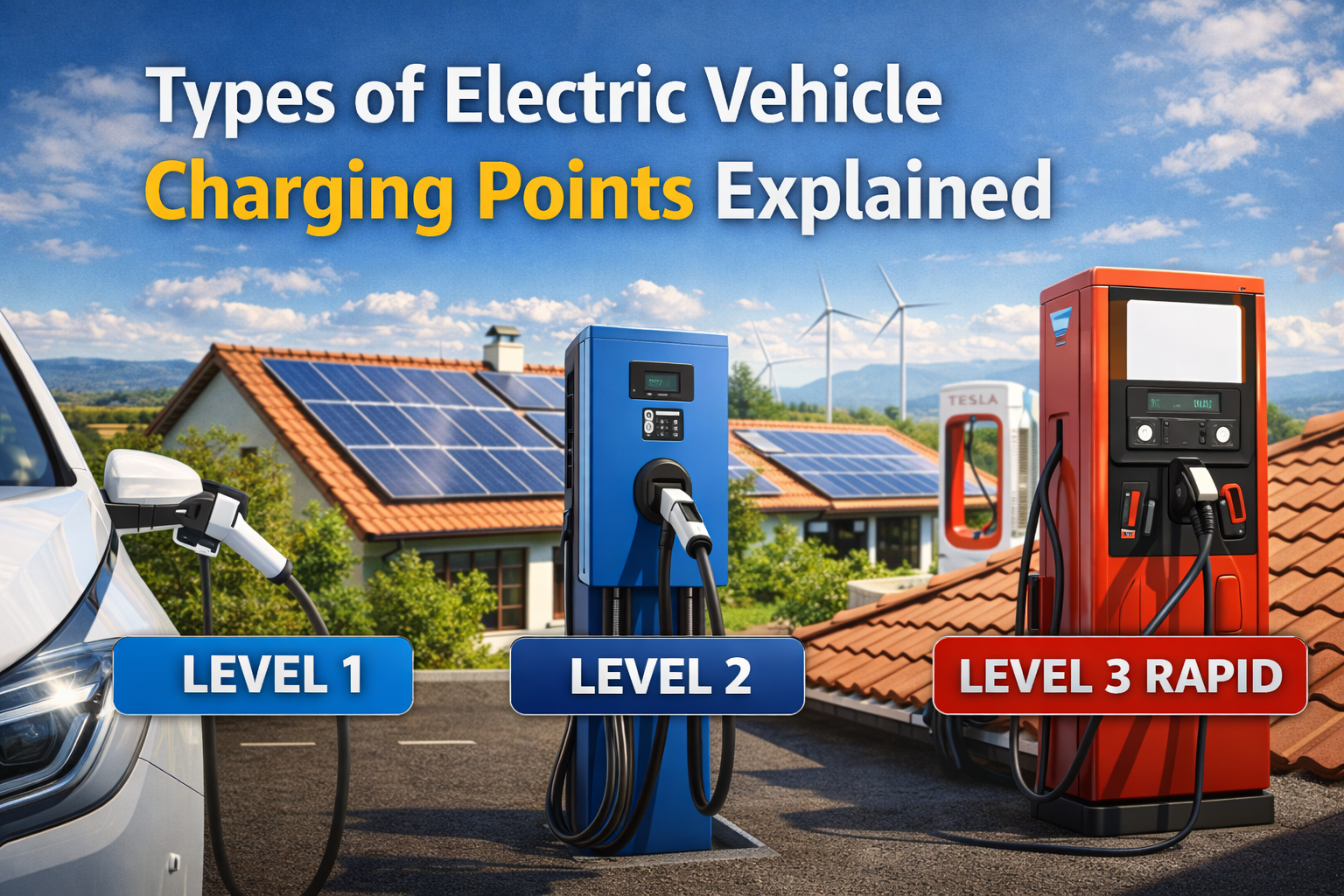
Electric vehicle charging is categorized into three main levels, each serving different purposes and offering distinct charging speeds.
Level 1 Charging (Slow Charging): This uses a standard household electrical outlet—230V, 16A in Spain. Level 1 charging delivers approximately 2.3 kW of power, adding roughly 15-20 km of range per hour. A typical 60 kWh battery would take over 24 hours to fully charge. This makes Level 1 impractical as a primary solution, though it works for plug-in hybrids with smaller batteries.
Level 2 Charging (Fast Charging): This is the ideal solution for home and workplace charging. Level 2 chargers use 230V AC power with higher amperage, delivering 3.7 kW to 22 kW. Most home installations in Spain use 7.4 kW chargers, which add approximately 40-50 km of range per hour. A 7.4 kW charger can fully charge a 60 kWh battery in 8-10 hours—perfect for overnight charging.
Level 3 Charging (Rapid and Ultra-Rapid): Also called DC fast charging, these chargers deliver direct current to the battery, ranging from 50 kW to 350 kW. A 50 kW charger adds 150-200 km of range in 30 minutes, while 150-350 kW ultra-rapid chargers can provide 300+ km in just 15-20 minutes. Level 3 charging is found at motorway service stations for long-distance travel.
Home EV Charging: The Foundation of Electric Vehicle Ownership
For most EV owners, home charging provides 80-90% of their total charging needs. Installing a dedicated home charging point offers convenience, cost savings, and seamless integration with daily routines.
V2C chargers explained: A V2C is a dedicated EV charging unit mounted on your garage or exterior wall. Unlike standard outlets, V2C provide faster charging speeds (typically 7.4 kW), built-in safety features, smart connectivity for scheduling, weather resistance, and integration with solar systems.
Installation requirements in Spain:
- Adequate electrical capacity (typically 32A circuit)
- Professional installation by certified electricians
- Proper earthing and circuit protection
- Municipal permits (requirements vary by location)
- Notification to electricity distributor for power upgrades if needed
Smart charging capabilities: Modern V2C offer scheduled charging during off-peak hours, solar excess charging (using only surplus solar production), load balancing to prevent overloading, mobile app control, and energy monitoring.
Public Charging Infrastructure in Spain
Spain’s public charging network has expanded to over 30,000 charging points in 2026, serving both urban and long-distance charging needs.
Urban public charging: Cities offer on-street charging, parking garage stations, and destination charging at shopping centers. These typically provide Level 2 charging (11-22 kW), suitable for 1-3 hour sessions. Urban public charging costs €0.25-€0.45 per kWh.
Motorway rapid charging hubs: Major motorways feature rapid charging stations at service areas every 50-100 km, offering 50-350 kW chargers with amenities. Premium pricing ranges from €0.45-€0.65 per kWh.
Major charging networks: Iberdrola, Repsol/Waylet, Endesa, Ionity, Tesla Supercharger, and Zunder operate extensive networks across Spain. Most require mobile apps, though newer stations accept contactless payments.
Understanding EV Charging Connectors
Type 2 (Mennekes) – AC Charging: The European standard for Level 1 and Level 2 charging. All modern EVs sold in Europe include a Type 2 socket, supporting up to 22 kW AC charging. This is what your home wallbox uses.
CCS (Combined Charging System) – DC Fast Charging: CCS2 combines Type 2 with two additional DC pins for rapid charging. This is the dominant standard in Europe, supporting 50-350 kW charging at motorway stations.
CHAdeMO: Japanese standard used by older Nissan Leaf models. Less common in Spain, with up to 50 kW charging. Many newer installations omit CHAdeMO in favor of CCS.
Tesla Supercharger: Tesla uses modified Type 2 connectors and is gradually opening Supercharger stations to non-Tesla vehicles through CCS adapters.
For Spanish EV owners: Type 2 for home and AC public charging, CCS2 for rapid public charging—these two standards cover virtually all charging scenarios.
Charging Speeds: What to Expect
Real-world charging rates depend on several factors:
Vehicle acceptance rate: Your EV’s maximum charging capability limits speed. Entry-level EVs accept 50-75 kW, mid-range models 100-150 kW, and premium EVs 200-350 kW.
Battery state of charge: EVs charge fastest between 10-80%. Charging slows significantly above 80% to protect battery health. Plan motorway stops to charge from low to 80%, not to 100%.
Battery temperature: Optimal charging occurs at 20-35°C. Cold or hot batteries charge slower.
Example charging times:
- Nissan Leaf (40 kWh, 50 kW max): 30-60 minutes for 20-80%
- Volkswagen ID.4 (77 kWh, 125 kW max): 30-35 minutes for 20-80%
- Tesla Model 3 Long Range (75 kWh, 250 kW max): 20-25 minutes for 20-80%
Charging Costs in Spain
Home charging: With average electricity rates of €0.16-€0.22 per kWh, charging at home costs €2.88-€3.96 per 100 km for a typical EV. Off-peak tariffs reduce this to €1.44-€2.16 per 100 km.
Solar charging: With solar panels, effective costs drop to €0.36-€0.90 per 100 km—nearly free driving.
Public AC charging: Urban stations charge €0.25-€0.45 per kWh (€4.50-€8.10 per 100 km).
Rapid charging: Motorway stations charge €0.45-€0.65 per kWh (€8.10-€11.70 per 100 km).
Cost comparison: A comparable petrol vehicle costs €9.60 per 100 km. Even expensive rapid charging is competitive, while home charging is 3-5 times cheaper, and solar charging offers overwhelming savings.
Integrating EV Charging with Solar Systems
The combination of solar panels and EV charging represents optimal sustainable transportation. At Solarea Tech, we design integrated systems maximizing this benefit.
Perfect synergy: An EV driven 15,000 km annually consumes ~2,700 kWh. A typical 5 kW solar system generates 7,000-8,000 kWh annually—enough for both home and vehicle.
Solar excess charging: Smart wallboxes charge your EV using surplus solar production, providing zero-cost driving after solar system depreciation.
Battery storage enhancement: Adding home battery storage allows evening charging from stored daytime solar energy. A 10 kWh battery provides 50-60 km of nightly EV range from solar.
Financial benefits: Solar-charged EV driving saves approximately €480 annually versus grid charging. Over 25 years, that’s €12,000 in fuel savings beyond home electricity savings.
Making the Right Charging Decision
If you have off-street parking: Install a 7.4-11 kW home wallbox. If you have or plan solar panels, choose a smart wallbox with solar integration.
If you’re in an apartment: Explore workplace charging or shared community charging infrastructure. Choose an EV with longer range (400+ km) and fast charging (100+ kW) if relying on public charging.
For long-distance driving: Modern EVs with 50+ kW rapid charging handle motorway journeys well. Plan routes using apps like Electromaps.
How Solarea Tech Supports Your EV Journey
At Solarea Tech, we provide integrated solar and EV charging solutions:
- Comprehensive system design for home and transport energy needs
- Professional wallbox installation meeting Spanish standards
- Smart technology integration for optimal solar utilization
- Future-proof planning for system expansion
- Complete permit handling and ongoing support
Whether planning solar installation while considering an EV, or already owning an electric vehicle and wanting solar power savings, we provide tailored complete solutions.
Take Control of Your Transportation Energy
The convergence of affordable EVs, expanding charging infrastructure, and accessible solar technology creates unprecedented opportunities for energy independence and dramatic savings, potentially €2,000-€3,000 annually on combined electricity and fuel costs.
With government incentives still available in 2026 for both solar and EV charging infrastructure, the investment case has never been stronger.
Ready to explore integrated solar and EV charging solutions? Contact Solarea Tech for a comprehensive assessment of your energy consumption, driving patterns, and property characteristics.
Schedule your free consultation today and discover how much you can save by combining solar power with electric vehicle charging!