If you already have solar panels — or you’re planning an installation — and you’ve started typing “where to buy efficient solar battery storage systems near me” into Google, you’re asking the right question at the right stage. A battery is what turns a daytime-only solar system into round-the-clock energy independence, letting you store the surplus your panels produce and use it after sunset instead of pulling from the grid at peak rates. Here’s how to find the right local supplier and what actually separates an efficient system from a mediocre one.
Why “near me” matters for solar battery storage
Unlike buying a phone charger online, a solar battery isn’t a plug-and-play purchase. It has to be sized correctly for your panel output and your household consumption, wired into your existing inverter (or replace it with a hybrid one), and installed to local electrical and safety codes. This is why searching locally — rather than ordering a battery online and hoping to find someone to install it — is almost always the better approach.
A local supplier in Alicante or the wider Valencian Community also means:
- Faster response times for maintenance, warranty claims, or troubleshooting.
- Accurate sizing based on your region’s actual sun hours and your real consumption data, not generic estimates.
- Familiarity with local subsidies and paperwork, including regional and municipal solar incentives that vary by province.
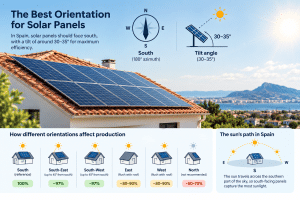
- A team that can visit your home to assess roof space, existing inverter compatibility, and panel orientation before recommending a system.
What makes a solar battery storage system “efficient”
Not all batteries perform the same, even at the same price point. When comparing options from a local supplier, these are the specs that actually determine efficiency:
Round-trip efficiency. This measures how much of the energy you store you actually get back out. Lithium-based systems (LiFePO4) typically reach 90-95% round-trip efficiency, compared to 80-85% for older lead-acid technology.
Depth of discharge (DoD). This is the percentage of the battery’s total capacity you can safely use. LiFePO4 batteries allow 80-90% DoD without damaging the battery, while traditional AGM batteries are usually limited to 50%. In practice, this means a smaller LiFePO4 battery can deliver the same usable capacity as a much larger AGM unit.
Cycle life. A quality lithium battery is rated for 4,000-6,000 charge cycles, versus roughly 500-1,200 for lead-acid alternatives — a major factor in long-term cost per kWh stored.
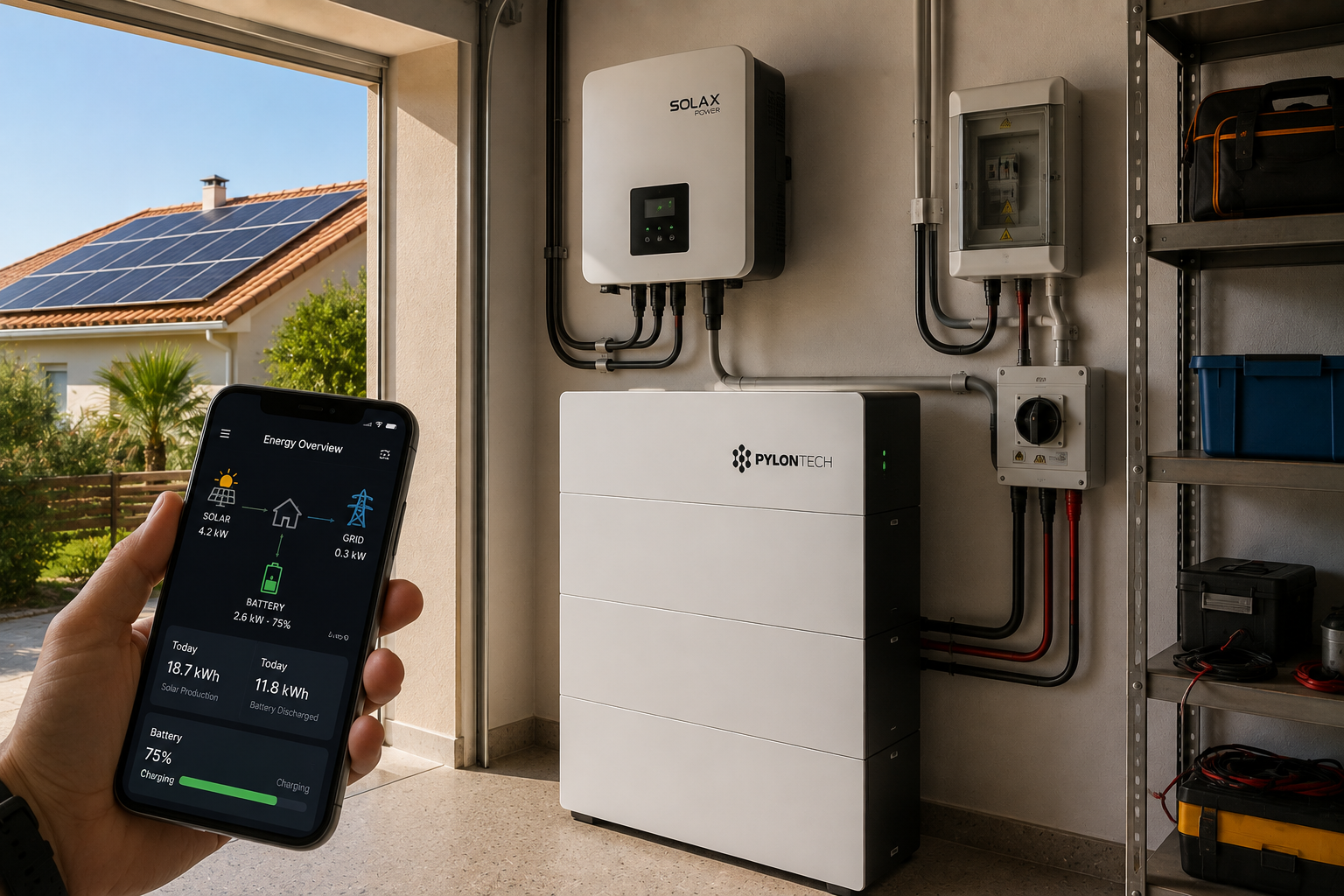
Smart monitoring. Efficient systems today include app-based monitoring so you can track charge levels, consumption patterns, and system health in real time, which also helps catch inefficiencies early.
Hybrid inverter compatibility. The most efficient setups pair the battery with a hybrid inverter that manages solar input, battery storage, and grid connection together, minimizing conversion losses compared to older systems using separate inverters.
How much does a solar battery storage system cost in Spain?
Prices vary based on capacity and technology, but as a general guide for the Spanish market in 2026:
- 5 kWh LiFePO4 battery: roughly €3,500-€5,500 installed
- 10 kWh LiFePO4 battery: roughly €6,000-€9,000 installed
- 15 kWh+ systems (for larger households or higher self-sufficiency targets): €10,000 and up
These figures typically include the battery, hybrid inverter (if needed), installation labor, and basic system commissioning. Exact pricing depends on your existing solar setup, whether you need a new inverter, and any structural work required.
What to check before buying from a local supplier
Ask how the battery will be sized for your home. A reliable supplier calculates your typical daily consumption and your panel output before recommending a capacity — not just offering their most popular size to everyone.
Confirm compatibility with your existing panels and inverter. If you already have solar panels installed, the battery and any new inverter need to integrate with what’s already on your roof.
Check the warranty separately from the panel warranty. Battery warranties are usually expressed in years and/or cycle count (for example, 10 years or 6,000 cycles, whichever comes first). Confirm both numbers.
Ask about self-consumption vs. backup power modes. Some systems are optimized purely to maximize self-consumption and reduce your bill; others are configured to also provide backup power during outages. These require different configurations, so be clear about which you want.
Look for a company that installs and services locally. A supplier that only sells the equipment — without a local installation and maintenance team — leaves you without support if something goes wrong down the line.
Where to buy efficient solar battery storage systems in Alicante
Solarea Tech supplies and installs efficient LiFePO4 battery storage systems across Alicante and the surrounding province, including Elche, Benidorm, San Vicente del Raspeig, Alcoy, Orihuela, and Torrevieja. As a local installer rather than an online-only retailer, every system is sized around your household’s actual consumption and existing solar setup, with hybrid inverters and battery brands selected for round-trip efficiency, deep discharge capability, and long cycle life — not just the lowest sticker price.
Frequently asked questions
Can I add a battery to an existing solar panel system? In most cases, yes. Depending on your current inverter, you may be able to add a compatible battery directly, or you may need to upgrade to a hybrid inverter. A local technician can confirm this with a quick site visit.
How long do solar batteries last? A quality LiFePO4 battery typically lasts 10-15 years, or 4,000-6,000 charge cycles, whichever comes first, with minimal maintenance required.
Is it better to buy a battery online or through a local installer? For sizing, installation, and long-term support, a local installer is almost always the better choice. Buying a battery online without a local team to install and service it can leave you without support for warranty claims or troubleshooting.
What size battery do I need for my home? It depends on your daily consumption and how much self-sufficiency you want. As a rough guide, a household consuming 10-15 kWh per day typically pairs well with a 5-10 kWh battery, though a proper assessment of your consumption and panel output gives a more accurate figure.
Get a personalized battery storage quote in Alicante
If you’re comparing options for efficient solar battery storage near you, Solarea Tech offers a free, no-obligation technical assessment. We’ll review your current setup (or plan a new one from scratch), calculate the right battery size for your consumption, and give you a clear, itemized quote.
📞 Contact us at 669 34 86 07