There are several types of solar panels, and although they all turn sunlight into electricity through the same physical principle (the photovoltaic effect), they differ in the material they use, how the cell is built, how efficient they are and where they make the most sense. In this guide we explain each type, how it works, its strengths and limits, and how to choose between them for a home in Spain.
The short answer
Solar panels fall into two big families:
- Crystalline silicon panels (monocrystalline and polycrystalline), which make up the overwhelming majority of the residential market.
- Thin-film panels, a lighter, more flexible technology used in specific applications.
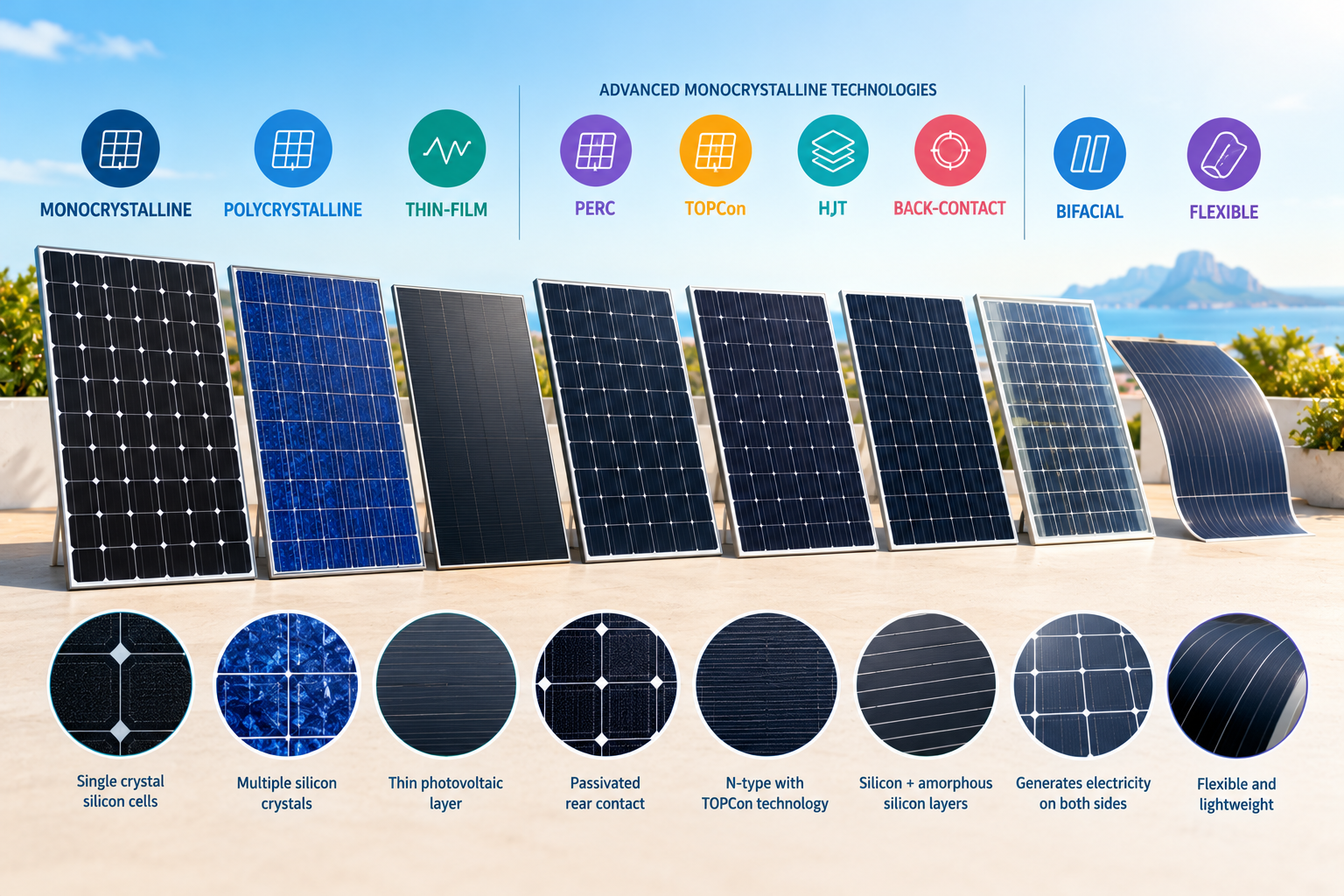
Within crystalline silicon, modern monocrystalline panels use different cell architectures (PERC, TOPCon, HJT, back-contact) that squeeze more power out of the same surface. Today, the typical choice for a home is a monocrystalline panel with PERC or TOPCon cells.
First, a quick refresher: how every solar panel works
All the types below share the same basic mechanism. A solar cell is made of a semiconductor, usually silicon, treated so it has two layers: one with extra electrons and one with “holes”. Where they meet there is an electric field (the P-N junction). When sunlight hits the cell, photons knock electrons loose, the electric field pushes them in one direction, and that flow is direct current (DC) electricity. An inverter then converts it into the alternating current (AC) your home uses. We explain this step by step in our article on how solar panels work.
What changes from one type to another is what the cell is made of and how it is built, which determines efficiency, cost, durability and behaviour in heat and low light.
Types of solar panels by cell material
1. Monocrystalline panels
What they are: each cell is cut from a single, highly pure silicon crystal, which gives them their uniform dark appearance.
How they work: because the crystal structure is continuous, electrons move with less resistance, so more of the light that hits the cell becomes electricity.
Strengths: highest efficiency among silicon panels (modern models commonly reach about 20–24%), best output per square metre, good performance in heat and low light, and long lifespans backed by warranties of 25 years or more.
Limits: usually a bit more expensive per panel than polycrystalline, although the gap has narrowed a lot.
Best for: most homes, especially where roof space is limited.
2. Polycrystalline (multicrystalline) panels
What they are: cells made by melting many silicon fragments together, giving a bluish, speckled look.
How they work: the same photovoltaic principle, but the crystal boundaries inside the cell create more resistance to electron flow, so conversion is somewhat lower.
Strengths: historically cheaper to manufacture.
Limits: lower efficiency (typically around 15–18%) and a larger surface needed for the same power. They have largely been displaced from the residential market by monocrystalline panels, so you will find few new models on offer.
Best for: very low-budget projects with plenty of space, where they are still available.
3. Thin-film panels
What they are: instead of silicon wafers, a very thin layer of photovoltaic material (such as cadmium telluride, CIGS or amorphous silicon) is deposited onto glass, plastic or metal.
How they work: the thin layer absorbs light and generates electricity through the same photovoltaic effect, but with less material and a different structure.
Strengths: light, can be flexible, adapt to curved surfaces, and tolerate heat and partial shade relatively well.
Limits: lower efficiency than crystalline silicon in most commercial versions, so they need much more surface for the same power, and for homes they are rarely the first choice.
Best for: large flat roofs, curved surfaces, and special uses where weight is critical.
Types of monocrystalline cell technology (what’s inside the panel)
When you compare monocrystalline panels, you will see acronyms such as PERC or TOPCon. They describe how the cell is built, and they are the main reason today’s panels are more powerful than those of a few years ago.
| Technology | How it works | Typical advantage |
| PERC | Adds a passivation layer on the back of the cell that reflects light that passed through and reduces electron losses | Mature, reliable, very widespread |
| TOPCon | N-type cell with an ultra-thin tunnelling oxide layer that reduces electron recombination | Higher efficiency and better behaviour in heat; now a dominant technology in new panels |
| HJT (heterojunction) | Combines crystalline silicon with thin amorphous silicon layers | High efficiency and low temperature losses |
| Back-contact (IBC / BC) | All electrical contacts are on the rear of the cell, leaving the front free of shading | Very high efficiency and a clean, uniform look |
In practice: PERC is the proven workhorse, TOPCon is where most of the market is heading, and HJT and back-contact panels are premium options with the highest efficiencies.
Other panel variations you will hear about
- Bifacial panels: capture light on both the front and the rear (reflected from the ground or surface), which can add extra production depending on the installation. They shine on ground-mounted systems and light-coloured or elevated surfaces.
- Half-cut cells: the cells are cut in half, which reduces electrical losses and improves behaviour with partial shading. Most modern panels use this design.
- Flexible panels: very thin and lightweight, used on caravans, boats and curved surfaces. They are not the usual choice for house roofs because of their shorter lifespan.
- Portable folding panels: designed for camping and mobile use, not for fixed installations.
Comparison: which type of solar panel is best?
| Type | Efficiency (orientative) | Cost | Typical use |
| Monocrystalline PERC | ~20–22% | Moderate | Most homes |
| Monocrystalline TOPCon | ~21–23% | Moderate | Homes wanting higher output per m² |
| HJT / Back-contact | ~22–24% | Higher | Limited space, premium projects |
| Polycrystalline | ~15–18% | Low | Few new models available |
| Thin-film | ~10–19% (varies) | Varies | Large roofs, flexible uses |
Efficiency ranges are orientative and vary by manufacturer and model. Always check the datasheet of the specific panel you are offered.
How to choose the right type for your home
- Start from your roof. If space is limited, higher-efficiency panels (TOPCon, HJT, back-contact) get more kilowatts onto the same surface. If you have plenty of space, a standard PERC panel can be the better value.
- Look at the warranty, not just the technology. Compare product warranty (typically 12–15 years or more) and performance warranty (25 years or more).
- Consider your climate. In hot places like the Costa Blanca, a low temperature coefficient matters, since panels lose some output as they heat up.
- Think about the coast. Seaside properties benefit from panels certified for salt-mist resistance.
- Do not choose on efficiency alone. Efficiency and power are different things, and the final price per installed kWp, the inverter and the installation quality matter as much as the panel type. We explain this in our guide to solar panel efficiency.
Frequently asked questions
What are the main types of solar panels?
The main types are monocrystalline, polycrystalline and thin-film. Monocrystalline panels are the most common for homes, and they come in different cell technologies such as PERC, TOPCon, HJT and back-contact.
Which type of solar panel is the most efficient?
Back-contact and HJT monocrystalline panels are among the most efficient commercially available, followed by TOPCon and PERC. Polycrystalline and most thin-film panels are less efficient.
How does each type of solar panel work?
All of them use the photovoltaic effect: light knocks electrons loose in a semiconductor and an internal electric field makes them flow as electricity. The types differ in the material and cell structure, which affects how much electricity they obtain from the same light.
Are monocrystalline panels worth the extra cost?
For most homes, yes, because they produce more per square metre and carry longer warranties. The price gap with other types has narrowed considerably.
What is the difference between PERC and TOPCon?
Both are monocrystalline cell technologies. PERC adds a rear passivation layer to reduce losses; TOPCon uses an ultra-thin oxide layer in an N-type cell, generally giving higher efficiency and better heat behaviour.
Are polycrystalline panels still a good option?
They work well but are less efficient and have been largely replaced in the residential market. If you find one, compare its price per watt and warranty with a monocrystalline alternative.
Which panels are best for the Alicante climate?
High-quality monocrystalline panels with a good temperature coefficient perform well in hot, sunny climates. For coastal properties, check salt-mist certification.
Choosing the right panels with Solarea Tech
Choosing a panel type is only part of the decision: the right choice depends on your roof, consumption and budget. At Solarea Tech we have completed more than 500 installations in the Alicante province, using panels from manufacturers such as JA Solar and LONGi, and we are rated 5.0/5 on Google across more than 129 reviews. We will recommend the technology that makes sense for your property, not the most expensive one.
👉 Request your free quote in English and we will get back to you within 24 hours.
📞 669 34 86 07