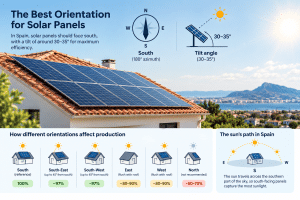
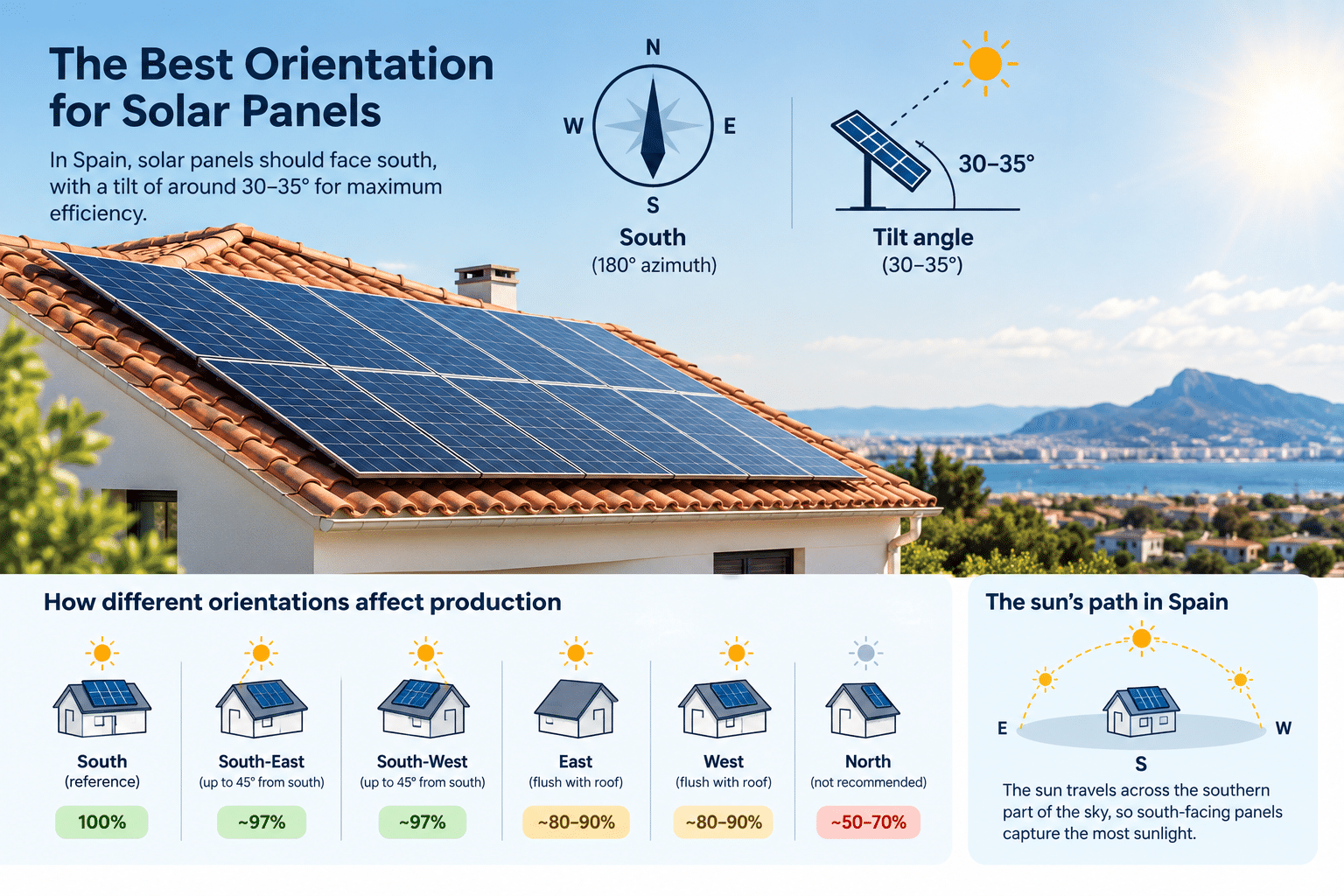
In Spain, solar panels should face south, tilted at roughly 30–35 degrees from horizontal. That combination captures the most sunlight over a full year. But it is not a strict rule: if your roof faces east, west or lies flat, you can still get excellent results, and in some cases a non-south orientation actually fits your electricity use better. This guide explains why south works best, how much you really lose with other orientations, and how to choose the best layout for your own home.
The short answer
- Best orientation: south (azimuth 180°), with no shading.
- Best tilt in Spain: about 30–35° for most of the country. For the Alicante area, around 33–35° is the usual reference.
- Good alternatives: south-east and south-west lose very little. East or west are still worthwhile, especially if your consumption is concentrated in the morning or evening.
- Avoid: north-facing roofs, which produce noticeably less and rarely make financial sense.
Why south is the best orientation in Spain
Spain is in the northern hemisphere, so the sun travels across the southern part of the sky. A south-facing panel sits closest to perpendicular to the sun’s rays during the hours of highest radiation, which is exactly when it can convert the most light into electricity.
Two angles define a panel’s position:
- Azimuth (orientation): the compass direction the panels face. South is 180°.
- Tilt (inclination): the angle between the panel and the horizontal. A flat panel is 0°, a vertical one 90°.
Together, they determine how directly sunlight hits the surface over the course of the day and the year.
What is the best tilt angle for solar panels?
The ideal tilt for yearly production is close to the local latitude, slightly reduced. In practice, Spanish references place the optimum for most of the peninsula between roughly 30° and 40°, with the southern peninsula (Andalucía, Murcia) around 33–34° and the Canary Islands lower, at about 24–29°. For a home in the province of Alicante, around 33–35° is a sound target.
Adjusting the tilt shifts when you produce most:
- A steeper tilt favours winter and the low sun.
- A shallower tilt favours summer production.
If your usage is steady all year, choose the angle that maximises average annual production. If most of your consumption is in summer (air conditioning, pool pumps, holiday homes), a slightly lower tilt can match your needs better.
Do not obsess over the exact degree. Being a few degrees off the optimum has a very small effect on annual output, so there is no need to alter a perfectly good roof just to gain a fraction of a percent.
How much do you lose with east, west or other orientations?
This is the question most homeowners actually care about. Figures from Spanish industry sources point to:
| Panel orientation | Approximate effect on annual production |
| South | Reference (best) |
| South-east / South-west (up to ~45° from south) | Very small loss, around 3% |
| East or West (panels flush with the roof) | Roughly 10–20% lower than south |
| North | Significantly lower; generally not recommended |
These are orientative figures; the real loss depends on your location, tilt and shading. A technician can simulate it for your exact roof.
The key takeaway: a roof that does not face exactly south is not a problem. A 10–20% lower production on an east or west roof can often be compensated with one or two extra panels, and the overall project can still be very profitable.
When east or west can actually be the better choice
Maximum total production is not the same as maximum savings. What matters is how much of your production you use directly, because that energy is worth much more than the surplus you send to the grid.
- West or south-west shifts production toward the afternoon, which suits homes where people arrive in the evening and air conditioning, cooking and appliances peak late in the day.
- East or south-east favours the morning, useful for early-schedule households or businesses.
- East-west split layouts (panels on both sides of a pitched roof) produce a flatter curve across the day: less at noon, more in the morning and evening.
So the best orientation depends on when you consume. If you work away from home all day, an evening-weighted profile can save you more than a perfectly south-facing array that produces its peak at 1 p.m. when nobody is home.
Flat roofs: you choose the angle
On a pitched roof, panels usually lie flush with the surface (a “coplanar” mounting), so the roof’s own slope sets the tilt. On a flat roof, mounting structures let you choose both the tilt and the orientation, so you can aim for south at roughly 30–35°.
There is one trade-off: tilted rows cast shadows on the rows behind them, so they need spacing, which uses more roof area. Some installations use a shallower tilt or an east-west arrangement to fit more panels in a limited space, accepting slightly lower production per panel in exchange for more total power installed.
Shading matters more than orientation
A well-oriented array can underperform badly if part of it is in shade. Chimneys, parapets, water tanks, antennas, trees or neighbouring buildings can reduce production more than the difference between south and east. Before deciding, check which parts of the roof are shaded and at what times of day and year.
Modern equipment can help in difficult cases. Microinverters or power optimizers let each panel (or group of panels) work independently, which is useful when panels face different directions or are partly shaded. This is something your installer should evaluate, rather than an automatic upgrade for every roof.
How about moving panels to follow the sun?
Solar trackers rotate panels to follow the sun and can increase production. In practice, they are mostly used in large ground-mounted solar farms. For homes, the extra cost, moving parts and maintenance rarely justify the gain, so fixed panels with a good orientation are the standard choice.
Other factors that affect efficiency
Orientation is only one piece. For maximum real-world performance, also consider:
- Temperature. Panels lose a little output when they get hot, so good ventilation under the panels and a low temperature coefficient help in hot climates.
- Panel quality and technology. Higher-efficiency panels produce more from the same space. See our guide to the types of solar panels and how each one works.
- Dirt and dust. Regular cleaning keeps production high, especially near roads, farmland or the coast.
- Inverter and system design. A well-matched inverter avoids losses in conversion.
How to choose the right orientation for your home: a quick checklist
- Look at your roof. Which way does each slope face, and how much usable, unshaded area is there?
- Think about when you use electricity. Mornings, afternoons, evenings, summer or all year?
- Compare options. South at 30–35° if available; otherwise south-east, south-west, west or east-west.
- Check shading at different times and seasons.
- Ask for a simulation. A professional study can estimate production for each layout using real data for your location.
Frequently asked questions
What is the best orientation for solar panels in Spain?
South, with a tilt of about 30–35° and no shading. This gives the highest annual production.
What is the ideal angle for solar panels in Alicante?
Roughly 33–35° for maximum yearly output. Small deviations have a very limited effect.
Do solar panels work on a roof that doesn’t face south?
Yes. East- and west-facing roofs typically produce around 10–20% less than south, and south-east or south-west lose only a few percent. Many of these installations are still very profitable.
Is it better to face solar panels east or west?
It depends on when you use electricity. West favours the afternoon and evening, east favours the morning. West suits many households with late-day consumption.
Can I install solar panels on a north-facing roof?
It is generally not recommended because production is much lower. If the only available surface faces north, it is usually better to look for another area, such as a flat roof, a pergola or the ground.
Does the roof tilt matter that much?
Less than people think. A few degrees away from the optimum changes annual production only slightly. Shading usually matters more.
What orientation is best for a flat roof?
South, tilted at around 30–35°. Because tilted rows need spacing to avoid shading each other, some installations use lower angles or east-west layouts to fit more panels.
Find the best layout for your roof with Solarea Tech
Every roof is different, and the best orientation for you depends on your roof, shading and consumption habits. At Solarea Tech we have completed more than 500 installations across the Alicante province, with our own technical team and a 5.0/5 rating on Google across more than 129 reviews. We visit your property, simulate the production of each option and recommend the layout that saves you the most.
👉 Request your free quote in English and we will get back to you within 24 hours.
📞 669 34 86 07 · www.solareatech.com/en
Sources consulted: Selectra – Orientación e inclinación de las placas solares · Repsol – Orientación e inclinación de placas solares