
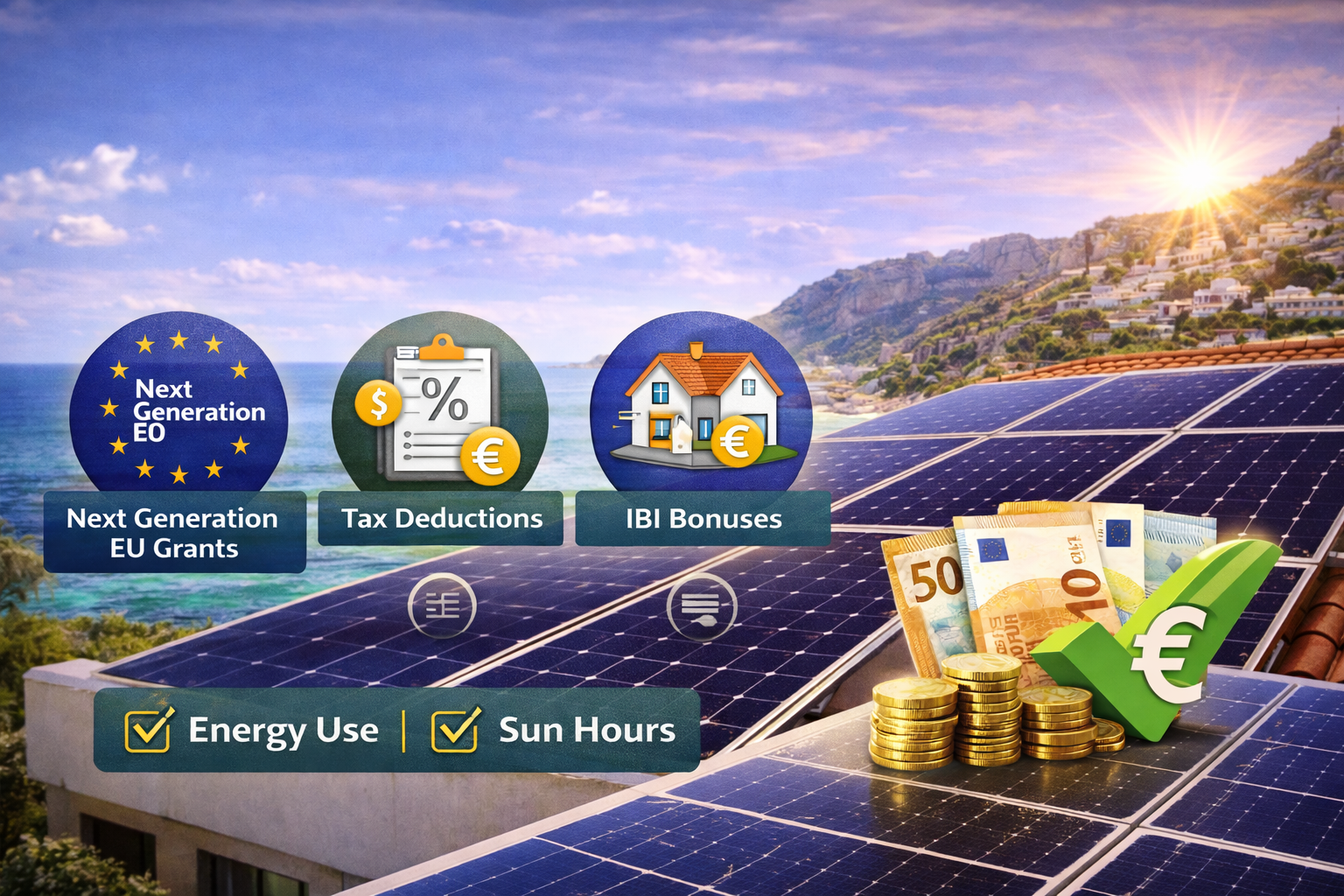
If you are considering installing solar panels in Spain, one of the first questions you will ask is: what financial help is actually available? The answer is more generous than most people expect. Between European grants, national tax deductions, and local municipal bonuses, a typical residential solar installation in Spain can see its net cost reduced by 40 to 85% depending on the incentives you qualify for and how you combine them.
At Solarea Tech, we install solar panels across Alicante and the surrounding province, and managing our clients’ subsidy applications is a central part of what we do. In this guide we break down every government incentive and subsidy available for solar energy in Spain in 2026, with real figures, real eligibility conditions, and a clear step-by-step process so you do not miss a single euro.
Quick Summary: Available Incentives at a Glance
Before diving into the detail, here is every layer of financial support currently available in Spain for residential solar installations:
| Incentive | Amount | Who manages it |
| Next Generation EU grant | Up to €650/kWp installed | Regional energy agency |
| Income tax deduction (IRPF) | Up to 40% of net cost, max €3,000 | Spanish tax authority (AEAT) |
| IBI property tax reduction | 10–50% for 3–5 years | Your municipality |
| ICIO construction tax exemption | 50–95% of the tax (typically 4% of cost) | Your municipality |
| Battery storage grant | Up to €520/kWh of storage capacity | Regional energy agency |
Used together, these incentives transform a €6,000 installation into a net cost of under €2,000 in many cases. We will show you exactly how below.
1. Next Generation EU Grants: Direct Subsidies
The cornerstone of Spain’s solar subsidy programme comes from European Next Generation EU funds, distributed through each autonomous community’s regional energy agency.
How much: Grants typically cover a significant portion of installation costs. These are direct subsidies, money you do not have to repay, applied after installation is complete.
Who qualifies: All property owners in Spain, whether individuals, residential communities, businesses or homeowner associations. The installation must be carried out by a certified installer (such as Solarea Tech) and all equipment must meet European quality standards.
Application process by region:
- Valencian Community: IVACE (Institut Valencià de Competitivitat Empresarial)
- Andalusia: Agencia Andaluza de la Energía / IDAE offices
- Madrid: Comunidad de Madrid energy agency
- Catalonia: ICAEN
- Basque Country: EVE
Applications are submitted after installation is complete. Processing times currently run between 2 and 4 months from application to payment.
Critical point for 2026: Next Generation EU funds operate on a first-come, first-served basis with a limited total budget. Applications submitted later in 2026 face a real risk of the programme being exhausted before they are processed. Acting early is not just advisable, it is financially significant.
Winning strategy: Finance your installation now, apply for the grant immediately after completion, then use the grant money to partially repay your financing. This approach reduces your effective monthly repayment by 40–50% from the moment you receive the funds.
2. Income Tax Deduction (IRPF): Recover Up to 40% of Your Investment
Spanish tax residents can claim a substantial income tax deduction for solar installations that improve their home’s energy efficiency rating.
The 40% deduction: For installations that achieve at least a 30% reduction in primary non-renewable energy consumption, or that improve the home’s energy certificate to an A or B rating, you can deduct 40% of the installation cost from your annual income tax return, up to a maximum deduction of €3,000.
Why solar qualifies: Solar panels directly reduce a home’s dependence on non-renewable energy from the grid, meaning the vast majority of properly designed solar installations automatically qualify for this deduction.
Requirements:
- An official energy performance certificate obtained before installation begins (this is essential, without it, you forfeit the deduction)
- A second energy performance certificate obtained after installation, demonstrating the improvement
- All payments made by traceable means (bank transfer or card, cash payments do not qualify)
How it combines with grants: You calculate the IRPF deduction on your net cost after applying any Next Generation grant.
Example: €6,000 installation, €2,500 Next Generation grant = €3,500 net cost × 40% = €1,400 income tax deduction.
This means the grant and the tax deduction together have reduced your out-of-pocket cost from €6,000 to just €2,100, a 65% reduction.
3. IBI Property Tax Reduction: Ongoing Annual Savings
The IBI (Impuesto sobre Bienes Inmuebles) is Spain’s annual property tax, charged by your municipality. Many Spanish councils offer a reduction of between 10% and 50% on your annual IBI bill for homes with solar installations, applied for a period of 3 to 5 years.
What this means in practice: If your annual IBI bill is €700 and your municipality offers a 50% reduction for 4 years, that is €1,400 in total additional savings on top of everything else.
How to access it: Some municipalities apply the reduction automatically once your installation is registered. Others require a specific application at the town hall. Solarea Tech provides guidance on the exact process for your municipality as part of our installation service.
Timing note: The reduction typically applies from the tax year following installation. An installation completed in 2026 means IBI savings from your 2027 bill onwards.
4. ICIO Construction Tax Exemption
The ICIO (Impuesto sobre Construcciones, Instalaciones y Obras) is a construction tax normally charged at around 4% of the installation cost. Many Spanish municipalities, particularly those with progressive energy policies, exempt solar installations from this tax entirely, or reduce it by 50–95%.
Savings on a typical installation: On a €6,000 system, the standard ICIO would be €240. An exemption saves that amount immediately, at no additional effort on your part.
How to access it: The ICIO exemption is handled during the building permit application process. When Solarea Tech applies for your installation permits, we ensure all applicable ICIO benefits are requested and documented.
5. Battery Storage Grant: Extra Incentive for Energy Independence
If you add a battery storage system to your solar installation, you qualify for an additional specific grant on top of the solar panel subsidy, recognising the role batteries play in maximising self-consumption and reducing grid dependency.
How much: Up to €520 per kWh of storage capacity installed. For a standard 10 kWh home battery, this represents up to €5,200 in additional grant funding, though in practice the approved amount varies by region and available budget.
Combined installation advantage: Installing solar panels and batteries simultaneously allows you to apply for both subsidies in a single process, simplifying the paperwork considerably.
Real example: A 4 kW solar system with a 10 kWh battery costing €10,500 total. With a €2,400 solar grant, a €3,920 battery grant and a €1,640 income tax deduction, the net cost comes to approximately €2,540, less than a quarter of the original price.
6. Surplus Energy Compensation
Once your system is installed and registered, any solar electricity you generate but do not consume is automatically exported to the national grid. Your electricity supplier credits this surplus on your monthly bill at the prevailing surplus compensation rate.
Current rates: Surplus compensation in Spain in 2026 runs at approximately €0.05 to €0.09 per kWh. A typical residential system generates around 500–700 kWh of annual surplus, producing €35–63 per year in bill credits.
This is a more modest benefit than the grants and tax deductions above, but it is ongoing for the full lifetime of your system, 25 to 30 years, and requires no action on your part beyond the initial registration, which Solarea Tech handles as part of the installation process.
Real Cost Example: What Does a Solar Installation Actually Cost After Incentives?
Here is a realistic worked example for a standard residential installation in Alicante in 2026:
Starting point: 5 kW system including installation, permits and monitoring — €6,000
| Incentive applied | Reduction |
| Next Generation EU grant | − €2,500 |
| Income tax deduction (40% of €3,500) | − €1,400 |
| IBI reduction (50% × 4 years × €700/year) | − €1,400 |
| ICIO exemption | − €240 |
| Total net cost | €460 |
That is a reduction of over 90% from the original price — and this is not an exceptional case. It reflects a homeowner who has applied for every available incentive correctly and on time.
Even in a more conservative scenario where the IBI reduction is lower and the Next Generation grant is smaller, it is entirely realistic to bring a €6,000 installation down to a net cost of €1,500–2,500.
The Winning Strategy: Finance + Subsidies Combined
One of the most effective approaches for 2026, and the one Solarea Tech recommends most frequently, is to combine financing with subsidy applications rather than waiting until you have saved the full purchase price.
Why this works:
Installing now means you start saving on electricity bills immediately, typically 50–75% of your current bill. That saving, often €50–80 per month, covers most or all of your monthly financing repayment from day one.
When your Next Generation grant arrives (typically 2–4 months after application), you use it to partially repay your loan, reducing your outstanding balance and your monthly repayment at the same time.
Concrete example: You finance €6,000 at a typical green loan rate over 7 years, monthly repayment approximately €82. Your electricity bill drops by €65/month immediately. Net monthly cost: €17. When your €2,500 grant arrives after 3 months, you repay it early, reducing your monthly payment to around €48, which your electricity savings now more than cover. You are effectively solar-powered for free from month four.
Common Mistakes That Cost Thousands
Not getting the pre-installation energy certificate. This single oversight forfeits your entire IRPF deduction. The certificate must be obtained before work begins. There is no way to claim it retroactively.
Using an uncertified installer. Only certified installers qualify for government incentive programmes. Attempting to save money on installation costs by using an unlicensed operator disqualifies you from all grants and subsidies.
Delaying the subsidy application. Next Generation funds are limited and allocated first-come, first-served. Every week of delay after installation is completed is a week someone else is claiming from the same shrinking budget.
Forgetting municipal incentives. Many homeowners claim the national and regional incentives but overlook the IBI reduction and ICIO exemption at their town hall, leaving hundreds or thousands of euros unclaimed.
Poor tax timing. The IRPF deduction applies to the tax year in which the installation is completed. If your taxable income in that year is low, the full deduction may not be usable. Solarea Tech recommends discussing timing with your tax adviser for high-value installations.
How Solarea Tech Manages Your Incentives
Navigating Spain’s multi-layer subsidy system, with regional agencies, town halls, tax authorities and energy performance certifiers all involved, is genuinely complex. Most homeowners who attempt to manage it alone miss at least one programme, leaving significant money on the table.
At Solarea Tech, subsidy management is not an add-on service. It is a core part of what we do for every installation:
We carry out a full incentive audit before the project begins, identifying every programme you qualify for based on your location, system size and property type. We arrange the pre- and post-installation energy performance certificates with accredited assessors. We submit all subsidy applications on your behalf immediately after installation is complete. We liaise with your municipality regarding IBI and ICIO benefits. And we provide full documentation support for your IRPF deduction in your annual tax return.
Our clients do not need to interact with IVACE, the town hall or any other agency. We handle everything.
Why 2026 Is the Right Year to Act
The combination of Next Generation EU grants, national tax deductions and municipal bonuses currently available in Spain represents an exceptional window for solar investment. But it is not permanent. Next Generation funds are being depleted through 2026 on a first-come, first-served basis. Programme terms and eligibility conditions are reviewed annually. And every month you wait is a month of electricity bills you are paying unnecessarily.
The financial case for solar in Alicante has never been stronger: over 2,850 hours of sunshine per year, electricity prices among the highest in Europe, and subsidies that can reduce your net investment to a fraction of the installation cost.
👉 Contact Solarea Tech for your free incentive assessment
We will identify every grant, deduction and bonus you qualify for, calculate your real net investment after incentives, and show you exactly what your installation will cost, and save, over its 25-year lifetime.