The most common question we hear from homeowners considering solar energy is a simple one: how many solar panels do I actually need? It sounds like it should have a straightforward answer. In reality, it depends on several factors specific to your home — but the good news is that the calculation is not as complicated as it might seem.
At Solarea Tech, we have carried out hundreds of solar installations across Alicante and the surrounding province. In this guide, we walk you through exactly how many solar panels are needed to power a house in Spain, what factors affect that number, and how to get a precise figure for your specific property.
The Short Answer: How Many Solar Panels Does a House Need?
For most homes in Spain, the answer falls within the following ranges:
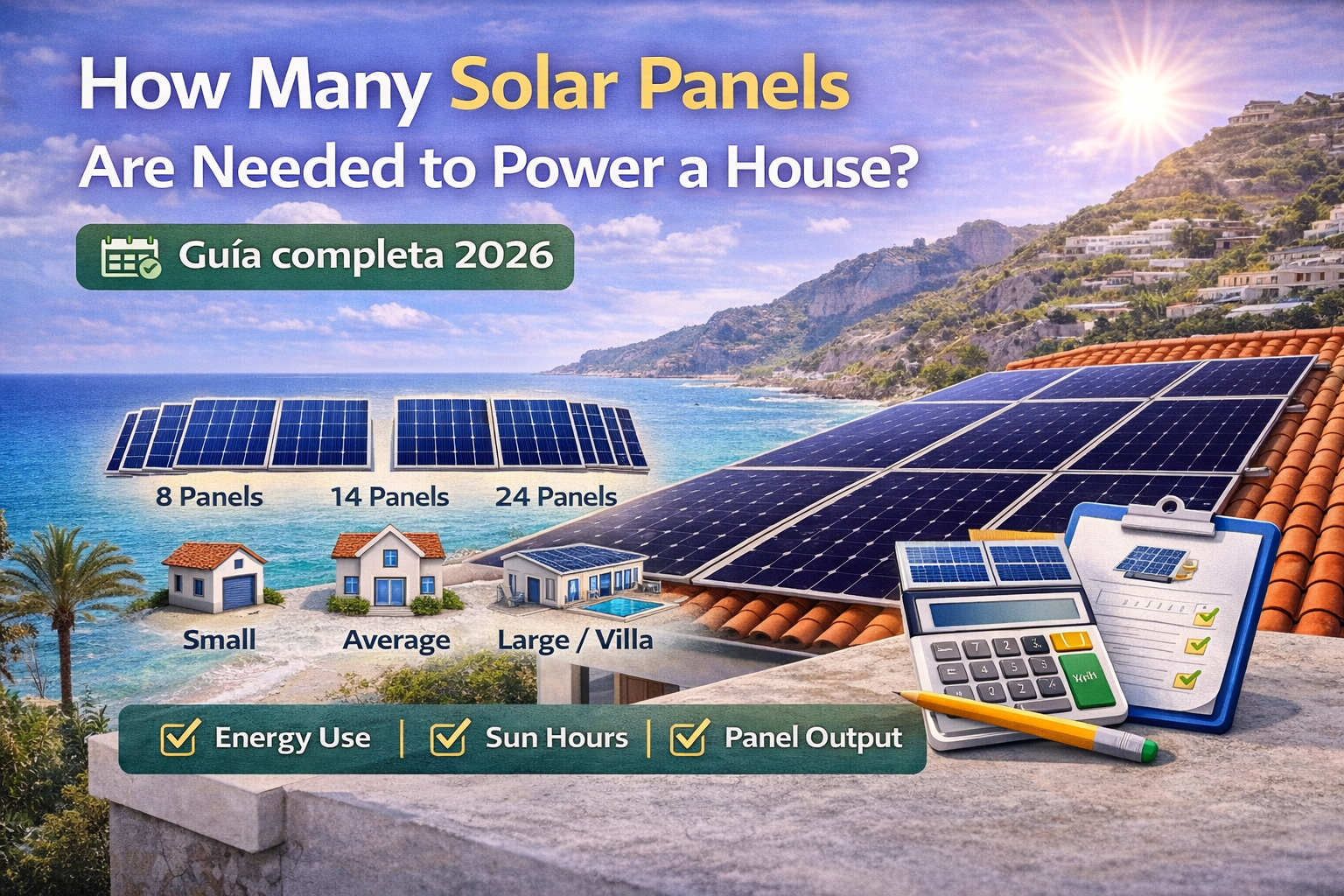
Small apartment or low-consumption home: 5 to 8 panels (2–3 kW system)
Average family home: 10 to 16 panels (4–6 kW system)
Large home or high-consumption property: 18 to 26 panels (7–10 kW system)
These figures are based on standard 400–430W monocrystalline panels, which are the type Solarea Tech installs across all residential projects. If you are unsure where your home falls, keep reading — the section below will help you calculate your specific number.
How to Calculate How Many Solar Panels You Need
The number of panels required depends on three key variables: your annual electricity consumption, the number of peak sun hours at your location, and the power output of the panels being installed.
Step 1: Know Your Annual Energy Consumption
The starting point is always your electricity bill. You are looking for your total annual consumption in kilowatt-hours (kWh). In Spain, this figure appears on your electricity invoice, usually expressed monthly or annually.
As a reference point, average electricity consumption by household type in Spain is approximately:
- Studio or one-bedroom apartment: 1,500 – 2,500 kWh per year
- Two to three-bedroom family home: 3,500 – 5,500 kWh per year
- Large detached house or villa: 6,000 – 10,000 kWh per year
- Home with pool and air conditioning: 8,000 – 14,000 kWh per year
If you have an electric vehicle that you charge at home, add approximately 2,000–3,500 kWh per year on top of your household consumption.
Step 2: Factor in Spain’s Sun Hours
Spain is one of the sunniest countries in Europe, which works significantly in your favour. The Alicante province, where Solarea Tech operates, receives over 2,850 hours of sunshine per year — one of the highest figures in mainland Spain. For calculation purposes, the relevant figure is peak sun hours (PSH), which in Alicante averages approximately 5.2 to 5.5 PSH per day.
To put that in context, a location with more sun hours requires fewer panels to generate the same amount of electricity as a location with less sun. This is why the same home in Alicante needs fewer panels than an equivalent home in northern Spain.
Step 3: Apply the Formula
The basic formula to estimate your system size is:
Annual consumption (kWh) ÷ 365 days ÷ peak sun hours = system size needed (kW)
For example, a family home in Alicante consuming 5,000 kWh per year:
5,000 ÷ 365 ÷ 5.2 = 2.63 kW minimum system size
Adding a 20–25% efficiency margin (to account for losses in the inverter, wiring and temperature), this becomes approximately 3.2 kW, which translates to around 8 panels of 400W each.
This is a simplified calculation. A professional energy study — which Solarea Tech provides free of charge — takes into account your roof orientation, shading, household usage patterns and local grid tariff structure to give a precise and optimised result.
Solar Panels Needed by Home Size in Spain
If you do not have your electricity bills to hand, the following reference table gives a practical starting point based on typical home sizes and consumption patterns in Spain:
50–80 m² apartment:
- Typical consumption: 2,000–3,000 kWh/year
- Recommended system: 2–3 kW
- Number of panels: 5–8
- Estimated installation cost: €3,000–€5,000
100–150 m² family home:
- Typical consumption: 4,000–6,000 kWh/year
- Recommended system: 4–6 kW
- Number of panels: 10–15
- Estimated installation cost: €6,000–€9,000
150–250 m² large home:
- Typical consumption: 6,000–9,000 kWh/year
- Recommended system: 6–8 kW
- Number of panels: 15–20
- Estimated installation cost: €8,500–€12,000
250 m²+ villa or property with pool:
- Typical consumption: 9,000–14,000 kWh/year
- Recommended system: 8–12 kW
- Number of panels: 20–30
- Estimated installation cost: €11,000–€16,000
All cost ranges above are before applying available government subsidies, which in 2026 can reduce your net investment by 40–60%.
Key Factors That Affect How Many Panels You Need
Roof Orientation and Tilt
In Spain, a south-facing roof at a 30–35 degree tilt is the optimal configuration for solar production. If your roof faces southeast or southwest, production reduces by approximately 5–10%, meaning you may need one or two additional panels to compensate. East or west-facing roofs reduce output by 20–30%, which would require a larger system to achieve the same coverage.
Shading
Any shading from chimneys, trees, neighbouring buildings or satellite dishes reduces the output of the affected panels and, in some configurations, the entire system. At Solarea Tech, we carry out a detailed shading analysis before designing every installation to ensure your system is sized correctly for your actual roof conditions.
Panel Efficiency
Higher-efficiency panels generate more electricity from the same surface area. A 430W panel from Aiko Solar or LONGi will produce noticeably more per square metre than a standard 370W panel. This is particularly relevant if your available roof space is limited — using a premium high-efficiency panel means you may need fewer panels overall while achieving the same energy output.
Whether You Are Adding Battery Storage
If you are installing a battery storage system alongside your solar panels, your system design may be slightly larger to ensure the battery charges fully during daylight hours and provides meaningful overnight autonomy. This typically adds 1–3 panels to the system compared to a grid-connected-only installation.
Air Conditioning and Electric Vehicles
Both of these significantly increase consumption and therefore the number of panels required. In Alicante, where air conditioning is used intensively from May through October, factoring in your cooling load is essential for a correctly sized system. An electric vehicle charging at home adds the equivalent of one to two extra panels in terms of the additional generation needed.
Can Solar Panels Fully Power a House?
Yes — but whether they do so 100% of the time depends on whether you have battery storage.
Without battery storage: A correctly sized solar system will cover 60–80% of a typical home’s annual electricity consumption. You will generate surplus energy during sunny daytime hours (which is exported to the grid and compensated financially) and draw from the grid during evenings, overnight and on heavily overcast days.
With battery storage: A solar system paired with a battery can cover 80–95% of annual consumption, providing genuine energy independence for most of the year. In Alicante’s sunny climate, battery-equipped homes can go days at a time without drawing from the grid during spring, summer and autumn.
At Solarea Tech, we assess your usage profile to advise whether battery storage makes financial sense for your specific situation — it is not always necessary, and the decision depends on when you consume most of your electricity during the day.
What Happens to Excess Solar Energy?
In Spain, any surplus electricity your panels generate and do not consume immediately is automatically exported to the national grid. Under the current net metering compensation scheme (compensación de excedentes), your energy supplier credits this surplus against your grid consumption, effectively reducing your bill further.
This means that even if your panels are producing more than you need at midday on a sunny day, that energy is never wasted — it is credited to your account and offsets the electricity you draw from the grid later.
Why Getting the Right Number of Panels Matters
Installing too few panels means you will not cover enough of your consumption to achieve a satisfactory return on investment. Installing too many panels, on the other hand, means you are generating surplus electricity that you cannot use or store, and the excess compensation rate in Spain is lower than the cost of grid electricity — so over-sizing a system without battery storage reduces the financial efficiency of your installation.
This is why a professional energy study is essential before committing to any installation. Getting the number right from the outset maximises your savings and minimises your payback period.
Why Choose Solarea Tech for Your Solar Installation in Alicante
At Solarea Tech we design every installation from scratch based on your specific consumption data, roof conditions and energy goals. We do not apply a one-size-fits-all approach.
Free personalised energy study: We analyse your electricity bills, assess your roof and calculate the exact system size you need before you commit to anything.
Premium panel brands: We work exclusively with Tier 1 manufacturers — Aiko Solar, JA Solar, Jinko Solar, LONGi Solar and Trina Solar — to ensure your panels perform as expected for 25 years or more.
Full project management: From design and installation through permits, grid connection registration and subsidy applications, we handle the entire process.
Subsidy maximisation: We manage all available incentive applications in 2026 to ensure you receive the maximum government support available for your installation.
Local expertise: We operate throughout the province of Alicante, including Elche, Torrevieja, Benidorm, Orihuela, San Vicente del Raspeig and Villena, with deep knowledge of local grid conditions and municipal requirements.