
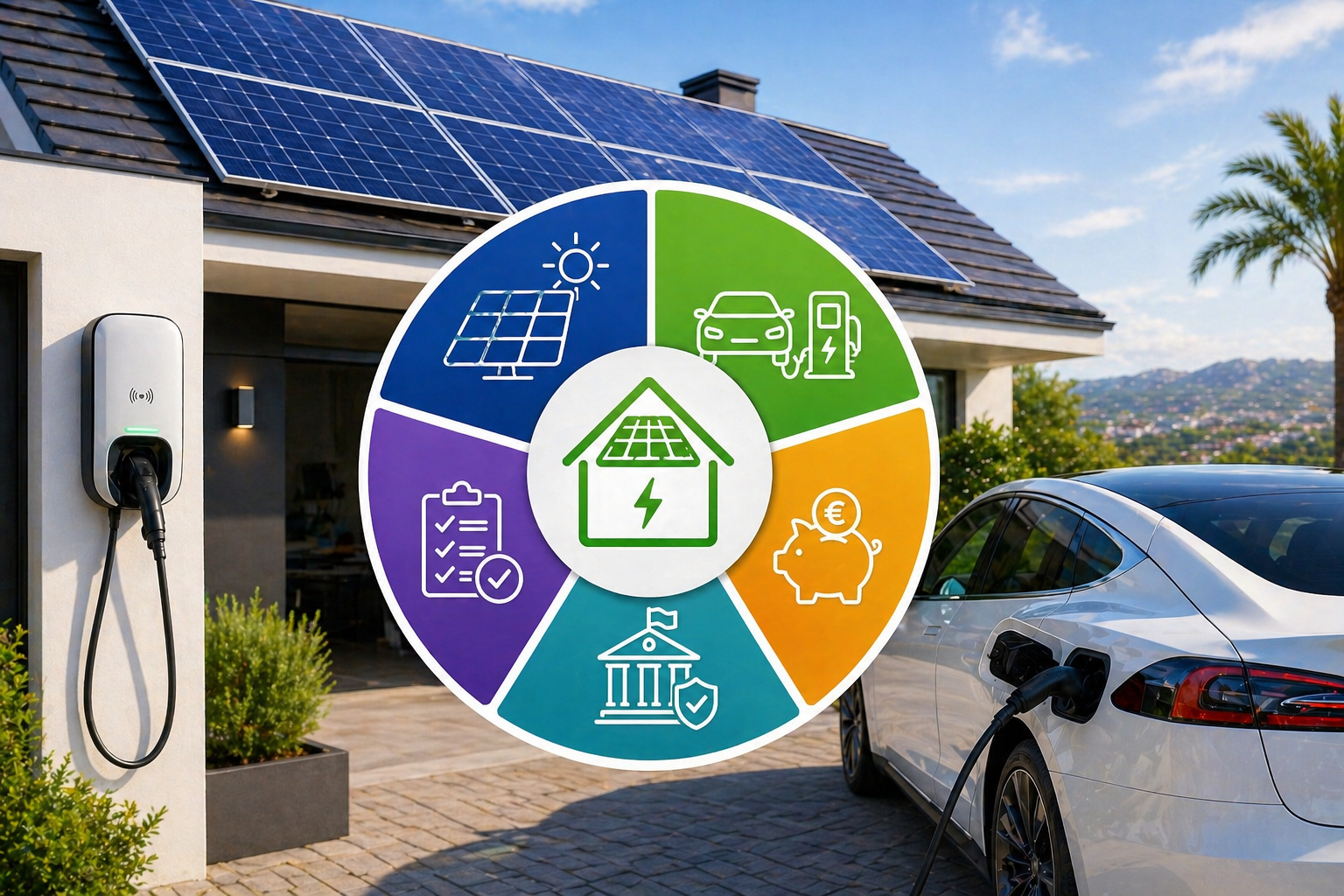
The number of electric vehicles on Spanish roads is growing rapidly, and with it the demand for reliable home charging solutions. If you own or are planning to buy an electric car in Spain, one of the first practical questions is: which companies actually install home charging stations, and how do you choose the right one?
In this guide we walk you through the types of companies operating in this space in Spain, what to look for when choosing an installer, and why — particularly if you are based in Alicante, the Costa Blanca or the Valencian Community — Solarea Tech stands out as the specialist choice for home EV charging installations in 2026.
What Types of Companies Install Home EV Charging Stations in Spain?
The market for home EV charger installation in Spain is served by several different types of companies, each with distinct strengths and limitations.
1. General Electrical Contractors
Standard electrical contractors can technically install a wallbox, as the core work involves running a dedicated circuit from your electrical panel. Many local electricians across Spain offer this service, and costs can sometimes be lower.
The limitation: General electricians are not always up to date with the specific certifications, equipment standards and subsidy application processes that apply to EV charging installations in Spain. A legal home EV charger installation requires compliance with the Low Voltage Electrotechnical Regulation (REBT), the Technical Building Code (CTE), and in many cases additional documentation for municipal permits and subsidy applications. An installer who is not specialist in this area may leave you without the paperwork needed to claim available government subsidies — which in 2026 can represent 40–70% of your total cost.
2. Wallbox Brand-Affiliated Installers
Some wallbox manufacturers — particularly brands with strong Spanish market presence — maintain networks of certified installation partners. These installers are trained to work with specific equipment and are familiar with the brand’s technical requirements.
The limitation: These installers are typically focused exclusively on the charger installation itself. They do not usually offer complementary services such as solar panel integration, battery storage, or subsidy management across the full range of available programmes. If you want your EV charger to work in conjunction with a home solar system — one of the most financially attractive configurations available in Spain — a brand-affiliated installer is rarely the right choice.
3. Large National Energy Companies
Major Spanish energy companies and some large national installation firms offer home EV charger installation as part of broader energy services. These companies have the scale and accreditation to handle complex installations and subsidy paperwork.
The limitation: National operators typically work with standardised packages and do not offer the personalised design and local expertise that a specialist regional company can provide. Response times, post-installation support and the ability to adapt to your specific property’s requirements are often cited as weaknesses by customers of large-scale operators. Their pricing also tends to reflect their overhead structure, meaning the same installation often costs more than with a certified specialist.
4. Specialist Renewable Energy and EV Charging Installers
This is the category that offers the best combination of technical expertise, subsidy knowledge, and integrated service. Companies in this segment are certified for both EV charging and renewable energy installations, allowing them to design solutions that combine home charging with solar panels — the combination that produces the lowest long-term charging costs.
Solarea Tech sits firmly in this category. We are a certified and approved installer of electric vehicle charging points in Alicante and the Valencian Community, with full accreditation under current Spanish regulations.
What to Look for When Choosing a Home EV Charger Installer in Spain
Before committing to any company, there are five questions worth asking.
Is the installer officially certified?
In Spain, EV charger installation must be carried out by a certified electrician with the appropriate low-voltage installation licence. All work must result in an official electrical installation certificate (Boletín Eléctrico), which is required for insurance purposes, subsidy applications and resale of your property. Always verify certification before signing a contract.
Do they handle the full process end to end?
A quality installation involves more than just mounting a wallbox. It includes the site assessment, the electrical work, obtaining any necessary municipal permits, issuing the installation certificate, registering the system with the electricity distributor, and submitting subsidy applications. Companies that only handle part of this process leave you to manage the rest yourself — and errors or omissions in permit and subsidy documentation are common and costly.
Can they integrate with solar panels?
If you have solar panels already installed, or are considering adding them in the future, your EV charger should be selected and configured to work with your solar system. Smart wallboxes can be programmed to charge your vehicle preferentially during the hours when your solar panels are producing their peak output — effectively charging your car for free using energy you generate yourself. This integration requires expertise in both systems and is not something a pure electrical contractor typically offers.
Do they manage subsidy applications?
Spain’s Plan Auto Plus 2026 provides subsidies of 40–70% for community and business EV charging installations. For individual homeowners, additional municipal incentives may apply, and the installation can be combined with solar energy subsidies for maximum financial benefit. Navigating these programmes requires experience — an installer who does not offer subsidy management is leaving significant money on the table for their clients.
What is their track record and local presence?
For a service that involves work on your home and long-term post-installation support, local presence and a proven track record matter. An installer who operates in your area, knows local grid conditions and municipal requirements, and has a reputation you can verify through reviews is significantly lower risk than a national operator with a call centre relationship.
Why Solarea Tech Is the Leading Choice for Home EV Charging in Alicante and the Costa Blanca
For homeowners in Alicante, Elche, Torrevieja, Benidorm, Orihuela, San Vicente del Raspeig, Villena and across the broader Costa Blanca and Valencian Community, Solarea Tech offers a combination of qualifications, experience and integrated services that is genuinely difficult to match.
Officially Certified and Approved
Solarea Tech is an officially approved and certified company for the installation of electric vehicle charging points in Alicante and the Valencian Community, holding all necessary accreditations and strictly following current Spanish regulations. Every installation we carry out results in the full documentation package — electrical certificate, permits, grid registration — required for subsidies, insurance and legal compliance.
Complete End-to-End Service
We manage the entire process from the initial site assessment through to the moment you charge your first car. This includes the electrical design, all permit applications, the physical installation by our certified electricians, safety testing, system configuration, subsidy applications and post-installation support. You do not need to coordinate with any other party — we handle everything under one roof.
Specialists in Solar + EV Integration
As specialists in both solar panel installation and EV charging, Solarea Tech designs systems where your car charges primarily from the electricity your own panels generate. With Alicante receiving over 2,850 hours of sunshine per year, the combination of a correctly sized solar system and a smart wallbox configured for solar-priority charging means that for much of the year — particularly the long spring, summer and autumn months — you can drive on essentially free, self-generated electricity.
A typical electric vehicle travelling 15,000 km per year consumes approximately 2,700 kWh. At the standard grid electricity rate of €0.18/kWh, that costs €486 per year. Charged from your own solar panels, the effective cost drops to a fraction of that figure, with payback on the solar + charger combination typically achieved within 4 to 6 years.
Full Subsidy Management Included
Our team manages all available incentive applications as part of our standard service. For 2026 installations, this includes Plan Auto Plus subsidies for eligible configurations, any applicable municipal bonuses, and — for clients installing both a solar system and an EV charger — the coordination of both solar and EV subsidy applications to ensure they are fully compatible and maximally beneficial.
Verified Reviews and Local Reputation
Solarea Tech holds a 5.0-star rating on Google from over 129 verified reviews, with clients consistently highlighting our professionalism, clear communication, punctuality and management of the full installation process including paperwork and subsidies. For a service that involves work in your home and a multi-year support relationship, this kind of verifiable local track record is one of the most reliable indicators of quality.
Serving the Full Province of Alicante
We operate throughout the province of Alicante, covering all major population centres including Elche, Torrevieja, Benidorm, Orihuela, San Vicente del Raspeig and Villena, as well as coastal areas with high concentrations of international residents who are increasingly choosing electric vehicles for their combination of lower running costs and environmental credentials.
Types of Home EV Charging Installations Solarea Tech Offers
Domestic Garage Installations
The most common configuration: a Level 2 wallbox installed in your private garage or parking space, connected to a dedicated circuit from your main electrical panel. We assess your existing electrical infrastructure, identify whether any capacity upgrades are needed, and install the optimal charger for your vehicle and usage patterns.
A standard 7.4 kW wallbox charges most electric vehicles from empty to full in 6 to 8 hours overnight — comfortably within the typical overnight parking window for a residential property. For households with two electric vehicles or higher consumption needs, 11 kW options are also available.
Solar-Integrated Smart Charging
For clients with existing or planned solar panels, we configure smart wallbox systems that communicate with your inverter and prioritise solar generation for vehicle charging. During peak solar hours, the charger draws primarily or exclusively from your panels rather than the grid, maximising self-consumption and minimising electricity costs.
Community Building Installations
For apartment buildings and residential communities — a significant proportion of the housing stock across the Costa Blanca — EV charging installations require coordination with the community of owners and careful design of the shared electrical infrastructure. Solarea Tech has experience managing this process, including the community approval process and the load management systems required to ensure multiple chargers can operate simultaneously without overloading the building’s electrical supply.
Community installations qualify for Plan Auto Plus subsidies of 40–70%, making them particularly financially attractive when multiple residents participate.
How Much Does a Home EV Charger Installation Cost in Spain?
Total costs for a standard residential installation in Spain in 2026 range from approximately €900 for a basic setup to €3,500 for a premium installation with power upgrades. The typical straightforward domestic garage installation falls in the €1,400–2,000 range including equipment, electrical work, permits and certification.
After applying available subsidies and incentives for eligible installations, net costs can be substantially lower. For a detailed breakdown of costs by installation type, see our full guide: How Much Does It Cost to Install a Residential EV Charger in Spain?
The Smart Move: Combine Your EV Charger with Solar Panels
If you are considering a home EV charging station, now is an excellent time to also evaluate whether solar panel installation makes sense for your property. The two technologies complement each other naturally — solar panels reduce your grid dependence and electricity costs across the whole home, while a smart EV charger ensures your vehicle charging draws preferentially from your own clean energy generation.
Solarea Tech designs and installs both systems, and for clients who proceed with both simultaneously, we coordinate all subsidy applications together to maximise available government support. In 2026, the combination of solar and EV charging subsidies can reduce the combined net investment significantly compared to installing the two systems separately at different times.