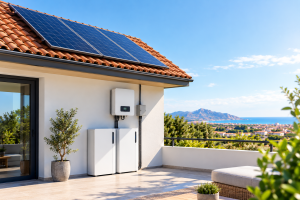
If you are searching for a solar panel 1000 watt, here is the first thing worth knowing: standard residential and commercial panels today top out at roughly 400–700 W each. A single 1000-watt panel for a roof does not exist as a normal product. What people almost always mean is a 1000W (1 kWp) solar system: for example, two 500 W panels working together, or a 1000 W solar kit with controller, battery and inverter. This guide explains exactly what that gives you, how much electricity it produces in Spain, what it can and cannot power, and how to decide whether 1000 watts is enough for your case.
The short answer
- A 1000W solar setup is usually two 500 W panels (or three of around 330–350 W), giving 1 kWp of power.
- In the Alicante area it can produce roughly 3.5–4.5 kWh per day on average (more in summer, less in winter), or around 1,300–1,600 kWh per year with good orientation and no shade. These are orientative values.
- That is enough for a fridge, lighting, electronics and some appliances, but not to run a whole home, and not an air conditioner all day.
- For a typical Spanish home, a 1000W system usually covers a fraction of your consumption; most single-family homes install between 3 and 8 kWp.
What does “1000 watt solar panel” actually mean?
Solar panel power is measured in watts peak (Wp): the maximum output under standard test conditions. People looking for “solar panel 1000 watt” usually mean one of three things:
- A 1 kWp rooftop system. Two 500 W panels plus an inverter, connected to your home and the grid.
- A 1000W off-grid kit. Panels, a charge controller, a battery and an inverter for a cabin, caravan, boat or garden shed.
- A portable or balcony setup with a couple of panels, generally for small loads.
They are very different products. The key is to understand where you will use it, because panel power is only one piece: the inverter, battery and installation define what you can really run.
How many panels make up 1000 watts?
| Panel power | Panels needed for ~1000 W |
|---|---|
| 500 W | 2 |
| 400 W | 3 (1,200 W) |
| 330–350 W | 3 |
| 200 W | 5 |
| 100 W | 10 |
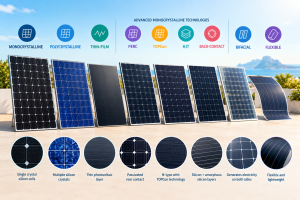
Two high-power panels need less roof space, less structure and less wiring than many small ones, which is why higher-wattage models have become so popular. We explain the trade-offs in our guide to the 500W solar panel.
How much energy does a 1000W solar system produce?
Output depends on location, orientation, tilt, shading and season. As a practical rule in Alicante, where we can count on around 4.5–5 peak sun hours per day, a well-oriented 1 kWp system typically produces:
- About 3.5–4.5 kWh per day on a yearly average.
- More in summer (it can exceed that on clear days) and less in winter.
- Roughly 1,300–1,600 kWh per year.
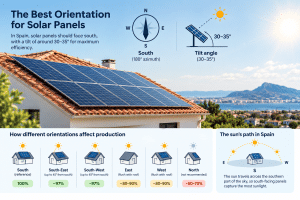
To put it in perspective: a home consuming 4,500 kWh a year would cover about a third of its electricity with 1 kWp. That is why most complete home installations are larger. If orientation is a question mark for your roof, see our article on what orientation solar panels should have for maximum efficiency.
What can a 1000W solar system power?
With about 4 kWh a day, you can cover a daily energy budget like this (typical consumption; check the label of your own appliances):
| Appliance | Typical use | Approx. energy per day |
|---|---|---|
| Efficient fridge | 24 h cycling | 0.4–1 kWh |
| LED lighting | 5 h | 0.1–0.2 kWh |
| TV + router | 5 h + 24 h | 0.3–0.5 kWh |
| Laptop and phone chargers | A few hours | 0.1–0.3 kWh |
| Washing machine | 1 cycle | 0.5–1 kWh |
| Small kitchen appliances | Short use | 0.2–0.5 kWh |
That fits within a 1000W system’s daily production on a sunny day, as long as you do not add heavy, continuous loads. What it generally cannot do is run an air conditioner, electric heating, an electric oven, a water heater, or several of them at once, all day. Our guide on whether a 200W solar panel can run a fridge explains how to do the maths for individual appliances.
Power vs. energy: an important distinction
- Power (W or kW) is how much a device draws at a given moment.
- Energy (kWh) is how much it uses over time.
The panels’ 1000 W tells you how much they can produce at best; the inverter’s rating determines how much you can draw at once; and in an off-grid system the battery’s capacity determines how long you can keep going without sun.
Grid-connected or off-grid?
Grid-connected (self-consumption). Panels feed your home first; any shortfall comes from the grid. No battery is required, and the system uses the grid as backup. In Spain, an installation connected to the grid must be processed and registered under the self-consumption regulations (Real Decreto 244/2019), with a simplified procedure for small installations. A professional installer handles this for you.
Off-grid. You need a battery and a charge controller (preferably MPPT) sized for your consumption, plus an inverter if you want to run 230 V appliances. Off-grid works well for caravans, cabins and remote sites, but it is more demanding to size correctly. For mobile uses, take a look at our guide on solar kit offers for caravans.
How much does a 1000W solar setup cost?
It varies widely depending on what you buy:
- Panels only: at Spanish distributors, higher-power panels in the 500 W range are typically sold at around 90–115 euros per unit as a component price, before inverter, structure, wiring, labour and paperwork. (Prices change frequently, so check current offers.)
- Complete installed system: small systems are usually more expensive per kWp than large ones. As a general market reference, installed residential systems range from about 1,000 to 1,500 euros per kWp, and for a system as small as 1 kWp the final price can land higher because fixed costs (inverter, visit, paperwork) are spread across fewer panels.
- Off-grid kits: the price depends heavily on the battery you choose, which is often the most expensive part.
Because the numbers depend so much on your situation, a personalised quote is far more reliable than any generic price.
Is 1000 watts enough for your home?
Ask yourself three questions:
- What is your annual consumption? Look at the kWh total on your last 12 months of bills.
- How much do you want to cover? A 1 kWp system covers a modest share of a normal home’s usage.
- How much roof space do you have? If space allows, a larger system usually offers a better cost per kWp.
For many homeowners, 1000 W is a starting point rather than an end point. Typical residential installations fall between 3 and 8 kWp, and the economics usually improve when you size the system to your real consumption.
Frequently asked questions
Is there a single 1000W solar panel?
Not as a standard product for homes. Common panels range from roughly 400 to 700 W. A “1000 watt solar panel” usually refers to a system made up of two or more panels.
How many panels do I need for 1000 watts?
Two 500 W panels, or three panels of around 330–350 W, or five 200 W panels.
How much electricity does a 1000W solar system produce per day?
In the Alicante area, around 3.5–4.5 kWh per day on a yearly average, with higher production in summer. These are orientative figures that depend on orientation and shading.
Can a 1000W solar system power a house?
Not entirely. It can cover part of a home’s consumption, such as the fridge, lights and electronics, but not heavy loads like air conditioning or electric heating all day. Most homes install 3 to 8 kWp.
Do I need a battery with a 1000W solar panel system?
Not if it is connected to the grid. For off-grid use you need a battery sized to your consumption.
How much does a 1000W solar kit cost?
It depends on whether it is panels only, a grid-connected system or an off-grid kit with a battery. As a rough reference, installed systems range from about 1,000 to 1,500 euros per kWp, and small systems can cost more per kWp.
Can I install a 1000W system myself?
Off-grid kits are often DIY. A grid-connected installation must comply with electrical regulations and be registered, so it should be handled by an authorised installer.
Get the right size for your home with Solarea Tech
The best system is not the biggest, but the one sized to your consumption, roof and budget. Solarea Tech has completed more than 500 installations across the Alicante province, with our own technical team and a 5.0/5 rating on Google across more than 129 reviews. We analyse your bills, visit your property and recommend the power that makes sense for you, whether that is 1 kWp or more.
👉 Request your free quote in English and we will get back to you within 24 hours.
📞 669 34 86 07