Choosing the right solar inverter is arguably the most consequential technical decision in any home solar installation. Panels get all the attention in marketing brochures, but it is the inverter that determines how much of your solar production actually reaches your home, how well the system handles varying conditions, whether you can add a battery later without replacing everything, and whether you get useful monitoring data on your phone or a black box you cannot understand.
At Solarea Tech we have completed more than 500 solar installations across the Alicante province, and we have installed, replaced, and troubleshot most of the major inverter brands on the market. This guide explains which residential solar inverter brands are top rated in 2026 based on independent global rankings, our real installation data, and the specific requirements of homes in Spain (three phase supply, Mediterranean climate, coastal salinity, and Spanish grid regulations). We will be honest about which brands we install and why, and equally honest about when a different brand might be a better choice.
If you are researching your first solar installation, considering adding a battery to an existing one, or wondering whether to replace an old inverter that is coming to the end of its warranty, this guide gives you the information you need to have a proper conversation with any installer.
The quick answer: our top 6 recommended brands
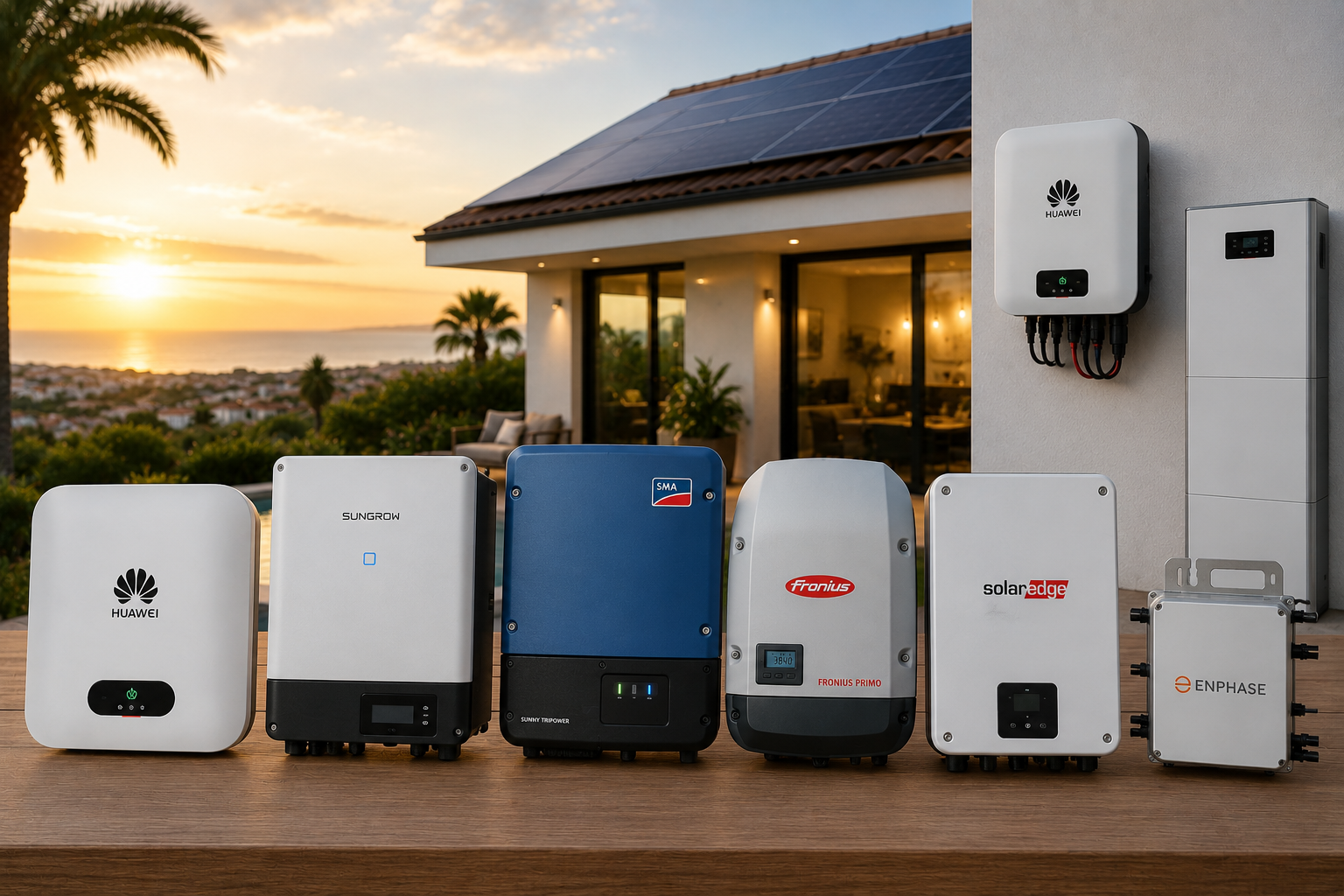
For residential installations in Spain in 2026, based on the current global rankings and our installation experience, these are the brands worth considering:
- Huawei (our primary recommendation for most installations)
- Sungrow (tied with Huawei at the global top)
- SMA (German engineering, top premium option)
- Fronius (Austrian, excellent for European homes)
- SolarEdge (best for complex roofs with heavy shading)
- Enphase (specialist microinverter option)
Every one of these brands has strong financial backing, extensive European operations, and warranties that can be extended to 20 or more years. The choice between them depends on your specific priorities: pricing, monitoring sophistication, shading complexity, warranty length, or country of manufacture.
At Solarea Tech we install Huawei SUN2000 series inverters on the vast majority of our residential projects, for reasons we explain in detail below. But we can and do install other brands when the specific project calls for it.
Why the inverter matters more than most people realise
Before diving into brands, here is why this decision deserves more attention than it typically gets.
A solar panel is a passive device. Sunlight hits it, and it produces DC electricity. There is not much that can go wrong with it under normal circumstances, and the leading manufacturers all produce panels with very similar performance and 25 year warranties.
An inverter is a completely different story. It is an active electronic device that processes every single watt your panels produce, every day, for 15 to 25 years. It handles voltage regulation, frequency synchronisation with the grid, power optimisation across varying light conditions, safety cutouts, battery management, and communication with your smartphone. It is the single most complex electronic component in your solar installation, and if it fails, your entire system stops producing.
Choosing an inverter is therefore choosing a brand that will be around in 15 years to honour its warranty, that provides real support in your local market, that continues receiving firmware updates to fix bugs and add features, and that integrates well with the other components of your system (panels, battery, EV charger).
Getting this decision right pays dividends for decades. Getting it wrong can leave you with an unresponsive company, an outdated system, or a costly replacement.
The Wood Mackenzie 2025 ranking (the reference the industry actually uses)
The most respected independent ranking of solar inverter manufacturers is published by Wood Mackenzie. In their first half 2025 report, the top ten manufacturers globally by market share and technical performance were:
| Position | Brand | Country | Score |
|---|---|---|---|
| 1 | Huawei | China | 93.9 |
| 2 | Sungrow | China | 93.7 |
| 3 | SMA | Germany | (top score) |
| 4 | Fronius | Austria | (top score) |
| 5 | Ginlong/Solis | China | (top score) |
| 6 | GoodWe | China | (top score) |
| 7 (tied) | TMEIC | Japan | (top score) |
| 7 (tied) | SolarEdge | Israel | (top score) |
| 9 | Aiswei/Solplanet | China | (top score) |
| 10 | Enphase | United States | (top score) |
These ten manufacturers together account for 71 percent of the global inverter market. Almost all of them now offer extended warranties of 20 years or more, which reflects the industry’s growing confidence in inverter longevity.
Six of the top ten also have an EcoVadis rating of silver or higher, placing them among the top 15 percent of companies globally for sustainability. And eight of the top ten reinvest more than 6 percent of revenue into research and development, which is why the technology keeps improving year after year.
For residential installations, this ranking is a strong starting point. Brands outside the top ten can be perfectly reasonable choices in some cases, but the risk of ending up with an unresponsive company or a product line that is discontinued is meaningfully higher.
Detailed analysis of the top 6 brands for residential use
Let us look at what each of the top rated brands actually offers for a home installation in Spain.
1. Huawei (our primary recommendation)
Huawei is currently the world’s number one solar inverter manufacturer by Wood Mackenzie’s ranking, and it has held the top position for multiple consecutive years. Their solar division (Huawei FusionSolar) operates independently of the more controversial parts of the Huawei corporate group, and their inverters are certified to all relevant EU standards and installed at scale across Europe, including large national grids.
Residential product line for Spain: the SUN2000 series covers powers from 2 kW to 20 kW, single phase or three phase, standard or hybrid, with or without integrated optimisers.
Strengths:
- Efficiency up to 98.7 percent, among the highest available in residential inverters.
- FusionSolar smartphone app with AI powered diagnostics that detect underperforming panels and predict faults before they cause problems.
- 10 year standard warranty, extendable to 20 years, which is competitive with any brand.
- Hybrid capability built in, so you can add a Huawei LUNA2000 battery later without replacing the inverter.
- Universal panel compatibility: works with panels from any Tier 1 manufacturer.
- OTA firmware updates that keep improving performance without on site visits.
- Excellent performance in hot climates thanks to intelligent cooling systems, which matters for Spanish summers.
- Plug and play installation that installers find efficient and reliable.
Weaknesses to acknowledge:
- Three phase unbalanced export limitations in some configurations.
- Geopolitical concerns for some buyers regarding Chinese ownership, although the solar division operates separately from the telecoms business.
- Aesthetic appeal: some models are visually neutral; if you specifically want a design forward look, other brands may appeal more.
Who it suits best: most Spanish residential installations, from small flats to large villas, particularly homes that value the monitoring quality, want future battery upgradability, and appreciate the strongest global market position.
For a deeper dive into why Huawei tops the rankings, see our dedicated article on the current Huawei inverter ranking (in Spanish).
2. Sungrow (tied at the top globally)
Sungrow is essentially neck and neck with Huawei in the Wood Mackenzie ranking (93.7 vs 93.9). They are less well known to consumers but massively respected among installers, and they have grown their European presence significantly in the last five years.
Residential product line for Spain: the SG-HS series and SH-RT hybrid inverters cover a similar range to Huawei.
Strengths:
- Comparable technical performance to Huawei in most metrics.
- Slightly lower price point than Huawei in some markets, which can make a difference in tight budgets.
- Strong hybrid inverter product line with good battery compatibility.
- 10 year warranty as standard.
- Growing global service network including Europe.
Weaknesses:
- Less mature monitoring platform than Huawei’s FusionSolar, although improving quickly.
- Smaller installer network in Spain, which can affect availability of local support in some regions.
Who it suits best: installations where budget is important without compromising on technical quality, and where the installer has specific experience with Sungrow.
3. SMA (German premium option)
SMA is the German heavyweight of the inverter industry, based in Kassel. They have been in the business since 1981 and are the historical benchmark for reliability and post sales support in the European solar market. Wood Mackenzie has them consistently in the top three globally.
Residential product line for Spain: the Sunny Boy series (single phase) and Sunny Tripower series (three phase), with hybrid versions available.
Strengths:
- Legendary German engineering and reliability.
- Excellent after sales support in Europe, including quick replacement units when needed.
- 10 year warranty extendable to 20 or more.
- Sunny Portal monitoring that has been steadily improved over the years.
- Strong reputation among installers who have worked with them for decades.
- Compatible with a wide range of batteries including third party options.
Weaknesses:
- Higher price point than Chinese competitors for equivalent power.
- App and monitoring, while good, is not as feature rich as Huawei’s FusionSolar for consumers.
- Some supply chain fluctuations in recent years due to global chip shortages.
Who it suits best: clients who specifically want a European made product, value long term reliability above premium features, and are willing to pay a modest premium for it. Popular among some expats who prefer a German brand.
4. Fronius (Austrian premium option)
Fronius is the Austrian equivalent of SMA, with a similar reputation for engineering excellence and long term reliability. Their inverters have a distinctive design and are among the most respected in the European residential solar market.
Residential product line for Spain: the Primo series (single phase) and Symo series (three phase), with the newer GEN24 hybrid series adding battery integration.
Strengths:
- Very high reliability with low failure rates.
- Excellent European service with fast replacement in case of issues.
- Innovative design with the snap in mounting system that installers love.
- 5 year standard warranty extendable to 10 or more with online registration.
- Strong installer network across Europe including Spain.
Weaknesses:
- Recent supply issues on the popular Primo series in some regions.
- Some minor faults reported on newer models, although generally resolved quickly by Fronius.
- Higher price than Chinese competitors.
- Shorter base warranty than most competitors (5 years vs 10 years standard).
Who it suits best: clients who value European manufacturing, have complex three phase installations, or prioritise proven reliability. Popular in premium installations across the Costa Blanca.
5. SolarEdge (specialist for complex or shaded roofs)
SolarEdge is different from the other brands on this list. It is designed around power optimisers: small devices attached to each panel that allow each one to operate at its own maximum output, unaffected by shading or damage to other panels in the string.
Residential product line for Spain: the HD Wave inverters paired with Power Optimizers P Series.
Strengths:
- Best in class handling of partial shading and complex roof orientations.
- Panel level monitoring: see the production of each individual panel on the app.
- 12 year manufacturer warranty, longer than most competitors.
- Very well suited to installations with chimneys, antennas, trees, or partial shading throughout the day.
- Strong US and European presence.
Weaknesses:
- Higher total system cost due to the optimisers on every panel.
- More points of failure than a simple string inverter (one optimiser per panel).
- Financial concerns in 2024 to 2025 as SolarEdge went through business restructuring; check current status before committing to a long warranty.
- Requires SolarEdge specific components, less flexibility for mixing.
Who it suits best: installations on roofs with significant partial shading that cannot be avoided (heritage properties, urban environments with neighbouring buildings, sites with mature trees you do not want to remove).
6. Enphase (microinverter specialist)
Enphase is different again. Instead of a central inverter, Enphase uses microinverters: one small inverter attached to each panel. Every panel independently converts DC to AC before the electricity is combined.
Residential product line for Spain: the IQ8 series microinverters.
Strengths:
- Panel level independence: shading, dirt, or damage on one panel does not affect the others.
- No single point of failure: if one microinverter fails, the rest keep working.
- 25 year warranty on microinverters (longer than most string inverters).
- Easier to expand incrementally by adding a few more panels plus microinverters later.
- Very compact and roof mounted, no wall inverter needed.
Weaknesses:
- Highest total system cost typically, due to one microinverter per panel.
- All the electronics are on the roof, more exposed to weather and heat.
- Battery integration requires additional Enphase specific components.
- Less common in Spain than string inverters, which can affect installer familiarity.
Who it suits best: small residential installations (up to about 6 kWp) where budget is not the main constraint, installations with significant partial shading, and clients who value the panel level redundancy.
Direct comparison: which one for which case?
Here is a decision framework based on the priorities most clients bring to us.
| Priority | Best choice |
|---|---|
| Best overall balance for typical Spanish home | Huawei |
| Best value while maintaining top tier quality | Sungrow |
| Best premium European engineering | SMA or Fronius |
| Best handling of complex shading | SolarEdge |
| Best panel level redundancy | Enphase |
| Best future battery upgradability | Huawei or Sungrow |
| Longest standard warranty | Enphase (25 years) or SolarEdge (12 years) |
| Best monitoring app for end users | Huawei FusionSolar |
| Best in hot Mediterranean climate | Huawei (intelligent cooling) |
For a typical Spanish family home with a straightforward roof and moderate consumption, Huawei is our default choice because it combines everything most people actually need: top tier efficiency, world class monitoring, hybrid capability for future batteries, excellent performance in hot climates, and the strongest global market position.
For a villa with complex partial shading, a Mediterranean home with mature trees or heritage architecture that generates shadows, SolarEdge or Enphase may be worth the additional cost.
For a client who specifically wants European made products and is willing to pay for it, SMA or Fronius are excellent choices.
String inverters, microinverters, hybrid inverters: understanding the terminology
Beyond brand, the type of inverter matters. Here are the four main categories.
String inverters are the most common type used in Spain and across Europe. All the panels connect in a “string” to a single central inverter, which is mounted on a wall (typically in the garage or utility room). This is the standard for most Huawei, Sungrow, SMA, Fronius, and Solis installations.
String inverters with optimisers add a small device on each panel that allows it to operate independently in terms of voltage. The central inverter still does the DC to AC conversion. This is the SolarEdge approach, and Huawei also offers optimisers as an add on for shaded installations.
Microinverters replace the central inverter with a small unit on each panel, converting DC to AC directly on the roof. This is the Enphase approach.
Hybrid inverters are string inverters designed to also manage battery charging and discharging. All the top brands now offer hybrid versions, and we install hybrid Huawei inverters as our default because they let you add a battery later without replacing the inverter.
For a typical Spanish home, a hybrid string inverter is the right choice in the vast majority of cases: it is cost effective, reliable, and futureproofed for batteries. String inverters with optimisers or microinverters are worth the added cost only when partial shading is a specific problem.
What we install and why (full transparency)
To be fully transparent: at Solarea Tech we install Huawei SUN2000 hybrid inverters as our default for the vast majority of residential projects across the Alicante province. Here is our specific reasoning:
- Global ranking: Huawei is number one in the most respected independent ranking (Wood Mackenzie), and has been at or near the top for years.
- Hybrid ready: our clients can add a Huawei LUNA2000 battery later without changing the inverter.
- Mediterranean climate suitability: intelligent cooling handles Spanish summer heat well.
- Monitoring quality: FusionSolar app is genuinely excellent for end users, with AI diagnostics that detect issues before they become problems.
- Warranty and support: 10 years standard extendable to 20, with a growing European service network.
- Panel compatibility: works well with the JA Solar and LONGi panels we install by default.
- Firmware updates: continuous OTA updates keep the system improving.
When we recommend a different brand:
- SolarEdge or Enphase for installations with significant unavoidable partial shading.
- SMA or Fronius if a client specifically requests European manufacturing.
- Sungrow if the budget requires and the technical case fits.
We can and do install any of the top 6 brands mentioned in this article. Our default recommendation exists because for the majority of cases, Huawei is the right answer, but we are not a Huawei only installer.
Common mistakes when choosing an inverter
After 500 plus installations, we see the same errors repeatedly. The five most common:
Choosing based on price alone. A 20 percent cheaper inverter from an unknown brand may save you 500 to 800 € upfront, but if the manufacturer goes bankrupt in year 7 you lose access to warranty support and replacement parts. That is not saving money.
Not choosing a hybrid inverter from the start. Many clients start without a battery to save money, then decide to add one two or three years later, only to discover their inverter is not hybrid ready. Replacing the inverter costs 1,500 to 2,500 € extra. Our default hybrid inverters cost slightly more upfront but save this cost.
Ignoring the monitoring platform. The app you interact with every day matters. Some inverter brands have basic apps that show only production. Huawei’s FusionSolar, SolarEdge’s platform, and Enphase’s Enlighten are all genuinely useful for daily monitoring, alerts, and diagnostic information.
Not verifying the specific model to be installed. Some installers quote “a Huawei inverter” or “an SMA inverter” without specifying the model. There are meaningful differences between models within a brand. Always insist on the exact model number in your quote.
Overlooking the warranty extension option. Almost all top tier brands offer warranty extensions to 15 or 20 years for a modest additional cost. It is worth understanding this option at purchase, when the inverter is easiest to register.
Why work with Solarea Tech for your solar installation
We are a solar engineering company based in San Vicente del Raspeig (near Alicante), serving the entire Alicante province including Torrevieja, Orihuela Costa, Altea, Calpe, Denia, Jávea, Moraira, Benidorm, Elda, Elche, and every coastal and inland community in between.
What sets us apart specifically when it comes to inverter selection and installation:
Technical honesty. Our default is Huawei because our data supports it, but we install other Tier 1 brands when the specific case calls for them. We do not push one brand over another for commercial reasons.
Every quote specifies the exact model. No vague brand references. You know exactly what you are getting before signing anything.
Warranty registration and management. We register your inverter warranty with the manufacturer and manage extension paperwork if you choose it. If a fault occurs later, we handle the warranty claim on your behalf.
Multi brand experience. Between us we have installed and serviced most of the major brands, which means when we recommend Huawei for your case, we are doing so with real comparative experience, not because it is the only one we know.
500+ installations completed across the province with 5.0/5 on Google over more than 129 reviews, several from international clients.
Bilingual Spanish and English service, with an English version of our website and English speaking technical staff.
Warranties up to 25 years on the main components.
For related information, see our companion articles on what are the best solar panel brands for residential use, how many solar panels are needed to power a house, and how much do solar panels cost in Spain.
Frequently asked questions about residential solar inverters in Spain
Is Huawei really the best inverter brand?
Huawei has been at the top of the Wood Mackenzie global inverter ranking for multiple years and it is our default recommendation for most Spanish residential installations. However, “best” depends on your priorities. For complex shaded roofs, SolarEdge or Enphase may be better. For clients who specifically want European manufacturing, SMA or Fronius are excellent alternatives.
Can I trust a Chinese brand for a 20 year investment?
The top Chinese brands (Huawei, Sungrow, GoodWe, Solis, Solplanet) all have strong global market positions, extensive European operations, and financial stability comparable to their European competitors. Chinese ownership per se is not a technical concern. Some buyers still prefer European manufacturers for personal or geopolitical reasons, and that is a valid preference that we respect.
How long does a solar inverter last?
Most residential inverters have a design life of 15 to 20 years. Top brands now offer warranty extensions to 20 years, and many installations continue working well beyond that. Compare this with the 25 to 30 year life of solar panels: the inverter is typically the first component to need replacement in a solar system.
What warranty should I expect on my inverter?
Standard warranties on top brands are 10 years, with extensions to 15 or 20 years available at reasonable cost. Fronius has a 5 year base warranty (extendable). SolarEdge and Enphase have longer standard warranties (12 and 25 years respectively). Always register your inverter for the extension when it is purchased.
Should I choose an inverter with an optimiser?
Only if you have significant partial shading that cannot be avoided. For a clean roof with good orientation and no shading, optimisers add cost without meaningful benefit. For a roof with intermittent shadows from a chimney, tree, or neighbouring building throughout the day, optimisers can significantly increase annual production.
Should I get microinverters instead of a string inverter?
Microinverters are worth considering for small installations (up to about 6 kWp) with complex shading, or for clients who highly value the panel level redundancy. For most standard installations in Spain, a hybrid string inverter is more cost effective.
Can I install a solar panel of brand X with an inverter of brand Y?
Yes, in the vast majority of cases. Top tier panels and top tier inverters are designed to be interoperable with any Tier 1 counterpart. We work primarily with JA Solar and LONGi panels paired with Huawei inverters, but Huawei inverters work equally well with Jinko, Canadian Solar, REC, and other Tier 1 panels.
What happens if my inverter fails after the warranty ends?
You have three options: repair the existing unit if the fault is minor and parts are available, replace with a new inverter of the same brand and family (typically compatible with your existing system), or upgrade to a hybrid inverter to add a battery at the same time. We provide replacement quotes and can manage the transition seamlessly.
Does the inverter brand affect subsidies in Spain?
No. The Generalitat Valenciana subsidy, MOVES III, and other Spanish programmes require certified installation by an authorised company. They do not restrict inverter brands provided the equipment meets CE certification standards. All the brands mentioned in this article are fully compliant.
How do I monitor my inverter from abroad?
All the top brands offer WiFi enabled inverters with smartphone apps that work internationally. Huawei’s FusionSolar, SMA’s Sunny Portal, Fronius Solar Web, SolarEdge’s app, and Enphase’s Enlighten all provide real time production data from anywhere in the world. Particularly useful for second home owners and non resident clients.
Get expert advice for your specific case
Choosing the right inverter for your home is a decision that depends on your roof, your consumption pattern, your budget, your future plans (battery, EV, expansion), and your specific priorities. The right answer is not the same for every house, which is why our assessment is personalised and takes all of these factors into account.
If you are considering a solar installation and want expert guidance on the right inverter brand and model for your specific case, we offer a free, no obligation assessment that includes:
- Analysis of your recent electricity bills.
- Site visit and roof assessment.
- Recommendation of the right inverter model based on your case.
- Comparison with alternative options if relevant.
- Full quote with Tier 1 components and transparent itemised pricing.
- All applicable subsidies and tax deductions calculated for your case.
- Remote management plan if you are not based in Spain full time.
👉 Request your free assessment in English and we will get back to you within 24 hours.
For related reading, see our guides on what are the best solar panel brands for residential use, what is solar energy and how does it work, how many solar panels are needed to power a house, and how much do solar panels cost in Spain.