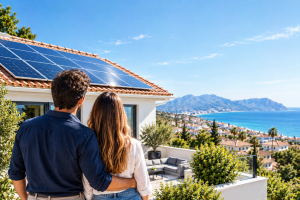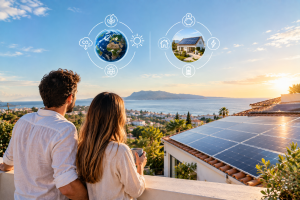
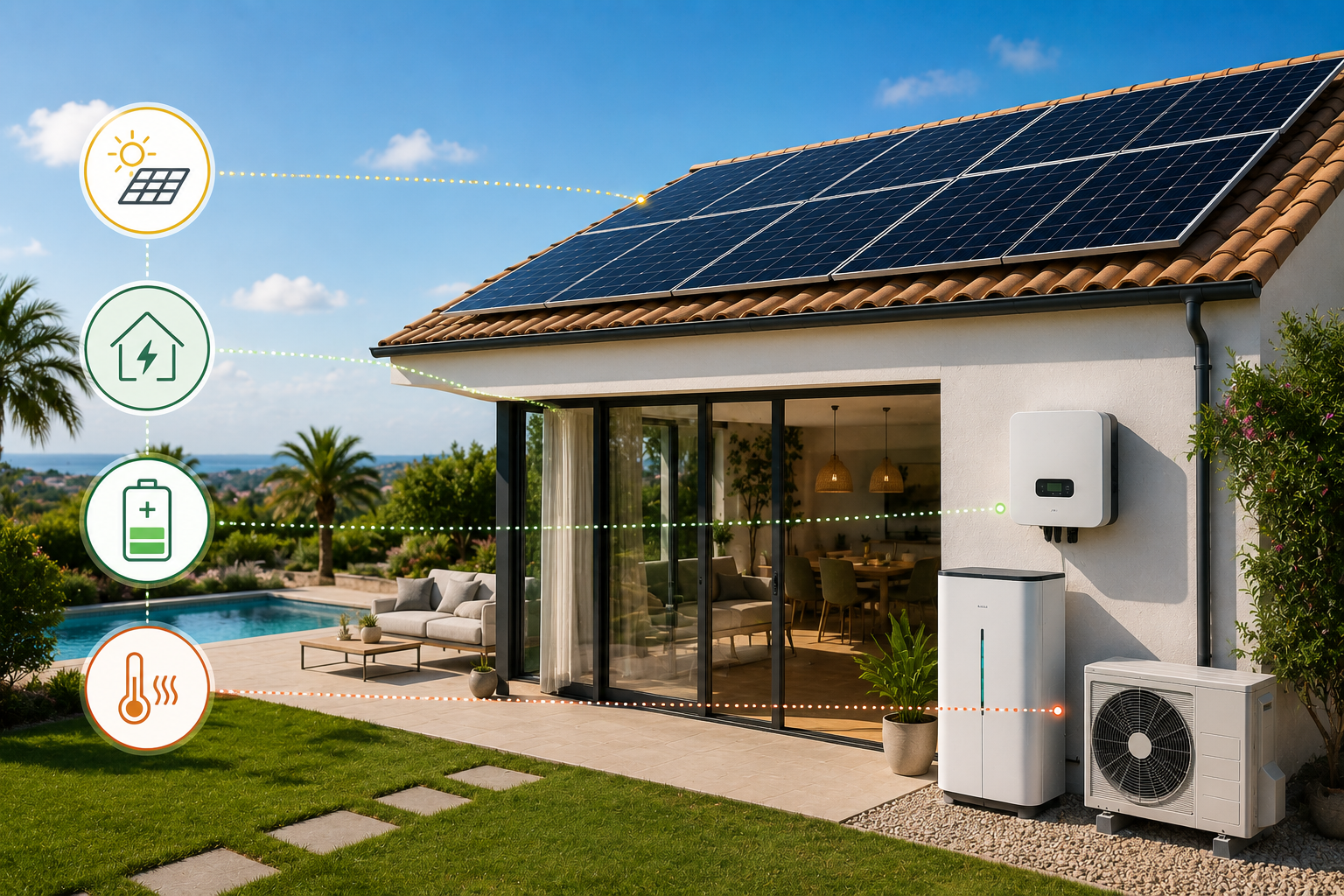
You have probably heard the term solar energy thousands of times. It comes up in news headlines, in conversations about climate change, in marketing brochures about home renovations, and almost certainly in the property listings of any Spanish villa you have looked at recently. But what does it actually mean? How does sunlight, something that has been falling on roofs for millions of years, suddenly become the electricity that runs your washing machine, your air conditioning, and (increasingly) your electric car?
In this 2026 guide we explain in plain English what solar energy is, the different ways it can be used, how a residential photovoltaic system actually works step by step, and why Spain (particularly the Costa Blanca) is one of the best places in Europe to take advantage of it. No jargon, no marketing fluff, no false promises. Just a clear picture of what you are dealing with so you can decide whether it makes sense for your home.
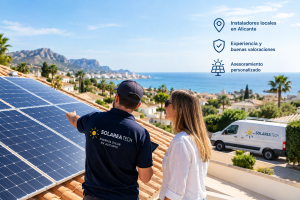
At Solarea Tech we have completed more than 500 solar installations across the Alicante province for both Spanish families and international residents. We have answered this exact question hundreds of times, and we know that the difference between understanding it well or not understanding it at all changes the quality of every later decision you make.
The simple definition
Solar energy is the energy that comes from the Sun, in the form of light and heat. The Sun radiates an enormous amount of energy every second, and a small fraction of it reaches the surface of the Earth. We have always used some of that energy passively (to dry clothes, to warm rooms, to grow crops), but in the last few decades we have learned to capture and convert it efficiently into the two things modern homes need most: electricity and hot water.
When you hear people talk about “solar energy” in a residential context, they almost always mean one specific use of it: converting sunlight into electricity through photovoltaic panels, which is then used at home to power lights, appliances, air conditioning, charging points, and everything else on a normal electricity meter.
The two main types of solar energy
Although both come from the Sun, there are two fundamentally different technologies that capture solar energy for practical use. It is worth understanding the distinction because they solve different problems.
Photovoltaic solar (the one that powers your home)
Photovoltaic (often shortened to PV) is the technology that converts sunlight directly into electricity. It uses panels made of silicon cells that react to sunlight by producing an electric current. The electricity generated runs through an inverter, which transforms it into the type of current your home uses, and from there it goes to your appliances, to a battery if you have one, or to the grid as surplus.
This is the technology that powers the vast majority of residential and commercial solar installations in Spain today, and the one you will almost certainly be looking at if you are thinking of installing solar panels at home. Spain is currently the third largest producer of solar electricity in the European Union, behind only the Netherlands and Germany, and the number of residential installations has multiplied many times over in the last five years.
Solar thermal (for hot water and heating)
Solar thermal is the older of the two technologies. Instead of producing electricity, it uses panels (called collectors) to capture the heat of the Sun and transfer it to water or another fluid. The hot water is then stored in a tank and used for showers, taps, washing dishes, or to support a heating system.
Solar thermal is highly efficient at what it does (producing hot water), but it is less flexible than photovoltaic because it does not generate electricity. You cannot run your fridge with solar thermal. For that reason, most modern homes in Spain today choose photovoltaic as their primary solar technology, sometimes complemented by an aerothermal heat pump for hot water and heating.
There is also a third category, concentrated solar power (CSP), which uses large mirrors to focus sunlight onto a receiver and generate electricity at industrial scale. This is used in big solar power plants but not in homes, so we will not cover it here.
How solar energy actually works step by step at home
Let us walk through what happens, every second, in a residential solar installation when the Sun is shining on your roof.
Step 1: sunlight reaches the panels
Each solar panel contains photovoltaic cells made primarily of silicon, the same material used in computer chips. When sunlight hits these cells, the photons (the particles of light) energise the electrons in the silicon, knocking them loose. This is called the photovoltaic effect, and it was first observed in 1839 by the French physicist Edmond Becquerel.
The energy that reaches the panels varies during the day (more at midday, less in the early morning and late afternoon), during the year (more in summer, less in winter), and according to your geographic location. On the Costa Blanca, we receive between 1,700 and 1,800 kWh per square metre per year of solar irradiation, which is one of the highest figures in Europe.
Step 2: the cells produce direct current (DC) electricity
The loose electrons in the photovoltaic cells move in a controlled way through the cell’s structure, producing an electric current in direct current (DC) form. Each cell on its own produces a small amount of electricity, but a panel contains many cells connected in series, and a residential installation typically connects several panels together to produce a meaningful amount of power.
In a standard 2026 residential installation, each panel is around 450W to 500W of nominal power, and an average system might have 8 to 14 panels, giving a total nominal power of 3.6 to 7 kW.
Step 3: the inverter converts DC into AC electricity
Your home appliances do not use direct current. They use alternating current (AC) at 230V and 50Hz, which is the standard Spanish (and European) household voltage. So between the panels and your home, there is a piece of equipment called an inverter that converts DC into AC.
The inverter is, in many ways, the brain of the whole installation. It does much more than just convert the current. It also:
- Optimises the production of each panel under varying light conditions.
- Manages the connection with the grid (for surplus and backup).
- Manages a battery if you have one.
- Provides monitoring data that you can see on your smartphone.
- Includes safety features like the “anti-island” protection that disconnects the system in case of a grid outage.
At Solarea Tech we install Huawei hybrid inverters by default, which are ranked first in independent global manufacturer ratings and are prepared for adding a battery later without changes.
Step 4: the electricity goes to your home (or somewhere else)
Once converted to AC, the electricity from your panels enters the same circuit as the electricity from the grid. From here, it goes to one of three places depending on the moment:
To direct consumption, if your home is using electricity at that very moment. The fridge, the lights, the air conditioner: everything that is on right now uses the solar electricity first, before pulling anything from the grid.
To a battery, if you have one and it is not fully charged. The battery stores the surplus for later, typically for use during the evening or at night.
To the grid as surplus, if your panels are producing more than your home is using and your battery (if any) is full. In Spain, you can have a contract for surplus compensation: the energy you send to the grid is paid for as a discount on your bill, up to the limit of what you pay for the energy you draw from the grid.
The brilliance of the system is that all this happens automatically. You do not have to manage anything. The inverter and the meter handle the flow of electricity continuously, prioritising what makes economic sense for you.
Step 5: monitoring everything from your phone
Modern installations include real time monitoring through a smartphone app. You can see how much your panels are producing right now, how much your home is consuming, what is going to (or coming from) the grid, and the state of charge of your battery if you have one.
This is particularly useful for second home owners or non resident clients. Even when you are in your home country, you can check that your Spanish installation is working as expected.
Why solar energy makes particular sense in Spain
Three facts make Spain (and especially the Costa Blanca) an exceptional location for residential solar.
More than 2,800 hours of sunshine per year. The Alicante province enjoys around 320 days of sunshine a year, one of the highest figures in Europe. By comparison, London averages around 1,650 hours of sunshine per year, Amsterdam around 1,700, and Oslo around 1,700. A panel installed in Alicante produces between 40 and 50 percent more electricity per year than the same panel installed in northern Europe.
Solar irradiation between 1,700 and 1,800 kWh per square metre per year. This is comparable to the best locations in Andalusia, southern Italy, or even parts of north Africa. It means that even a modest installation produces a lot of electricity.
Mature regulatory framework. Spain dropped the controversial “sun tax” on residential self-consumption in 2018, and since then the legal environment for installing and benefiting from solar has improved every year. Subsidies are available from the autonomous communities (in Valencia, up to €3,000 per residential installation), tax deductions on personal income are in place, and several town councils apply property tax reductions for homes with solar.
The combination of plentiful sunshine, fair pricing, and active incentives makes solar one of the most rentable investments a Spanish homeowner can make today. Payback periods on the Costa Blanca are typically 5 to 7 years, after which you have 18 to 25 more years of essentially free electricity.
What solar energy actually does to your home and your bill
In plain terms, here is what changes in a typical home after installing solar panels:
Your electricity bill drops by 50 to 90 percent, depending on system size, your consumption pattern, and whether you add a battery. A typical Spanish home with a moderate consumption can expect to save €600 to €1,800 per year on the electricity bill.
You become resilient to electricity price spikes. When wholesale prices rise (which they regularly do, due to geopolitics, gas prices, or fiscal changes), your panels keep producing at the same cost (effectively zero). You only feel the rise on the portion of consumption you still take from the grid.
Your property value increases. Homes with solar installations sell on average for 4 to 6 percent more than equivalent properties without. On the Costa Blanca property market, where international buyers actively value energy efficiency, this can mean several thousand euros at sale time.
Your carbon footprint drops significantly. A typical home with solar avoids around 1.5 to 2.5 tonnes of CO2 emissions per year, compared to taking the same electricity from the grid.
You gain energy independence, particularly if you add a battery. You produce, consume, and store your own energy. The grid becomes a backup rather than your main source.
Limitations you should know about
For balance, here are the genuine limitations of solar energy at home.
Panels do not produce 24 hours a day. They produce during daylight, with peak production around midday. Without a battery, you still take electricity from the grid at night.
Production is seasonal. Summer produces much more than winter. A well designed system accounts for this by sizing appropriately for the lower months and benefiting from surplus compensation in the higher months.
Initial investment is real, although ayudas significantly reduce the net cost. A typical residential installation costs €6,000 to €8,500 before subsidies and tax deductions. After applying them, the net cost can be substantially lower.
You need suitable roof or surface. South facing is best, east or west is acceptable, north facing is poor. Shading from trees, chimneys, or neighbouring buildings reduces production unless managed with optimisers like TIGO.
Coastal installations need salt resistant equipment. This is not a problem if specified correctly from the start (panels with IEC 61701 salt mist certification, anodised aluminium structures), but it can become a problem if cheap materials are used.
Common myths about solar energy
After 500 plus installations, we have heard most of the myths. Here are the ones worth dispelling.
“Solar panels don’t work on cloudy days.” They produce less, but they do produce. Diffuse light (the kind you get on cloudy days) still triggers the photovoltaic effect. Modern panels generate around 10 to 25 percent of their peak output on overcast days.
“Solar panels stop working in winter.” Not at all. They produce less than in summer, but on the Costa Blanca winter production is still substantial. December typically gives around 60 to 70 percent of June production. Annual averages already account for the seasonal variation.
“Panels need constant maintenance.” They need very little. A periodic cleaning (more frequent in coastal areas due to salt and dust) plus an annual technical check is enough for most installations. There are no moving parts and no consumables.
“You make money selling electricity to the grid.” Not really. Spain has a system of “compensation of surplus”, which discounts the value of the surplus from your bill, not a system that pays you cash. The compensation cannot exceed what you consume from the grid in the same period. The savings come from not buying electricity, not from selling it.
“Solar panels damage the roof.” Properly installed panels protect the section of roof they cover and last 25 to 30 years. The mounting structures we use (Novotegra, designed for European roof types including the Spanish clay tile) are non invasive and certified for European standards.
“Solar panels are made with toxic materials and are not really green.” Modern panels are made primarily of silicon (essentially refined sand), aluminium, glass, and copper. There are some specialised materials in small quantities. Studies consistently show that the energy “debt” of a panel (the energy used to manufacture it) is repaid in 1 to 3 years of operation, after which it is producing clean electricity for 22 to 28 years.
Why work with Solarea Tech for your solar installation
We are a solar engineering company based in San Vicente del Raspeig (near Alicante), serving the entire Alicante province including Torrevieja, Orihuela Costa, Altea, Calpe, Denia, Jávea, Moraira, Benidorm, and every community in between.
What sets us apart, particularly for international and second home clients:
Bilingual Spanish and English service, with a fully English version of our website and English speaking technical staff who can guide you through every step of the project.
Tier 1 components only: panels by JA Solar (500W three-phase systems) and LONGi, inverters by Huawei (the world’s leading manufacturer by independent ranking), mounting structures by Novotegra including specific designs for Spanish clay tile roofs, and TIGO shade optimisers where partial shading is a factor.
Salt mist certified equipment for coastal homes, with anodised aluminium or stainless steel mounting structures and panels certified to IEC 61701.
Two service formats: comprehensive installation (we supply and install everything) or installation of solar kits you have purchased on your own (we install, configure, and legalise systems you bring). This is a less common service that we offer specifically because we believe in the technology, not just in selling it.
Complete project management including site visit, technical design, council permits, installation, grid connection, and subsidy applications.
Remote management option if you are not based in Spain full time. We coordinate everything while you are abroad, with digital signatures and English communication throughout.
500+ installations completed across the province, with 5.0/5 on Google over more than 129 reviews, several from international clients.
Warranties up to 25 years on the main components.
To see our service for residential clients in detail, visit our page on self-consumption solar installation for homes, or our specific page for solar panel installation across the Costa Blanca.
Frequently asked questions about solar energy
Is solar energy the same as solar power?
Almost. Solar energy is the general term for the energy that comes from the Sun. Solar power specifically refers to the electricity produced from solar energy (through photovoltaic panels or concentrated solar plants). In everyday conversation, the two are often used interchangeably.
Does solar energy work at night?
No. The panels need sunlight to produce electricity. However, if you have a battery, the electricity produced during the day is stored and used at night. Without a battery, your home takes electricity from the grid after sunset.
How long do solar panels last?
Quality panels from Tier 1 manufacturers (JA Solar, LONGi, and similar) come with 25 to 30 year performance warranties, guaranteeing at least 87 percent of original output at year 25. In practice, well maintained installations on the Costa Blanca often perform at 90 percent or more of their original output at the 25 year mark.
Is solar energy really clean if panel manufacturing pollutes?
Yes. The manufacturing process does have an environmental footprint, but the energy “debt” of a panel is repaid in 1 to 3 years of operation. For the remaining 22 to 28 years of its life, the panel produces clean electricity. The lifetime carbon footprint per kWh produced by solar is 25 to 50 times lower than for fossil fuel electricity.
How much electricity can solar energy actually replace at home?
Without a battery, typically 50 to 65 percent of your annual consumption. With a battery, 80 to 90 percent. With a battery and active management of consumption (shifting laundry, dishwasher, EV charging to daylight hours), up to 97 percent.
Can I use solar energy for hot water and heating?
Yes, although the most efficient modern approach is to install photovoltaic panels plus an aerothermal heat pump, rather than separate solar thermal collectors. The PV produces electricity, the heat pump uses that electricity to produce hot water and heating with very high efficiency. This combination is the standard for modern energy efficient homes in Spain today.
What is the difference between solar energy and solar self consumption?
Solar energy is the general concept (energy from the Sun). Self consumption is a specific way of using solar energy, where you generate electricity on your own property for your own use, rather than buying it all from the grid. Most residential solar installations in Spain today are self consumption installations.
Will solar panels work for my type of roof?
Almost certainly yes. We install on flat roofs, inclined tile roofs (both modern and traditional Spanish clay tile), metal roofs, sandwich panels, and pergolas. The mounting structures and methods vary, but a competent installer can find a solution for nearly any roof type.
Do I need permission to install solar in Spain?
For standard residential installations connected to the grid, normally a declaration responsible (a kind of light permit) is enough. In protected historic centres (parts of Altea old town, for example) additional patrimonial approval may be needed. We handle the whole process with the local council on your behalf.
What happens if I sell my property?
The solar installation transfers with the property as part of the building. It typically increases the property value by 4 to 6 percent, and any active IBI tax bonifications continue benefiting the new owner until they expire.
Start producing your own clean energy
Solar energy is no longer an experimental technology or a luxury for environmental enthusiasts. It is a mature, proven, profitable way to generate the electricity your home needs, with payback in a few years and decades of essentially free production after that. Particularly in a country like Spain, with more sunshine than almost anywhere else in Europe.
If you would like to know how solar energy would work specifically for your home, your consumption, and your roof, we offer a free, no obligation assessment that includes:
- Analysis of your recent electricity bills.
- Solar production simulation for your exact location.
- Quote with Tier 1 components and full warranty information.
- Subsidies and tax incentives applicable to your case.
- Remote management plan if you are not based in Spain full time.
👉 Request your free assessment in English and we will get back to you within 24 hours.
For related reading, see our guides on how many solar panels are needed to power a house and why your electric bill is so high in Spain.