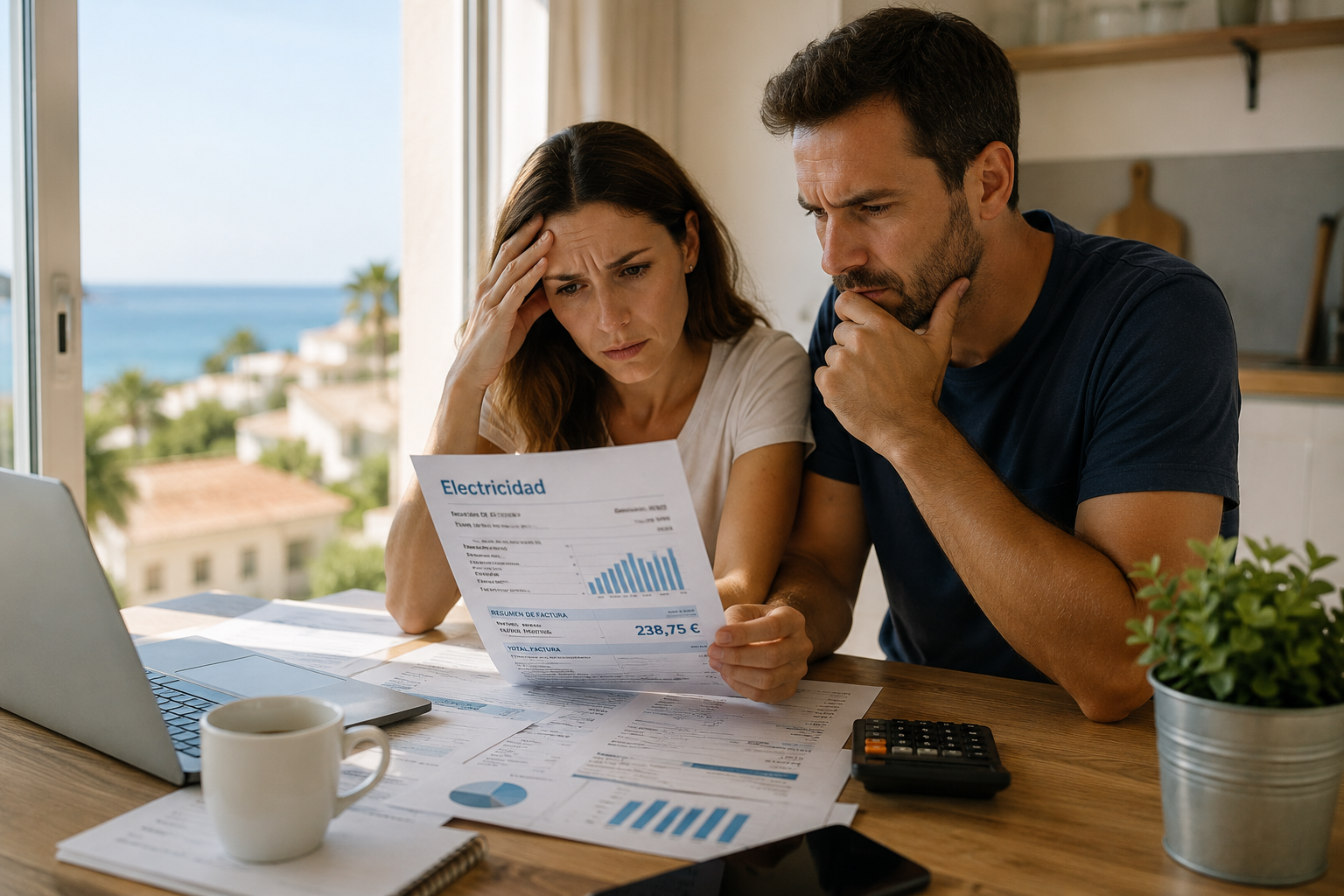
Spain is one of the sunniest countries in Europe, with more than 2,800 hours of sunshine a year along the Costa Blanca. It is, in fact, the third-largest solar electricity producer in the European Union, behind only the Netherlands and Germany. So when newcomers open their first Spanish electricity bill especially British, Dutch, German, Belgian, Norwegian or Irish residents who have just moved to Spain or own a holiday home here the most common reaction is a frowning question: “Why is my electric bill so high in Spain?”.
If you are asking yourself the same, you are not alone, and you are not imagining it. Spanish electricity prices are genuinely among the highest in Europe in terms of final cost per kilowatt-hour to the household, despite Spain’s enviable solar potential. There is a structural explanation for this, and once you understand it, you can also take action to dramatically reduce what you pay including, in many cases, taking your bill close to zero.
At Solarea Tech we have completed more than 500 solar installations across the Alicante province, many of them for non-Spanish residents and holiday-home owners on the Costa Blanca. In this 2026 guide, we will explain in plain English why your Spanish electricity bill is so high, how the tariff system works, how it compares to what you may be used to back home, and what you can actually do about it.
The short answer: it’s the combination of six different things
Before diving into the detail, here is the short version. Your Spanish electricity bill is high because of:
- A wholesale electricity market that lets the most expensive fuel set the price of all electricity sold each hour.
- Heavy dependence on imported natural gas for backup generation.
- Geopolitical instability (Ukraine, Middle East) that keeps gas prices volatile.
- High taxes VAT at 21%, Special Electricity Tax at 5.113%, and re-instated production taxes.
- A complex multi-tariff system with peak, off-peak and shoulder periods that most expats don’t fully understand.
- Fixed charges (contracted power, meter rental) that you pay no matter how little electricity you use.
Now let’s look at each of these in detail, because once you understand them, you can decide what to actually do.
How the Spanish electricity market actually works (and why it pushes prices up)
This is the part most expats never get explained properly. Spain has a wholesale electricity market called the pool, operated by OMIE. Each day, generators (nuclear plants, wind farms, solar plants, hydroelectric, gas plants) offer their electricity at a price, and retailers buy it for the next day. So far, so similar to other European markets.
The catch is in how the price is set. Spain like much of Europe uses marginal pricing: the cost of the most expensive technology that has to be switched on to meet demand sets the price for all electricity sold that hour. Even the very cheap nuclear and solar power gets paid at the gas plant’s price.
In practice, this means that when gas-fired plants are needed (typically during peak demand hours, on cloudy or windless days, or in winter), the gas price determines what you pay even though most of your electricity might actually come from cheaper renewable sources.
The historical peak: on 8 March 2022, in the wake of the Russian invasion of Ukraine, the price in the 8 pm slot hit €700 per MWh in Spain. Average prices for the day reached €544/MWh. These are extraordinary numbers compared to the typical €50-€60/MWh of pre-2022 years.
This is the structural reason Spanish electricity is sensitive to gas prices, and why a war, a pipeline closure, or a cold winter in Europe immediately shows up in your Spanish electricity bill.
High taxes are doing more damage than you might think
If you are reading this from the UK, you may be used to a 5% VAT on domestic energy. In Spain, the picture is very different.
VAT at 21%. Spain’s standard VAT rate of 21% applies to electricity for households with contracted power below 10 kW (i.e., the vast majority of homes). Between mid-2021 and the end of 2023, the government temporarily reduced this to 10% and even 5% to ease the impact of the energy crisis. As of January 2024, VAT on electricity returned to 21%. That alone added roughly 10-15% to the average household bill compared to the temporary lower rate.
Special Electricity Tax (IEE) at 5.113%. This tax was reduced to 0.5% during the worst of the energy crisis. It has now been restored to its standard rate of 5.113%, which applies on top of the energy cost.
Tax on Electricity Production (IVPEE) at 7%. A tax that utilities pay (and pass on to consumers) on the value of the electricity they produce. It was temporarily suspended; it is back in effect.
When you add it all up, roughly 25-30% of your final bill is tax. Compare that to the typical UK domestic bill where VAT is just 5%.
How the tariff system actually works (and why it confuses everyone)
Here is the part that genuinely shocks most expats when they first see a Spanish electricity bill.
Most domestic contracts in Spain are on the 2.0TD tariff, which has three different prices for electricity depending on the time of day:
- Peak hours (Punta): Monday to Friday, 10:00 to 14:00 and 18:00 to 22:00. The most expensive period.
- Shoulder hours (Llano): Monday to Friday, 8:00 to 10:00, 14:00 to 18:00, and 22:00 to 24:00. Mid-range.
- Off-peak hours (Valle): All other hours, plus the whole weekend and public holidays. The cheapest.
The difference between peak and off-peak can be three to five times the price per kWh. A kilowatt-hour consumed at 9 pm on a Tuesday can cost you five times what the same kilowatt-hour costs at 2 pm on a Saturday.
This system was designed to encourage consumers to shift consumption to off-peak hours, easing demand pressure on the grid. In theory, it works. In practice:
- Many expats and second-home owners are not aware of the tariff structure when they first arrive.
- It’s particularly punishing in households where consumption naturally happens in peak hours (evenings: cooking, watching TV, air conditioning).
- The price difference is large enough that simply running the dishwasher or washing machine in the wrong slot can cost notably more.
If your bill seems unreasonably high, the first thing to check is your consumption pattern compared to these time slots.
Fixed charges you can’t avoid
Even before you use a single watt, every Spanish electricity bill has fixed charges:
- Standing charge for contracted power you pay a monthly amount based on the kilowatts of power you have contracted, regardless of consumption. The bigger your contracted power, the more you pay every month.
- Meter rental if the meter belongs to the distribution company (the most common arrangement).
- System tolls and grid access charges, which are regulated.
For a typical household, these fixed costs alone can amount to €20-€40 per month before any electricity is consumed.
Important tip: many Spanish homes have more contracted power than they actually need. The previous owner may have contracted a larger amount, or the property may have been originally fitted out before the property’s needs changed. Reducing your contracted power from, say, 5.75 kW to 4.6 kW can save you €60-€120 per year with no impact on day-to-day life. It’s the lowest-effort, highest-impact change you can make this week.
How Spanish bills compare to the UK and Northern Europe
This is where the genuine sticker shock comes in. Here is a rough comparison for an average household consuming around 3,500 kWh per year:
| Country | Typical annual electricity bill (2025) | VAT on electricity |
| Spain | €1,000 – €1,400 | 21% |
| United Kingdom | £1,200 – £1,500 (~€1,400-€1,750) | 5% |
| Germany | €1,400 – €1,800 | 19% |
| Netherlands | €1,300 – €1,700 | 21% (much reduced grid fees in recent years) |
| Norway | NOK 14,000 – 22,000 (~€1,200-€1,900) | 25% |
So Spain isn’t necessarily the most expensive in absolute terms. What feels different to many expats is:
- Higher VAT than UK (21% vs 5%).
- Tariff complexity that doesn’t exist in most countries of origin.
- A larger share of fixed costs, which feels punitive when you’re trying to be careful.
- Greater volatility Spanish prices swing much more than, say, Norwegian or French ones.
- The mismatch between climate and bill: the sunniest country in Europe shouldn’t have such expensive electricity, and yet it does.
Recent volatility you may have noticed: the Iberian blackout
If you were in Spain or Portugal on 28 April 2025, you experienced firsthand one of the most striking recent examples of how fragile the electricity system can be: the Iberian blackout, the largest power outage in modern Spanish and Portuguese history.
In the hours following the recovery of supply, wholesale electricity prices spiked by up to 450% above the previous baseline. Events like this geopolitical conflicts, technical failures, extreme weather translate almost immediately into higher consumer bills.
The lesson is uncomfortable but useful: the traditional grid is vulnerable, and being entirely dependent on it puts you at the mercy of forces well beyond your control.
What you can actually do to reduce your Spanish electricity bill
Now to the practical part. Here are the four real strategies, ordered from lowest impact to highest.
1. Shift consumption to off-peak hours
The easiest win, and free. Run the dishwasher overnight, programme the washing machine for the morning, charge the electric car after 22:00. Even small habit changes can save 5-15% of your bill.
The limitation is obvious: you cannot move all consumption. Your fridge, your standby devices, and your evening cooking are stuck in peak hours by definition.
2. Reduce your contracted power
We already mentioned this many homes are over-contracted. Reducing your contracted power by 1 kW can typically save €60-€120 per year. It’s a simple change you arrange with your electricity retailer. Important: make sure the new figure still covers your real maximum simultaneous consumption (don’t end up tripping the breaker every time you turn on the oven and the air conditioner together).
3. Negotiate a fixed-price tariff
Many Spanish retailers offer fixed-rate tariffs that lock your kWh price for 12-24 months, insulating you from market volatility. This typically prices the kWh at €0.15-€0.20.
It’s worth doing, but with two caveats:
- The fixed price only covers the energy term. Taxes, tolls, and fixed charges keep moving regardless.
- You’re locked in. If wholesale prices fall, you don’t benefit.
4. Install solar panels: the only strategy that truly insulates you
This is the strategy that genuinely changes the picture, because it doesn’t try to reduce what you pay per kilowatt-hour it reduces the number of kilowatt-hours you have to buy at all.
For a typical home on the Costa Blanca with a properly sized solar installation:
- No battery, on-grid: 50-65% annual bill reduction.
- With battery storage: 80-90% annual bill reduction.
- Optimised system with battery, smart consumption shifting, and EV charging on solar: up to 97% reduction.
In a region like the Alicante province where solar irradiation is among the highest in Europe the payback period is typically 5-7 years. After that, you have 18-25 years of essentially free electricity.
The key number to understand the protection: when Spanish electricity prices rose 80% in 2022, a household with solar saw less than 20% of that impact on their final bill (because most of their consumption was self-produced). A household without solar got hit by the full 80%. That gap is what self-consumption really gives you: insulation from market shocks.
Solar power for expats and non-resident property owners: yes, it works for you too
A very common misconception among non-Spanish residents is that solar panels are not worthwhile for them because:
- They only live in Spain part of the year.
- They are not Spanish tax residents and can’t access the same incentives.
- They are not based in Spain to manage the project.
Let’s address these one by one.
“I only live in Spain part of the year”
Solar panels don’t need you to be at home to be profitable. When you’re away, the electricity your system produces is fed into the grid and credited back to your bill under Spain’s surplus compensation mechanism. Your installation keeps generating value even when you’re in Manchester, Oslo, or Düsseldorf.
In addition, solar production peaks in summer exactly when most second-home owners on the Costa Blanca are present and running air conditioning, pool pumps, and high-consumption appliances. Production aligns naturally with peak usage.
We discuss this case in detail in our guide on solar panels in Torrevieja for second homes and foreign owners, which applies equally to Altea, Benidorm, Orihuela Costa, La Manga, and other Costa Blanca communities.
“I’m a non-resident, can I access subsidies?”
Yes, with nuances. Here is the honest breakdown:
- Generalitat Valenciana subsidy (up to €3,000): available to you with a NIE and the property in your name. Some administrative steps may require Spanish fiscal representation; we handle this on your behalf.
- Municipal IBI/ICIO reductions (where available): available to you, since these benefits are tied to the property, not to the taxpayer’s residency status.
- Spanish IRPF deductions for energy efficiency upgrades: NOT available to non-residents who file IRNR (Non-Resident Income Tax) instead of IRPF. This is the one incentive you cannot claim if you’re a non-resident.
- Direct savings on your electricity bill: fully available regardless of residency status. The bill goes down for whoever owns the meter.
- Property value increase: studies suggest homes with solar installations sell for 4-6% more than equivalent properties without. On the Costa Blanca property market, where international buyers actively look for energy-efficient properties, this is a meaningful advantage at resale.
“I’m not based in Spain to manage the installation”
Our service is designed precisely for this. We handle:
- The technical site survey on your behalf.
- Project design and quote (in English).
- All permit applications with the local council.
- The physical installation.
- The legal registration with Industry.
- Subsidy applications.
- Ongoing remote monitoring via the Huawei FusionSolar app, accessible from your phone in any country.
You sign documents (digitally, if you prefer), pay, and that’s it. We keep you updated throughout, in English.
Why Solarea Tech makes sense for expats on the Costa Blanca
We are a solar engineering company based in San Vicente del Raspeig (just outside Alicante city) and we serve the entire Alicante province, including Torrevieja, Orihuela Costa, Punta Prima, La Zenia, Benidorm, Altea, Calpe, Denia, Jávea, Moraira, and every community in between.
What sets us apart for international clients:
- Bilingual Spanish-English service, with a fully English version of our website and English-speaking technical staff.
- Tier 1 components only. Panels by JA Solar and LONGi, inverters by Huawei (the world’s leading manufacturer by independent ranking), mounting structures by Novotegra, and shade optimisers by TIGO where partial shading is a factor.
- Salinity-rated equipment for coastal installations: certified resistance to salt mist (IEC 61701), anodised aluminium or stainless steel mounting structures, and periodic cleaning programmes designed for the Mediterranean coast.
- Integral project management: we handle everything from the first site visit to final commissioning, including subsidy applications and council permits.
- 500+ installations completed across Alicante.
- 5.0/5 rating on Google with more than 129 reviews, several from international clients.
- Up to 25-year warranties on the main components.
For more detail on our service in the area, see our page on solar panel installation across the Costa Blanca.
Frequently asked questions
Is electricity really more expensive in Spain than in the UK?
Per kilowatt-hour, prices are broadly similar in 2026, although Spain is more volatile. Where Spain feels more expensive to UK residents is in the share of tax (21% VAT vs 5%), the complexity of the multi-tariff system, and the larger fixed-charge component. Total annual bills depend heavily on consumption patterns and contracted power.
Why does Spain have such high electricity prices when it’s so sunny?
Because the wholesale price of electricity is set by the most expensive technology in the mix at any given hour usually natural gas during peak periods. So even when most of the electricity is coming from cheap solar or nuclear, the bill follows the gas price. The way to escape this is to generate your own electricity rather than buying it from the grid.
Can I install solar panels if I don’t live in Spain full-time?
Yes. The system continues to generate electricity all year, whether you’re at the property or not. When you’re away, the energy your panels produce is sent to the grid and you receive credit on your bill, so the installation pays for itself regardless of occupancy.
Do I need to be a Spanish tax resident to install solar panels?
No. You need a NIE (foreigner identification number) and the property registered in your name. The subsidies, IBI reductions, and direct bill savings are accessible regardless of residency. The only incentive limited to tax residents is the IRPF income tax deduction.
How long does the installation process take?
For a standard residential project: 6 to 10 weeks total, including the site visit, project design, permits, physical installation, legal registration, and subsidy application. The physical work on your property is normally completed in 1 to 3 days.
What happens during a blackout like the one in April 2025?
Standard grid-connected installations disconnect automatically when there is a grid outage, for safety reasons. If you want your home to keep running during blackouts (especially important on isolated urbanisations with vulnerable grid connections), you’ll need a battery system with back-up function. We’ll explain whether this makes sense for your particular property during the initial assessment.
Can I monitor my installation from abroad?
Yes. All Huawei inverters we install include a smartphone app (FusionSolar) that gives you real-time production, savings figures, and alerts from anywhere in the world. You’ll be able to see exactly what your home is producing while you’re back in your home country.
Will solar panels add value to my Spanish property?
Yes. International buyers increasingly aware of energy costs and sustainability actively look for properties with renewable energy installations. Studies put the resale uplift at 4-6% on average, which on a typical Costa Blanca property can mean several thousand euros at sale time.
How do I claim the subsidy if I’m based abroad?
The Generalitat Valenciana subsidy is paid into a Spanish bank account in the name of the property owner. If you don’t have a Spanish account, we can help you set one up or, alternatively, appoint a fiscal representative authorised to receive the payment. We handle the entire application process for you.
What’s the minimum information you need to give me a quote?
A copy of your recent electricity bill, the address of the property, and a photo of the roof (if you have one). With that, we can prepare an initial estimate and arrange a site visit at your convenience.
Stop paying for someone else’s gas
Every month you keep paying a Spanish electricity bill that you find unreasonably high, you are essentially paying for fluctuations in international gas prices, recovered taxes, and a complex tariff system that wasn’t designed with your specific situation in mind. There’s no good reason to keep doing that especially when you live (or own a home) in one of the sunniest regions in Europe.
If you’d like to know exactly how much you could save on your particular property and how the system would work specifically for you as a non-resident or part-year resident we’d be happy to prepare a free, no-obligation assessment:
- Analysis of your recent electricity bill.
- Solar production simulation for your exact location.
- Quotation with Tier 1 components.
- Available subsidies and the net cost after deductions.
- Remote management plan if you’re not based in Spain.
👉 Request your free quote in English and we’ll get back to you within 24 hours.
If you prefer to read this article in Spanish, you can find our full guide on por qué sube el precio de la luz en España.