
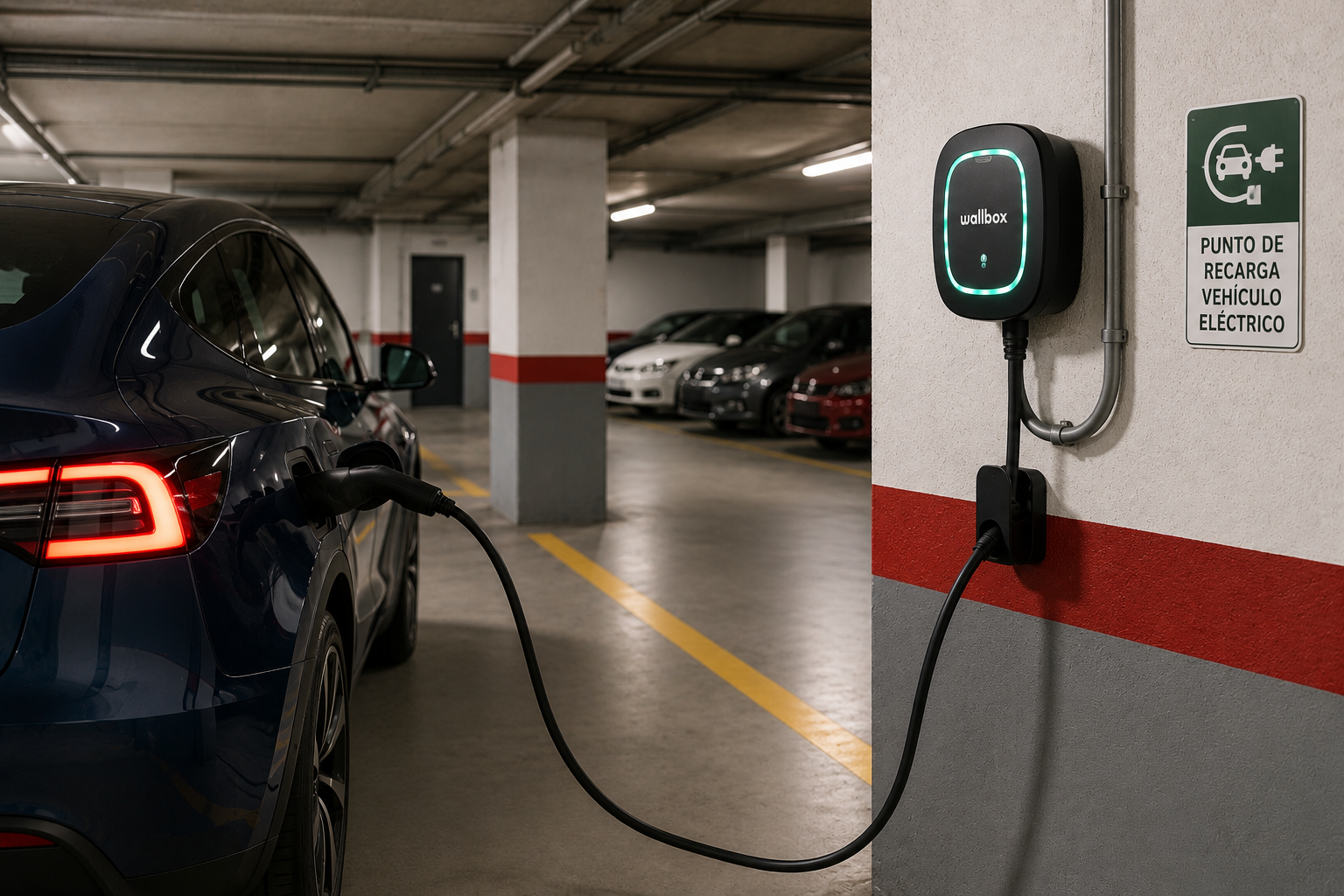
Living in an apartment with an electric vehicle raises an immediate question: how do I charge at home? It’s one of the most common concerns among EV owners in Spain, and the good news is that the answer is simpler than most people think, especially since Spanish law is firmly on your side.
At Solarea Tech, we install EV charging points across Alicante province for private homeowners, apartment residents, and residential communities. In this guide, we’ll walk you through the best home EV charger options for apartment buildings, what the law says, how much it costs, and what subsidies are available in 2026.
Can You Install an EV Charger in an Apartment Building in Spain?
Yes — and you don’t need your neighbours’ permission.
Under Article 17.5 of Spain’s Ley de Propiedad Horizontal (LPH), any apartment owner with a private parking space has the legal right to install an EV charging point without requiring community approval. You simply need to notify the building’s president or administrator in writing at least 30 days before the installation starts.
The key legal requirements are:
- Written notification to the community president or building administrator
- Installation must be connected to your own individual electricity meter (not the communal supply)
- The installation must not compromise the building’s structural safety or communal electrical supply
- The work must be carried out by a certified electrician (instalador autorizado)
This is a huge advantage for apartment dwellers in Spain. The law was specifically designed to remove bureaucratic barriers and encourage EV adoption — so don’t let anyone in your building tell you that you can’t do it.
Types of EV Chargers for Apartments: Which Is Right for You?
Level 1 — Standard Schuko Plug (2.3 kW)
A regular household socket can charge an EV, but it’s extremely slow — typically 10–20 hours for a full charge. In Spain, this is only recommended for emergencies or as a very temporary solution. For regular daily use, the heat generated in the cable over hours of charging creates real safety risks.
Level 2 — Wallbox / Mode 3 Charger (7.4 kW–22 kW) ✅ Recommended
This is the standard choice for home and apartment charging in Spain. A 7.4 kW wallbox fully charges most EVs overnight in 4–8 hours, connecting via the EU-standard Type 2 (Mennekes) connector. A 22 kW wallbox charges roughly three times faster but requires a three-phase electrical connection, which not all apartments have.
For most apartment residents in Alicante, a 7.4 kW smart wallbox is the ideal solution — fast enough for overnight charging, compatible with all modern EVs sold in Europe, and eligible for MOVES III subsidies.
Level 3 — DC Fast Charger (50 kW+)
DC fast chargers are for public infrastructure and commercial use. They’re not suitable for apartment buildings due to their high cost, space requirements, and the electrical infrastructure demands they place on buildings.
Best EV Charger Features to Look for in an Apartment Setting
Not all chargers are equal in a shared building environment. Here’s what matters most:
Smart Load Management (Dynamic Load Balancing) This is essential for apartments. Smart wallboxes monitor your home’s total electricity consumption and automatically reduce charging power when other appliances are running heavily — preventing you from tripping the main circuit breaker. This means you don’t need to upgrade your electrical panel to add an EV charger.
Wi-Fi & App Connectivity A connected charger lets you schedule charging for off-peak hours (when electricity is cheapest in Spain — typically between 00:00 and 08:00 on the PVPC tariff), monitor energy use, and receive alerts.
Independent Metering Spanish law requires the charger to be connected to your own meter, not the community supply. Smart chargers make it easy to track exactly how much energy you consume, keeping your costs fully separate from communal bills — which protects you and keeps neighbours comfortable.
Weatherproof Rating If your parking space is outdoors or in a ventilated garage, look for an IP54 rating or higher.
Type 2 Connector (Mennekes) This is the EU standard for AC charging in Spain. All new EVs sold in Europe use it. Avoid chargers with proprietary connectors.
OCPP Compatibility Open Charge Point Protocol means the charger can work with different software platforms — useful if your building ever moves to a communal management system.
Recommended Wallbox Chargers for Apartments in Spain (2026)
Rather than recommending specific brands (which change frequently), here are the key specifications to look for when choosing a wallbox for apartment use in Spain:
| Feature | Recommended Spec |
| Power output | 7.4 kW (single-phase) |
| Connector | Type 2 (Mennekes) — EU standard |
| Smart features | Wi-Fi, app control, scheduled charging |
| Load management | Dynamic load balancing |
| Weatherproofing | IP54 or higher |
| Cable length | 5–7 metres |
| Certification | CE marked, compatible with MOVES III subsidy |
At Solarea Tech, we source and install certified wallbox units that are fully compatible with Spain’s MOVES III subsidy programme, ensuring you can claim the maximum possible grant on your installation. Contact us for a personalised recommendation.
How Much Does an EV Charger Cost in an Apartment in Spain?
The total cost depends on how far your parking space is from your electricity meter:
| Installation Scenario | Estimated Total Cost (2026) |
| Apartment with underground parking (same building) | €900 – €1,800 |
| Apartment with garage in separate building | €1,500 – €3,000+ |
| Simple private parking space (short cable run) | €600 – €1,200 |
These figures include the wallbox unit (typically €400–€800) and installation labour. For more detail on pricing across Spain, see our article on How Much Does It Cost to Install a Residential EV Charger in Spain?
Government Subsidies for Apartment EV Chargers in Spain (2026)
This is where it gets very interesting. Several schemes can dramatically reduce your upfront cost:
MOVES III
Spain’s flagship EV charging incentive covers up to 70% of eligible installation costs, capped at €5,000 for individuals (and up to €2.5 million for businesses and communities of owners). In municipalities with fewer than 5,000 inhabitants, coverage rises to 80%.
IRPF Tax Deduction
A 15% personal income tax deduction applies to home charger installation costs, extended through 31 December 2026, on a maximum tax base of €4,000.
Plan Auto+ 2026
The newer Plan Auto+ programme extends additional funding beyond MOVES III, combining EV purchase subsidies with charging infrastructure grants.
Comunitat Valenciana (Alicante)
As residents of the Valencian Community, Alicante homeowners can also access regional top-up subsidies. Our team handles all the paperwork for MOVES III and regional grants — you don’t need to navigate the bureaucracy yourself.
In practice, many Solarea Tech clients in Alicante cover 50–70% of their charger installation cost through combined subsidies, bringing the net cost to as little as €400–€600 for a standard apartment setup.
Can You Integrate Your EV Charger with Solar Panels?
Absolutely — and it’s one of the smartest things you can do.
If you have (or plan to install) solar panels on your property or participate in a community solar scheme, a smart wallbox can be configured to prioritise charging your car using solar-generated electricity. This means your EV effectively runs on free sunshine rather than grid electricity.
In Alicante, with over 2,800 hours of sunshine per year, this combination delivers exceptional savings. A household that charges an EV primarily from solar panels can reduce per-kilometre energy costs to near zero during daylight hours.
We install integrated solar + EV charging systems across the province. Learn more about our EV charging point installation service.
Step-by-Step: How to Install an EV Charger in Your Apartment Building
Here’s exactly how the process works with Solarea Tech:
1. Free consultation We assess your parking space, cable distance from your meter, and electrical panel capacity. We’ll recommend the right charger for your situation.
2. Written notification to your community We help you draft the required written notification to your building administrator, in compliance with Article 17.5 LPH. You typically need to send this 30 days before installation.
3. Subsidy application We submit your MOVES III application and any applicable regional subsidy paperwork before installation begins (most programmes require pre-approval).
4. Professional installation Our certified electricians install the wallbox, run the dedicated cable to your meter, install the independent meter if required, and configure the smart features.
5. Legalisation & certification We issue the required Certificado de Instalación Eléctrica (CIE) and handle all legal registration, so your installation is fully compliant.
6. You start charging The whole process typically takes 2–4 weeks from first contact to first charge.
Frequently Asked Questions
Do I need community approval to install an EV charger in my parking space? No. Under Spanish law (Article 17.5 LPH), you only need to notify — not get approval from — your community. They cannot legally block you if the installation meets technical requirements and uses your own electricity meter.
What if my parking space is in a different building from my apartment? In this case, you’ll need a separate electricity supply contract and meter for the parking space, rather than running a cable from your home meter. It’s more complex but entirely doable. Solarea Tech handles these cases regularly.
Can my neighbours also install chargers in the future? Yes. If you anticipate multiple residents wanting chargers, a shared electrical infrastructure for the garage (installed in phases) can be more cost-effective than each resident running their own cables separately. We can design a scalable solution for your whole building.
What connector type do I need? All EVs sold new in Europe use the Type 2 (Mennekes) connector for AC home charging. This is the standard we install.
How long does charging take with a 7.4 kW wallbox? It depends on your car’s battery size. A typical mid-size EV (60 kWh battery) charges from 20% to 100% in roughly 7–8 hours — perfect for overnight charging.
Summary
Installing an EV charger in an apartment building in Spain is legally straightforward, financially supported by generous subsidies, and technically simple with the right installer. The ideal setup for most Alicante apartment residents is a 7.4 kW smart wallbox with dynamic load management, connected to your own individual meter.
With MOVES III covering up to 70% of costs and additional IRPF tax deductions available, there’s never been a better time to set up home EV charging.
Ready to Install? Talk to Solarea Tech
Solarea Tech is Alicante’s trusted installer for both solar panels and EV charging points. We manage everything — from subsidy applications to legal registration — so you don’t have to.
📍 We serve San Vicente del Raspeig, Elche, Benidorm, Torrevieja, Orihuela, Alcoy, Villena, and all municipalities across Alicante province.
📞 Call us: 669 34 86 07 🌐 Request a free quote
Related reading: