
Spain’s public fast-charging network has grown quickly, but it’s still split across half a dozen operators with different pricing models, app requirements, and coverage strengths. If you’re trying to figure out which one to actually rely on — whether for road trips, city charging, or as a backup to home charging — here’s an honest comparison of the main options as they stand in 2026.
The main fast-charging networks in Spain
Iberdrola (now transitioning to BP Pulse branding in some locations) is Spain’s largest public charging network by point count, with strong coverage in major cities and along motorway corridors. It’s a reliable default choice precisely because of its size, though charging speeds and reliability can vary more between individual sites than with some smaller, more consistent networks.
Endesa X Way has a strong presence at retail parks, shopping centres, and fast-food locations, particularly along the A-7 Mediterranean corridor — useful if you’re combining a charging stop with an errand or a meal rather than waiting in a car.
Zunder has expanded aggressively with ultra-fast hubs (150-400 kW) along major motorways and increasingly on secondary roads, and tends to offer competitive per-kWh pricing along with flat-rate subscription options, making it a strong pick for frequent long-distance drivers.
Tesla Supercharger opened its network to non-Tesla vehicles in Spain some time ago and remains one of the most consistently reliable options — dedicated sites, high uptime, and straightforward per-kWh pricing through the Tesla app, even for other brands.
Ionity runs high-power hubs (up to 350 kW) at key motorway stops, particularly strong on routes like Madrid-Barcelona. Its pay-as-you-go pricing has historically been among the highest in Europe, so it makes the most financial sense with a subscription if you use it regularly.
Repsol (Waylet) integrates charging into its existing network of fuel stations, which means familiar, easy-to-find locations for drivers transitioning from petrol. Waylet members typically get a lower per-kWh rate than non-members paying at the point.
Wenea focuses on destination charging — restaurants, hotels, leisure venues — often at lower cost or free while you’re a customer at the venue, which makes it a good fit for tourists and day-trip charging rather than fast highway top-ups.
Moeve (formerly Cepsa) and smaller networks like Powerdot and EDP fill in additional urban and service-station coverage, useful as backup options when checking availability across an app that aggregates multiple networks.
How pricing actually works
Public charging in Spain is typically priced in one of three ways:
Per kWh, the most common and easiest to compare directly, generally ranging from around €0.30/kWh for slower AC charging up to €0.55-0.65/kWh for the fastest DC options.
Per minute, used by some operators, which can penalise vehicles that charge more slowly — worth checking before assuming a per-minute rate is a good deal.
Subscription-based, where a monthly fee unlocks discounted per-kWh rates across a network or roaming alliance. These tend to make financial sense once you’re doing more than two or three long trips per month; for occasional use, pay-as-you-go is usually cheaper overall once the subscription fee is accounted for.
Which network to choose depends on how you actually drive
For long-distance road trips, Zunder, Tesla Supercharger, and Ionity are generally the strongest options thanks to their ultra-fast charging speeds and solid motorway coverage.
For city and errand-based charging, Iberdrola, Endesa X Way, and Wenea tend to work well, since they’re positioned at shopping centres, retail parks, and venues where you’re stopping anyway.
For drivers who still frequent fuel stations (mixed households with one EV and one combustion car, for example), Repsol Waylet offers a familiar, integrated experience.
For unpredictable routes or areas with sparser official coverage, a community-based app like Electromaps — which aggregates live availability, photos, and user reviews across nearly every charge point in the country — tends to be more reliable than trusting a single operator’s own app.
Apps worth having regardless of which network you use
Rather than committing to a single operator, most experienced EV drivers in Spain run two or three of these in parallel:
- Electromaps for the broadest database of charge points and real-time community feedback
- A Better Route Planner (ABRP) for planning long trips with charging stops factored into range calculations
- The specific network apps (Iberdrola, Endesa X Way, Zunder, Tesla) for authentication and payment where roaming isn’t available
Why public fast charging isn’t the best option for daily use
Here’s the part most comparisons skip: public fast charging, even at the best rates listed above, is still considerably more expensive per kWh than charging at home — and materially more expensive than charging at home from your own solar panels.
Around 80% of EV charging happens at home for a reason: it’s cheaper, it happens overnight or whenever your car is parked anyway, and it doesn’t depend on a charger being available or working when you need it. Public fast charging is the right tool for road trips and emergencies, not for topping up daily.
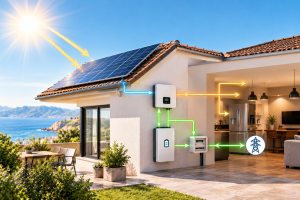
If you have off-street parking, installing a home wallbox — ideally paired with solar panels — turns your daily charging cost into a fraction of what you’d pay even at the cheapest public network, while still leaving the fast-charging networks above available for the days you actually need them.
Frequently asked questions
What’s the best fast charging network for a road trip across Spain? Zunder, Tesla Supercharger, and Ionity generally offer the fastest, most reliable charging along major motorway corridors, though coverage varies by specific route.
Is a charging subscription worth it in Spain? Usually only if you make more than two or three long trips per month. For occasional use, pay-as-you-go pricing tends to work out cheaper once the subscription fee is factored in.
Can non-Tesla EVs use Tesla Superchargers in Spain? Yes, Tesla has opened much of its Supercharger network in Spain to other brands, typically through the Tesla app.
Is public fast charging cheaper than charging at home? No. Even at the most competitive public rates, home charging — especially from solar — is significantly cheaper per kWh, since it avoids the margin built into public network pricing.
What app should I use to find charging points in Spain? Electromaps is widely considered the most comprehensive for finding and comparing charge points across different networks, particularly outside major cities.
Considering a home charger to cut down on public charging?
If you’re in Alicante or along the Costa Blanca and want to rely less on public fast charging for everyday use, Solarea Tech installs home EV charging points — often paired with solar panels — so your daily charging costs a fraction of any public network’s rate.
📞 Contact us at 669 34 86 07 or visit www.solareatech.com to request a free assessment.